
There are a few other ETFs that Vanguard UK announced that are available for investors:
| ETF | What | Accumulating / Distributing | TER | Currency |
| All World Ex-US | Developed minus US | Both | 0.12% | USD, EUR, GBP |
| Developed Europe Small Cap | Europe Small Cap | Both | 0.19% | EUR |
| Eurozone | Euro countries no UK | Both | 0.07% | EUR |
| Global All-Cap | Develop + Emerging, Large, Mid, Small | Both | 0.07% | USD, EUR, GBP |
| Global Small-Cap | Develop + Emerging, Small | Both | 0.22% | USD, EUR, GBP |
| Russell 1000 Growth | US Large Growth | Both | 0.16% | USD, EUR, GBP |
| Russell 1000 Value | US Large Value | Both | 0.16% | USD, EUR, GBP |
| Russell 2000 | US Small-Cap | Both | 0.20% | USD, EUR, GBP |
| Russell US Mid-Cap | US Mid-Cap | Both | 0.20% | USD, EUR, GBP |
I think the Ex-US one should be useful for investors who wish to tweak their overall portfolio allocation closer to something that they are comfortable with. I think the Global Small Cap one as well.
The US large, mid and small-cap allows you to express your philosophy or tactically tilt/speculate if you need to and don’t have to worry about estate taxes. The same for for the Russell 1000 Growth and Value.
All of these are physical replication, and domicile in Ireland.
But perhaps my reader base would be more interested in the FTSE Global Small-Cap ETF.
That ETF tracks the FTSE Global Small-Cap index.
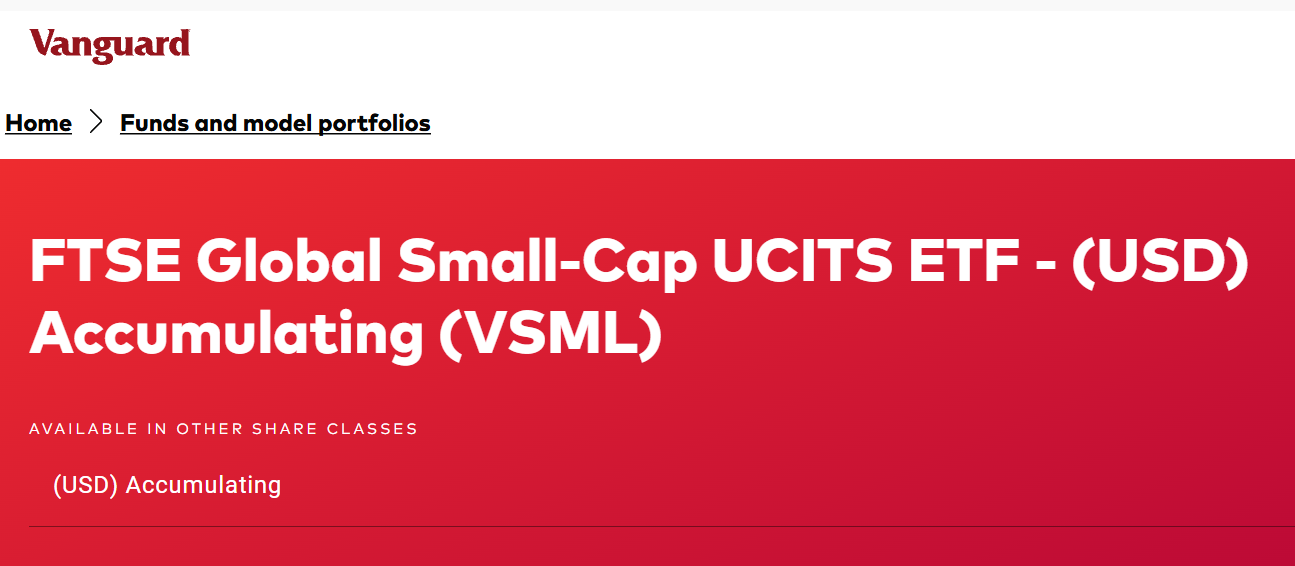
Some readers have asked if there is a small cap index that covers develop and emerging market and the Vanguard FTSE Global Small-Cap UCITS ETF covers it.
The USD ticker should be VSML on Interactive Brokers. But do be careful that both the GBP and USD are the same, but you should try to recognize based on the actual currency:

Now.. if we are talking about systematic passive (or index tracking) small caps what we currently have:
| Fund | Region | Ticker | Total Expense Ratio |
| iShares MSCI World Small Cap UCITS ETF | Develop Market | WSML | 0.35% |
| State Street® SPDR® MSCI Emerging Markets Small Cap UCITS ETF | Emerging Market | EMSD | 0.55% |
| FTSE Global Small-Cap UCITS ETF | Develop + Emerging | VSML | 0.22% |
In case you didn’t notice the ticker for both the iShares and Vanguard one looks rather similar.
SML stands for small minus large, which is how they are trying to calculate the premium of investing in small caps over large caps.
If you wish for one fund for your small cap exposure, the cost is lower with VSML. Vanguard just made the cost so low. This is good for folks who just want to cover but don’t want to think so much.
How big is the difference between WSML and VSML?
VSML has 90% Develop and 10% Emerging.
For one, you will have China (2.2%), Taiwan (2.75%), India (2.42%), Korea (1.5%) that you won’t have in WSML. South Korea and Poland are classified as Developed by FTSE but as Emerging by MSCI. This means WSML won’t have Korea.
I don’t think I will have VSML in my portfolio because of my believe that we have to remove the “junk” or less profitable companies from small caps. My ideal fund to express this implementation is one that does that, and we have those for develop markets like AVGS, DDGT.
When do you use VALL or IMID and when do you have VSML?
With IMID and VALL, you can have a simple, fuss free 1-fund allocation.
VSML is useful if you want to peel small caps out and observe how they perform.
You can express the same IMID or VALL with:
- VWRA: 90%
- VSML: 10%
You would have a develop + emerging markets large cap and mid cap and a small cap.
Of course if you want develop only it will be:
- IWDA: 90%
- WSML: 10%
If it is emerging markets:
- SEMA: 90%
- EMSD: 10%
How Much Should I have in Small Caps (if I want one)?
This is a tough question.
Having something like VSML allow you to observe your small cap. If it is inside say a VALL, you won’t be able to tell the difference.
How much you should have in something, relative to a general IMID or VALL allocation is how much you believe in the philosophy and evidence behind small minus large.
Some folks who came from an individual investing world has always been operating in the small cap space and thus know the “total package” of risk and returns that come with small cap.
But for someone who is new to funds, indexing, and have not fully digest how different investment returns can be, you will take time to adjust. I think its always good to start with say 5% of a small to medium portfolio, and spend some time feeling your emotions as you own the portfolio. As you become more familiar perhaps you want to bump it up to 10%.
Moving above that… would usually require the person who kind of gets it.
There are years where small cap did -10% and the rest of the market did 10%. That’s a 20% difference and its not easy to live through. Of course there potentially can be the year where it did 50% while your large cap did 15%.
Ultimately, the ideal allocation is the one that you are at peace with.
In Daedalus, my small cap is almost 33-34% of the portfolio. Sometimes, I am also not sure if that is a good idea.
The lens of someone that stared at the charts below and those who didn’t would look at risk and returns very differently:


Kyith is the Owner and Sole Writer behind Investment Moats. Readers tune in to Investment Moats to learn and build stronger, firmer wealth foundations, how to have a Passive investment strategy, know more about investing in REITs and the nuts and bolts of Active Investing.
Readers also follow Kyith to learn how to plan well for Financial Security and Financial Independence.
Kyith worked as an IT operations engineer from 2004 to 2019. Currently, he works as a Senior Solutions Specialist in Fee-only Wealth Advisory Firm Providend. All opinions on Investment Moats are his own and does not represent the views of Providend.
You can view Kyith’s current portfolio here, which uses his Free Google Stock Portfolio Tracker.
His investment broker of choice is Interactive Brokers, which allows him to invest in securities from different exchanges all over the world, at very low commission rates, without custodian fees, near spot currency rates.
You can read more about Kyith here.