
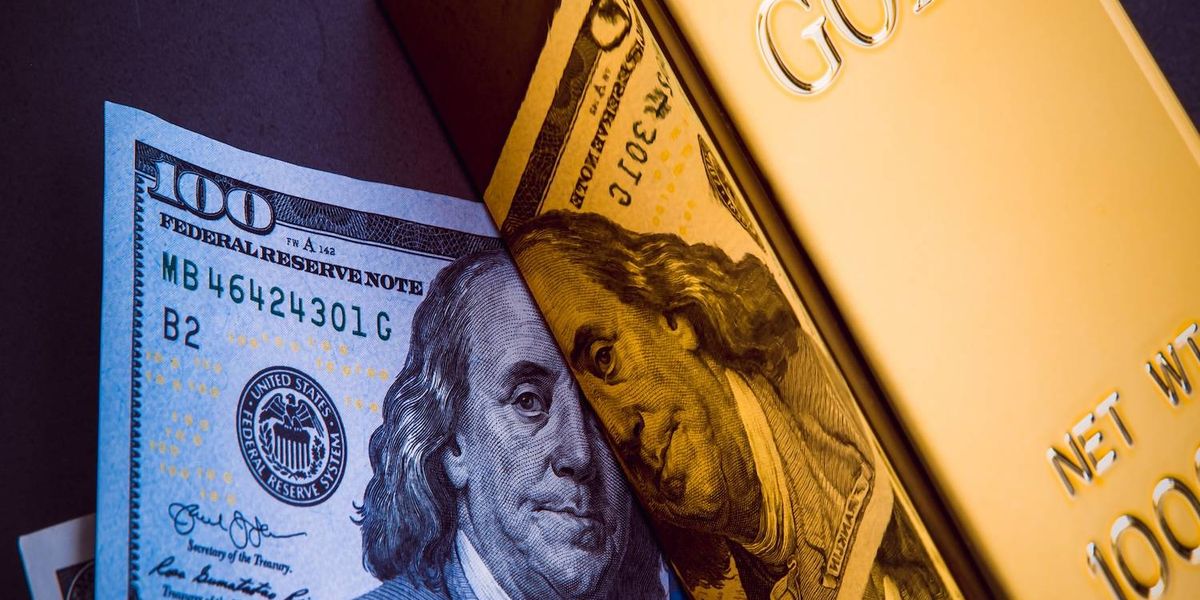
Soaring US debt may provide a significant tailwind to accelerate demand for safe-haven gold and set the stage for another record price rally.
The US debt held by the public hit US$31.27 trillion in late March 2026, eclipsing the 12-month gross domestic product (GDP) of US$31.22 trillion.
This is the first time since World War II that the nation’s debt load has surpassed the size of the entire American economy. The milestone represents a stark warning that the current US fiscal policy is unsustainable.
For gold investors, it’s a bullish signal of higher prices to come.
Historically, when governments accumulate debt faster than the economy can grow, it erodes confidence in fiat currencies and places downward pressure on nominal treasury bond yields.
Such an environment often promotes safe have demand for gold as a store of value and a hedge against currency debasement. As this debt crisis continues to worsen, it will strengthen the investment case for gold, from bars and coins to exchange-traded funds and quality mining stocks.
US debt crisis deepening
“Yes,” it’s definitely a significant milestone for a country’s debt to surpass its GDP, Brien Lundin, editor of Gold Newsletter, told the Investing News Network (INN) via email.
“It’s historically been a warning sign of a debt spiral that can sink an economy. But the cold hard fact is, the US passed that marker long ago,” he added. Lundin was referring to the difference between the debt owned by the public — which is the figure currently grabbing headlines — and the total gross debt.
Debt held by the public includes money the US government owes to individuals, foreign governments, and the Federal Reserve. Whereas the total gross debt includes public debt and money the government owes itself. That number as of the last week of April stood at more than US$38.95 trillion, representing more than 120 percent of the GDP.
“Pundits, media and government bureaucrats like to use the smaller ‘debt owned by the public’ measure of federal debt rather than the gross federal debt number that includes debt owned by government-sponsored enterprises (GSEs) like Social Security, Medicare and other retirement funds and entitlement programs,” said Lundin.
“By using the smaller measure of federal debt that stands at just about 80 (percent) of the total debt, the government understates the amount of debt and implies that the remaining 20 (percent) is irrelevant, since ‘we owe it to ourselves.’”
The Congressional Budget Office reports that increased spending on GSEs are the biggest factor behind the nation’s snowballing dent load. Lundin agrees, pointing out that this is the debt that must be paid back, particularly the GSE allocated to seniors, which make up a huge slice of the voting public.
The elephant in the room is the interest to be paid out on the debt itself, which now accounts for about 14 percent of total US government spending. With the Federal Reserve seeing the need to battle inflation by holding interest rates steady (and potentially raising them), the US national debt crisis is bound to get worse.
US deficit spending to drive gold demand
If the federal debt continues on the current trajectory, interest payments costing hundreds of billions to trillions annually will make it tough to pay for these GSEs and other spending without creating further debt.
For the fiscal year 2025, the US national deficit had already reached US$1.78 trillion and is expected to reach more than US$2 trillion this year. That means the US Treasury will need to take on more debt to cover the deficit and finance the spending promises outlined in the budget.
These conditions are ripe for currency devaluation and further inflation as more money is added into the economy. Such monetary instability is a boon for safe-haven gold as a non-fiat store of value.
The further erosion of confidence in the US dollar as a reserve currency globally will also spur on more central bank gold buying activity which has already become a major pillar of demand and higher prices for the yellow metal in this current bull market cycle.
The US-Iran War may be helping to support the US dollar in the short term as oil prices remain elevated; however, the longer term impact on the greenback is painting a much weaker outlook.
“The broader issue is fiscal: the Iran war has already cost [US$25 billion] to the US government and, given the current trajectory, that figure is likely to rise. At the same time, US debt is increasing alongside expansive fiscal policies,” explained Ipek Ozkardeskaya, senior analyst at Swissquote, in a market commentary shared with INN.
Ozkardeskaya pointed out that interest costs accrued by the US federal government during the fiscal year 2025 were on par with national defense spending — which is one of the largest spending categories for the US after Social Security and Medicare.
“It’s a serious issue. Debt held by the public is now close to 100 percent of GDP, and projections from the Congressional Budget Office suggest it could rise to 120 percent within a decade — and potentially 131 percent if tax cuts are extended,” she added. “As a result, global investors are gradually shifting away from US Treasuries, potentially in favour of alternatives such as gold. In that context, dips in gold remain attractive buying opportunities.”
Don’t forget to follow us @INN_Resource for real-time updates!
Securities Disclosure: I, Melissa Pistilli, hold no direct investment interest in any company mentioned in this article.
Editorial Disclosure: The Investing News Network does not guarantee the accuracy or thoroughness of the information reported in the interviews it conducts. The opinions expressed in these interviews do not reflect the opinions of the Investing News Network and do not constitute investment advice. All readers are encouraged to perform their own due diligence.