
The Netherlands has long been regarded as a European leader in agricultural and food innovation, but that position appears to be under threat.
A new report published today by Dutch national investment institution Invest-NL warns that the country risks losing its competitive edge as other nations move faster to commercialise emerging agricultural technologies.
According to the report, Deep Dive Agrifood Biotech, addressing the barriers facing Dutch agrifood biotechnology companies could unlock approximately €17 billion in additional annual revenue by 2040. However, without coordinated action on regulation, financing and commercialisation, much of that opportunity could be captured elsewhere.
Based on interviews with more than 150 entrepreneurs, investors, researchers and policymakers, alongside investment data spanning 2010 to April 2026, the study examines three strategic areas: seed breeding and genetics, biological agricultural inputs, and biotech-derived food ingredients.
A strong start, a weaker finish
The Netherlands is home to notable agricultural research institutions, established seed breeders and a sophisticated food production ecosystem. Yet it seems scientific excellence is not necessarily translating into globally competitive businesses.
The report highlights a particularly telling imbalance: the Netherlands accounts for 3.3% of BioTech startups worldwide, but only 1.3% of scale-ups, according to broader BioTech data cited from the Netherlands Organisation for Applied Scientific Research (TNO). This suggests that while the country remains effective at generating innovation, it is less successful at helping young companies achieve meaningful commercial scale.
Invest-NL identifies three recurring weaknesses:
- too few promising technologies become scalable ventures
- regulatory and validation processes delay market entry
- insufficient financing prevents companies from reaching industrial production
The stakes extend beyond individual businesses. In a favourable scenario, Invest-NL estimates that annual Dutch agrifood BioTech revenues could reach approximately €25 billion by 2040, compared with just €8–9 billion if current conditions persist.
Crucially, the report argues that the Netherlands does not need to manufacture everything domestically. Instead, it should focus on retaining strategically valuable knowledge, intellectual property, companies and specialised capabilities, while taking advantage of European production networks where appropriate.
Ten years to say yes
One of the most striking obstacles concerns biological crop protection, where Dutch companies are developing alternatives to conventional chemical pesticides.
Obtaining European regulatory approval for a new biological crop protection product can take eight to ten years. Existing frameworks were largely designed around chemical products, making them less suited to certain biological innovations.
Consequently, some companies prioritise launching in markets such as Brazil and the United States, where commercialisation can proceed more quickly. Invest-NL warns that Europe risks losing ground in a biological crop protection market that could expand seven- to tenfold by 2040.
Food biotechnology faces similar difficulties. Regulatory approval for novel ingredients can take one to three years longer in Europe than in the United States, while building a first commercial production facility can require tens or even hundreds of millions of euros.
For fermentation-derived food ingredients alone, Invest-NL estimates that favourable conditions could support approximately €8 billion in annual Dutch revenues by 2040, compared with around €2 billion under existing policies.
The report stresses that faster approvals should not come at the expense of safety. Instead, regulators should offer earlier guidance, more predictable assessments and opportunities for companies to validate products under real-world conditions.
Innovation is not the issue
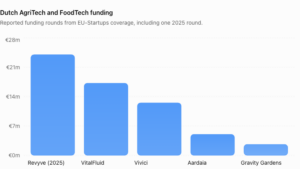
Recent EU-Startups coverage demonstrates that Dutch AgriTech entrepreneurs continue to attract investor interest across several areas identified in the report.
In August, Eindhoven-based VitalFluid secured €17.2 million to accelerate the commercialisation of its plasma-activated water technology, which offers growers an alternative to chemical crop protection. The investment was co-led by Invest-NL and Alder Tree Investments.
Meanwhile, Wageningen-based Aardaia raised €5 million in July to advance its genomics-driven crop breeding platform and develop a protein-rich tuber, while Nijmegen-based Gravity Gardens secured €2.6 million in September to scale its chemical-free seed activation technology.
Dutch food BioTech is also producing notable funding announcements. In June, Vivici received €12.5 million in European Innovation Council backing to expand the supply and commercial reach of its precision-fermented dairy proteins.
Last year, EU-Startups also reported on Revyve’s nearly €24 million Series B to expand production of yeast-based ingredients that can replace eggs in food manufacturing. Revyve had already commissioned a first-of-a-kind production facility in the Netherlands, illustrating that industrial scale-up is achievable with sustained backing.
Nevertheless, these successes do not eliminate the wider structural challenges. They illustrate the breadth of Dutch innovation, but also the importance of providing companies with appropriate financing and support beyond their initial funding rounds.
Europe will not wait
Across Europe, EU-Startups has reported comparable investment activity, illustrating how competition is developing around the same technologies.
In biological crop protection, France’s Agriodor raised €15 million in April to expand its natural scent-based pest management technology, while Denmark’s Mycoverse secured €2.4 million in March to develop fungal alternatives to chemical pesticides.
The competition is equally visible in food ingredients. French precision fermentation startups Verley raised €32 million and Standing Ovation secured €30 million in 2026, while Belgian fermentation company MAASH obtained a €12.15 million financing package combining equity and public financing to support industrial-scale mycoprotein production.

These announcements do not establish that the Netherlands has already lost its position. They do, however, show that European competitors are securing capital, developing production capacity and pursuing commercial opportunities in precisely the areas where Invest-NL sees significant Dutch potential.
To respond, Invest-NL proposes an indicative €650 million to €1.1 billion in public financing capacity between 2026 and 2030, spanning research, regulatory improvements, infrastructure and industrial scale-up.
Its ambitions for 2030 include doubling the number of agrifood BioTech ventures, reducing time to market by a factor of three, and developing five globally competitive companies capable of raising more than €100 million each.
For the Netherlands, the question is therefore becoming less about whether it can develop the next generation of agricultural technologies, and more about whether it can create the conditions for those technologies to become successful businesses.