
Proxima Fusion, a German stellarator fusion company, has today signed a Memorandum of Understanding (MoU) in Japan to strengthen the industrial supply chain behind Germany’s ambition to become a global leader in fusion energy.
The MoU was signed during Chancellor Merz’s visit to Japan with Kyoto Fusioneering, a Japanese fusion technology provider, and marks the cooperation of critical technologies needed to build and operate commercial fusion power plants.
Dr. Francesco Sciortino, co-founder and CEO of Proxima Fusion, said: “The global race to fusion will be won in factories and supply chains. Japan has spent decades building world-class fusion engineering capabilities; Germany has the leading stellarator engineering in the world and knows how to industrialise. In working closely with Kyoto Fusioneering and Fujikura, we are building a new industry together, one that makes both our countries more secure.
“Japanese partners choosing to work with Germany is a direct result of the strong backing fusion enjoys from the German government and the European Union, as well as our determination to apply world-leading technology to the world’s increasing energy demands and climate challenge.”
Today’s news comes off the tail-end of a spectacular couple of years for the Munich-based startup.
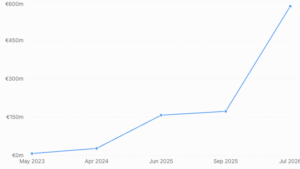
EU-Startups has followed Proxima Fusion’s development since its €7 million pre-Seed round in 2023, followed by a €20 million Seed round in 2024 and a €130 million Series A in June 2025, extended by a further €15 million that September. In July 2026, the company secured another €411 million, bringing its reported funding and public grants to more than €650 million and supporting the development of its Alpha demonstration stellarator.
This progression comes amid investment in other European fusion technologies, including fellow Munich-based Marvel Fusion’s €50 million Series B extension in 2025 and Bristol-based Astral Systems’ €26 million Series A in 2026, the latter focused on medical-isotope applications.
Together with Proxima’s latest round, they represent €487 million in investment across 2025–2026, reflecting the varied European approach to fusion power.
Kiyoshi Seko, Representative Director, President and COO, Kyoto Fusioneering, said: “Germany is approaching fusion not only as a future source of energy, but as a pillar of its High-Tech Agenda to build national prosperity through advanced technology. Manufacturing and engineering are at the heart of that vision, and they are also at the heart of what Kyoto Fusioneering does. Through our cooperation with Proxima Fusion, we will bring our state of the art plasma heating.. technologies to one of the most ambitious stellarator programmes in the world, and help turn fusion into a real industry in Germany.“
Founded in 2023, Proxima Fusion is a spin-out from the Max Planck Institute for Plasma Physics. The company is developing commercial fusion power plants based on the QI-HTS stellarator concept. With Alpha, Proxima is developing a net-energy fusion demonstrator targeted for the early 2030s, paving the way for Stellaris, the world’s first commercial stellarator fusion power plant later that decade.
On the other side of the MoU sits Kyoto Fusioneering, a premier fusion technology and integrated systems developer. It delivers technologies and engineering services for plasma heating, tritium fuel cycle, and tritium breeding blanket and thermal cycle systems that are essential to advanced fusion programmes worldwide, regardless of confinement approach.
Under the MoU, the two companies will continue and expand joint work on next-generation gyrotrons for plasma heating and on fuel cycle technologies. Kyoto Fusioneering will also contribute its technologies and engineering expertise to the commercialisation and industrial deployment of fusion energy in Germany, including within the national Fusion Hubs initiative of the German Federal Ministry of Research, Technology and Space’s (BMFTR).
The German federal government has set the goal of building the world’s first fusion power plant in Germany. Turning that ambition into reality depends on secure, industrial-scale supply chains for components that, in many cases, do not yet exist at scale anywhere in the world.
Building on Proxima’s existing partnerships across the supply chain, including for high-temperature superconducting (HTS) magnets, the agreement with Kyoto Fusioneering adds key building blocks of that supply chain: the systems that heat and fuel the plasma.
The agreement brings together Japan’s long standing expertise in fusion engineering with Germany’s world-leading stellarator research and industrial capabilities. It also strengthens industrial ties between the two countries as governments and companies worldwide race to turn fusion science into a new source of firm, dispatchable and clean energy.
The partnership will support Proxima’s roadmap towards Alpha, its demonstration stellarator planned for the early 2030s, and Stellaris, its first commercial fusion power plant.