
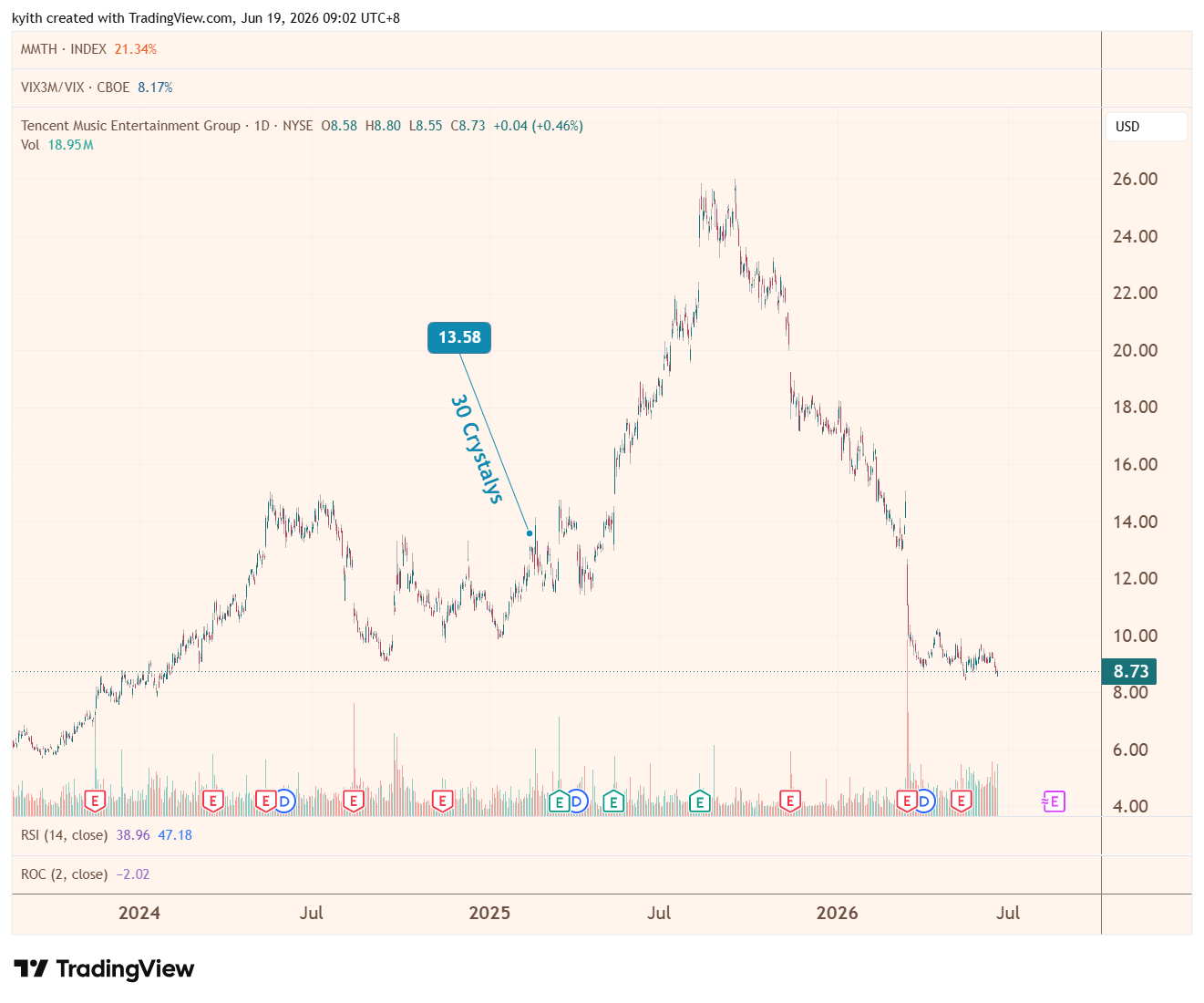
Tencent Music (Ticker: TME) isn’t doing so well since my last post on Nov 2025.
The price probably cratered 50% since the last posting.

And it is not without its challenges:
1. ByteDance’s “Soda Music” is a Threat.
This is the dominant narrative everywhere. Soda Music, owned by TikTok’s parent ByteDance, grew from a quiet 2022 beta launch to over 140 million monthly active users.
Its monthly average user is 120 million by September 2025 (up over 90% year-on-year), climbing to 140 million by early 2026 — putting it within range of NetEase Cloud Music, the long-standing #2 player.
The mechanism:
Users hear a song they like while scrolling Douyin short videos and can seamlessly jump to Soda Music for the full track — a “discovery via short video → instant listen → full playback” funnel that TME simply cannot replicate, because it doesn’t own a short-video platform with Douyin’s 700 million daily active users. A 2024 catalog move made it worse: ByteDance began bundling music licensing so that Douyin’s rights deals also covered Soda Music, expanding its catalog to 50 million songs — enough to function as a real standalone competitor, not just a Douyin gimmick.
2. The user-base erosion is now visible in the numbers, and management just reduced transparency around it
TME’s MAUs fell 5% year-over-year in Q4 2025, accelerating from a 3.2% decline in Q2 2025 to 4.3% in Q3 2025.
This shows that this erosion is not a one quarter thing.
But what spooked investors was that management announced that starting in 2026, TME will no longer disclose quarterly MAU, paying-user, or ARPPU data, switching to annual paying-user disclosure only. This reduces market visibility into user trends and has amplified concerns about continued deterioration.
From a value-investing lens, reduced disclosure right when the core competitive metric is weakening is a yellow flag worth weighing, even if management’s stated rationale is legitimate.
3. Margin guidance turned cautious, layered on top of the user concerns
CFO Shirley Hu guided that 2026 gross margin would be “flat or a little bit lower than 2025,” with net margin “similar to 2025, might be a bit lower”, explicitly because TME is shifting investment toward higher-growth but initially lower-margin businesses like offline concerts and merchandise.
This is a real near-term margin headwind, even if it’s a deliberate strategic reinvestment rather than a sign of weakening core economics.
4. There’s also pending litigation
A securities-fraud investigation (Johnson Fistel) was announced around the same March 2026 selloff, almost certainly triggered by the same earnings-related stock drop and the reduced-disclosure decision; this is typical of US securities law firms chasing large single-week drawdowns, and isn’t independent evidence of wrongdoing, but it’s a real overhang on sentiment and adds legal cost risk.
Tencent Music Valuation Metrics Look Good.
To a certain degree, I was pretty clear TME faced challenges even in the previous Investment Moats article.
In the last 3 quarters we can see their revenue slow:
- Q3 2025: +20.6%
- Q4 2025: +15.9%
- Q1 2026: +7.3%
TME’s price rose in the past most likely because the market thinks that it has turned the tide. Growth was perceived to be okay. Not melting or stagnating.
And so now that it is showing things like that, it validates people are looking at it as a grower.
Here are most of its financials:
| Metric | Value |
|---|---|
| Price (per ADS) | $8.91 |
| ADS ratio | 1 ADS = 2 Class A ordinary shares |
| Ordinary shares outstanding | 3,147,809,000 (Class A: 1,482,859,752 / Class B: 1,664,949,248) |
| ADS-equivalent shares outstanding | ~1,573.9 million |
| Market capitalization | ~$14.02 billion |
| Cash + term deposits | ~$5.62 billion |
| + FVOCI investment stakes (incl. Spotify) | ~$3.87 billion |
| = Total cash + investment stakes | ~$9.49 billion (68% of market cap) |
| Total liabilities (no meaningful debt) | ~$2.88 billion |
| Enterprise Value (net of cash + deposits only) | ~$8.40 billion |
| Enterprise Value (net of cash + deposits + stakes) | ~$4.53 billion |
| Valuation | |
| P/E — based on market cap (TTM earnings) | ~10.96× |
| P/E — based on market cap (FY2025 earnings) | ~8.36× |
| P/E — ex-cash & deposits (EV/FY2025 earnings) | ~5.01× |
| P/E — ex-cash & investment stakes (EV/FY2025 earnings) | ~2.70× |
| Earnings yield — based on market cap (TTM) | ~9.1% |
| Earnings yield — based on market cap (FY2025) | ~12.0% |
| Earnings yield — ex-cash & deposits (FY2025) | ~20.0% |
| Earnings yield — ex-cash & investment stakes (FY2025) | ~37.0% |
Notes for the article:
- RMB figures converted at USD/CNY ≈ 6.77 (mid-June 2026 spot rate)
- FY2025 net income: RMB 11,353M; TTM net income (through Q1 2026): ~$1.28B — included both since they diverge meaningfully and readers should know which one drives which ratio
TME feels like PYPL. With an earnings yield of 20% ex the cash, they should enhance shareholder return by buying back shares.
But what is the ex-cash & investment stakes?
TME’s Strategic Investment Stakes
Tencent Music own strategic stakes in Spotify (SPOT), Universal Music Group (UMG) and Warner Music Group (WMG).
These stakes are worth about US$3.8 billion. Against a market cap of US$14 billion, that is pretty significant.
TME’s Strategic Investment Stakes — Estimated USD Value
| Holding | What It Does | Disclosed Stake | Market Cap (Jun 2026) | Estimated Value of TME’s Stake |
|---|---|---|---|---|
| Spotify (NYSE: SPOT) | World’s largest music streaming platform — ~31.7% global market share, SEC.gov ~290M paid subscribers | ~2.5% immediately following the Dec 2017 investment MTFX (likely diluted somewhat since) | $93.68B | ~$2.3B (at undiluted 2.5%) |
| Universal Music Group (Amsterdam: UMG) | World’s largest music label/rights-holder (Universal, Capitol, Def Jam, Interscope) | 2% direct, received March 2025 | ~$38.5B | ~$0.77B |
| Warner Music Group (NASDAQ: WMG) | Major record label (Atlantic, Warner Records, Elektra) | ~0.78%, acquired for ~$100M in 2020. | ~$15.1B | ~$0.12B |
| Total estimated value | ~$3.2B |
This $3.2B estimate lines up reasonably well with the ~$3.87B FVOCI balance reported on TME’s actual Dec 31, 2025 balance sheet — the gap (~$0.65B) is plausible and explainable in that the Spotify stake may not have been diluted all the way down from 2.5% by 8 years of Spotify share issuance — if it’s held closer to the original 2.5%, then the valuation would be correct.
Something to Think About
I think there are a few things for us to watch for:
- How the competition develops. Do we get a clearer picture? Did the market worry over nothing when Tencent Music have natural counter to this.
- Does management really show their willingness to focus on shareholder return.

Do Like Me on Facebook. I share some tidbits that are not on the blog post there often. You can also choose to subscribe to my content via the email below.
If you’re thinking of opening an Interactive Brokers account, my referral link is here.
As the new account holder, you’ll receive USD 1 in IBKR stock for every USD 100 you deposit, up to USD 1,000 in shares — so a USD 10,000 deposit gets you USD 100 in IBKR stock, and the bonus is capped at USD 1,000 for deposits of USD 100,000 or more. A few other things to know: the minimum deposit to qualify is USD 10,000, done within 30 days of opening, and the bonus shares are locked up for one year from the award date. The promotion is currently active, and using the link costs you nothing extra. On a separate note, if you haven’t already, it’s worth taking a look at how IBKR’s share price has performed over the past five years — the stock you receive as a bonus isn’t just a token; it’s a stake in a company that has done quite well for its shareholders.
I break down my resources according to these topics:
- All my personal notes about how my philosophy behind my own money and how I manage it.
- Building Your Wealth Foundation – If you know and apply these simple financial concepts, your long term wealth should be pretty well managed. Find out what they are
- Active Investing – For active stock investors. My deeper thoughts from my stock investing experience
- Learning about REITs – My Free “Course” on REIT Investing for Beginners and Seasoned Investors
- Dividend Stock Tracker – Track all the common 4-10% yielding dividend stocks in SG
- Free Stock Portfolio Tracking Google Sheets that many love
- Retirement Planning, Financial Independence and Spending down money – My deep dive into how much you need to achieve these, and the different ways you can be financially free
- Providend – Where I work and do research. Fee-Only Advisory. No Commissions. Financial Independence Advisers and Retirement Specialists. No charge for the first meeting to understand how it works

Kyith is the Owner and Sole Writer behind Investment Moats. Readers tune in to Investment Moats to learn and build stronger, firmer wealth foundations, how to have a Passive investment strategy, know more about investing in REITs and the nuts and bolts of Active Investing.
Readers also follow Kyith to learn how to plan well for Financial Security and Financial Independence.
Kyith worked as an IT operations engineer from 2004 to 2019. Currently, he works as a Senior Solutions Specialist in Fee-only Wealth Advisory Firm Providend. All opinions on Investment Moats are his own and does not represent the views of Providend.
You can view Kyith’s current portfolio here, which uses his Free Google Stock Portfolio Tracker.
His investment broker of choice is Interactive Brokers, which allows him to invest in securities from different exchanges all over the world, at very low commission rates, without custodian fees, near spot currency rates.
You can read more about Kyith here.