
Most of my colleagues and I would usually went for a company retreat at the start of the year. Last year we went Da Nang [You can read about Da Nang here]
This year the retreat committee brought us to Guangzhou, China.
We spent 4 days at the retreat and I decide to extend for about 5 more work days. Our data analyst Ken Chan extended the same number of days so we decide to spend a few days in Guangzhou before going to Hong Kong.
This post will be about my experience. Not to be taken seriously but if you always wonder about Guangzhou (more likely) and Hong Kong (less likely) then you might find this post useful.
Gratitude
After the great financial crisis, the assets under advice at Providend fell tremendously hard and we didn’t really recovered until 2016-2018. Still there was company retreats but at very nearby places at very constrained budgets because it shows how much a retreat is meant for the company.
Most of us that came after that never experienced that but it is a stark reminder of what we enjoyed today is a function of the health of a business. We could have done better managing our client’s money better and the operating performance showed the eroded trust in many clients with us. That is a stark reminder that what we enjoyed this past 4-days is a function of our improvement since then and if we failed to live up to our service standards again, the same thing could happen.
The whole company work hard, in a way that we want, to deliver service in a way that aligned to our client’s interest and the first gratitude should be to the existing clients we continue to serve, but also the new ones who started their experience with us.
The second gratitude is for our retreat committee Sudhan, Wenjun, Jaren, Huishi, Cindy, Jiamin and Shiyun. This is a part time job for them but it is a massive job trying to bring 50 plus people abroad and making sure we have a good time.
We had a great time getting to know each other, of Guangzhou, everything went off without much problems.
The third gratitude is to our data analyst Ken Chan for doing so much heavy lifting planning out the non-retreat Guangzhou and Hong Kong experience (Ken did 98.5% of the planning I just be that guy who was in the project team but still got an A grade). If you know one is 45-years old and another is 26-years old, you would likely guess the 45-year old be the one more likely to navigate two places where Cantonese was used so heavily.
But it is the other way round and without Ken, I wonder how I would have fared surviving in Hong Kong. You can just reflect and wonder how many of your niece and nephew around Ken’s age that knows or speaks their dialect today and I was so fortunate Ken speaks Cantonese so well.
A Short Summary of the Guangzhou and Hong Kong Experience
I have never been to both places.
The weather in January in both places was like aircon temperature. I thought it would be worse in Hong Kong but turns out by the time we came to Hong Kong in the week of 19-23rd of January, the night was less chilly and it became chilly for those who stayed in Guangzhou.
Guangzhou and Hong Kong are places where they speak mainly Cantonese. More so in Hong Kong than in Guangzhou. If you talk to most in Guangzhou, my passable Chinese can still work but in Hong Kong I felt like in Thailand. I was quite lucky Ken was Cantonese if not I wonder if I would have died here alone.
The first difference I notice is that Guangzhou is young and Hong Kong is old.
In the initial few days, we kept wondering where the older people were in Guangzhou. Everyone seem so young and it is only when we go to the places where the locals mingle do we really see the older people. Hong Kong feels like Singapore to me.
The pace in Hong Kong does not feel faster. It feels Singapore. Not sure if that is always a good thing. Hong Kong in January feels like Singapore with worse infrastructure (if you don’t consider the skyscrapers and shopping centers) but air-con weather.
There is a vibrancy about the people in Guangzhou when we pay attention to them. Everyone is talking to everyone whereas in Hong Kong they feel like…. Singaporeans. They spend more time minding their own business in some deeper thoughts.
Guangzhou feels safe. But you might not like the smell of cigarettes and you do have to watch out for e-scooters or e-bikes because Guangzhou is infested with them. Unlike a motor bike, they are so quiet that you might not realize one is near you until the bike is very close.
The city is certainly safer than London or United States based on those who has travelled there for work in recent months. Guangzhou feels like a city that has gotten so much right and almost (if not) ready to tilt.
But beyond the food, weather, scenery, I wonder what can Guangzhou be for us.
Every meal I take in Hong Kong seem to cost S$10 but 1.5 times Singapore’s size. Every meal I take in Guangzhou seem to cost S$5-10 in Singapore’s size, with the higher end stuff costing about S$10. I would usually go to the supermarket to take a look and those imported stuff is like the price I find in Singapore’s supermarket. The only crazy thing is how gigantic their Bao are! Coffee costs S$4-6 in Guangzhou, and in Hong Kong which is not too different than in Singapore.
It just felt every place I went to overseas is horrendously dear through the lens of a local’s purchasing power.
Yet, where we spend as tourists, the locals (as well as tourist) seem to be spending on the same thing. The main streets of Beijing road and Shangxiajiu pedestrian roads were infested on Saturday and Sunday. They were buying the same Naixue and whatever bubble tea my colleagues were buying.
We all have to ask what different cities offered us, at different phases of our lives. It can be for family, for work, for solitude.
Guangzhou is livable if you want a Singapore experience, without the horrendous Internet. There is a reason I posted nothing on Investment Moats from 12 to 23 Jan. Firstly, I was too tired to think and secondly, I could not get any decent WIFI at Sheraton hotel, or Ji hotel to the western world. I just totally gave up.
While food is a recurring staple, that cannot be the only reason to feel better about a place. At 45, I felt like I have eaten all the good food around and there will be great food that I never eaten. But you can’t eat sinful food without thinking of potential repercussions. Guess that is the difference between my colleague Ken who is nearly 20 years younger than me, with higher tolerance for decadence.
Okay story time is over.
Now for the weird and potentially fun stuff. They might not be in order. Almost all the food that I eat is serviceable. The more fat and lard there is the better it tastes. I will try and tell you what you should at least try and some that it might be okay to missed out.
Total Spending in Guangzhou and Hong Kong
I spent a total of S$1,236 over the two weeks and this is the break down in categories:

These are my own individual spending.
Spending Money in Guangzhou
Like many places in China, you can pay through Alipay and WeChat.
That is how we take public transport or hail a rid with DiDi Chuxing.
Some of us brought cash but I think most of us didn’t end up using. I found a stash of CNY notes left by my late dad so I brought more as spare in case we end up needing it. Turns out there is no need.
I link my Wise Card to Alipay and WeChat
While many of you would use YouTrip, I am among the less common person to use LSE-listed Wise.
Wise became popular as a platform to remit money more cheaply compare to the traditional banks but they eventually build out their service to offer something slightly more.
I have used Wise for my Bangkok trip and that serve me pretty well.
The main reason is that due to business reasons, I keep spare cash in my Wise and Wise allows me to convert between different currencies at a transaction fee of between 0.30%-0.55%. It also allows overseas vendors to pay me in USD, CNY, or their respective currencies because it provides a US bank address for the vendor to send payments to.
They issue me a physical credit card and this is the number that I can add to Alipay or WeChat.

I keep part of the money in USD and here you can see me exchanging $150 for CNY.
The wise fee is 0.32%. The rate at XE Currency is 6.9818 and on Wise is 6.9774. The difference ends up 0.06%. That is a total of 0.38%. Lower than my total conversion in my Bangkok trip.
You should also have no problems accessing the Wise app in China.
Spending Money in Hong Kong
You still need cash because a few of the good eateries (that we ventured to) accept only cash.
I didn’t bring a lot of Hong Kong dollar notes for this trip but thankfully Ken did.
But actually you can withdraw physical cash with your Wise card.
Withdrawing Physical HKD Dollar Notes with Your Wise Card.
At one point, I decide to try and see if I can withdraw physical cash from my Wise wallet and not incur much fee.
And I was able to successfully withdraw money and no fee charged to my Wise account.
- Make sure you converted some HKD in your Wise app.
- You may need to enable overseas transactions if you have not.
- I went to one of the Bank of China ATM.
- Key in the pin that I set in my Wise account.
- Select Savings Account when asked where to withdraw from.
I checked my Wise app and didn’t see any additional fees incurred.
I converted some CNY to HKD. Here is Wise’s rates and some online rates:
- Wise: CNY 1: HKD 1.11990
- XE: CNY 1: HKD 1.1203 [+6.6 bps]
- Onada: CNY 1: HKD 1.11914 [-6.6 bps]
One time Wise take rate: CNY 0.86. This equals 43bps take rate.
Booking Train Tickets via Trip.com
We booked our train ticket to travel from Hongkong back to Guangzhou (where we will take our flight). We deliberated whether we want to pre-buy the tickets or buy at the train station.
Since we need to make sure that we get to the Guangzhou airport on time, we decide not to risk it.
I booked the train ticket through Trip.com.
Note: You can only buy the tickets not more than 2 weeks before the trip. Can’t buy it too early.
We searched up the schedule of the ride we want (even if we cannot buy it):

There are 3 classes of seats and we chose to 2nd class one.

There is a booking fee. The cost actually came up to SG$91 as I finish entering the details. Not sure if I just been a carrot-head.

Moving Around in Guangzhou
I think most will find calling a car or taxi using Didi to be convenient and it is affordable.
The taxi come relatively fast but do note that Guangzhou traffic can be problematic.
You can try one of their premium cars because they are relatively affordable to Singapore purchasing power. They come with massage functions!
Beyond that, we also frequently move around on their mass rapid train network. The big difference is that bag checks through conveyor belt is more common than in Singapore and Hong Kong.
But it is a good experience.
Each ride like cost us a flat 2 CNY.
I spend like a total of 21 CNY or about S$4 for those 7 days in Guangzhou.
Our China High Speed Train Experience
We took the high speed train from Guangzhou to Hong Kong and from Hong Kong back to Guangzhou.
The railway station feels like an airport.
If you have bought the tickets, you don’t have to show the tickets. Through our experience, the only thing we keep showing and scanning are our passport. Everything is very well integrated.
The processing is pretty seamless but if you are entering or leaving China via Hong Kong you want to arrive at least 45-50 minutes earlier due to the various checks.
We realize that after the checks, we just end up on time and not early. So that is some warning.
We bought the lowest grade seats and the screen shot below shows you how crowded our train from Guangzhou to Hong Kong:

Note that not all the tickets end up $30-45.
If you are going to other parts of China via high speed train, the cost can be cheaper if it is more nearby.
And you can purchase the tickets via Trip.com
WIFI in Guangzhou Sucks
I think that is our consensus.
There is a reason you didn’t see me write for 1-2 weeks because the WIFI in Sheraton Hotel sucks and so is the hotel we booked after our official company retreat.
I ended up using my ICC data plan that Ken bought from Sim Lim Tower (which I think you can buy off Shopee). This worked pretty well.
After this, I will think twice about my experience if I go China to chill.
Sheraton Guangzhou Hotel
We stayed at the Sheraton Guangzhou Hotel in the Tianhe district.
If you are organizing retreat this is a good hotel to stay at because:
- It is integrated with a Tee Mall, so you guys can immediately get food.
- There are a few malls close by.
- There is a Tao Tao Ju in the Tee Mall.
- There is a Dagefan opposite.
This is a rough map of the Sheraton hotel:

It is 40 mins away from the airport if there is no traffic jam.
Google Map just sucks in China. You need to get this AMap. This is why you realize my map sucks as if like there is nothing there. Anyway, the back of the hotel across the street is this really not bad mall.
To the right is another mall, but… what is hidden in an underpass is…. a lot a lot of shops selling Anime and Manga toys! It is a shame that some of us discovered it too late (and especially so close to us) and didn’t have the opportunity to explore.
Dagefan is in front.
The Tee Mall that is integrated is pretty good.
If you have the budget, you may like the experience.
iclub Sheung Wan Hotel in Hong Kong
Ken booked this iClub hotel in the Sheung Wan district in Hong Kong. You will end up pretty close to Central if that is where you want to explore. The hotel is not the newest and you can see from the screen shot below how cramp or not cramp it is:


This cost us S$140 a night which we can split half half among us.
Bing Sheng Mansion in Xiancun Road | Guangzhou
We had our first retreat dinner in this Michelin star restaurant. The price is not cheap (my colleague shared it comes up to S$50 per person) but the quality of the food is…. The char siew, roast duck. Man I think I enjoyed everything here.
The first thing I ate was the char siew (photo below).
There is just a few pieces and I only get to eat one.
But fxxk, I thought after that piece my life is complete. I said its great but my colleague Zhiqiang dislike it because of how much fat is in the char siew. What is good or not good is sometimes a pretty personal experience.


If there is a couple of restaurant that you want to try in Guangzhou, Bing Sheng would be my top in my opinion.
Yang Rou Chuan (羊肉串) | Guangzhou
One of the nice thing about going China, and having China-born colleagues is that we can get a better feel of stuff they like.
Our IT man Zhiqiang (the gentleman seating far top opposite me in the photo below) brought the bunch of us to eat Chinese lamb skewers. In my opinion this is Chinese satay.


The oysters are side show but man the side show is damn mad.
They refuse to let me pay part of it because I did not eat the oysters and only drink a tiny glass of beer.
I am not sure how many skewers we ate, drank relatively controlled amounts of alcohol and this comes up to 78 RMB per person (shared by 9 people). This is about S$14.50 per person.
Dagefan 大鴿飯 (Tiyu West Road Branch) | Guangzhou
大鴿飯 is basically a place where we eat pigeons.
And it is good.
If you are in Guangzhou I would recommend you to try it. The price is reasonable for Singaporeans. We order the Roast port char siew meat, almost 8 pigeons (nearly 1 for each), clay pot rice, and vegetables and it still comes up to be less than S$17 per person. (if I remember correctly).
Most of the customer service in Guangzhou is good in my opinion but I find Dagefan’s service unique.
After we ordered, the lady set this hour-glass on our desk:

The hour glass times for 30 minutes.

You can see what it says that if the food comes after 30 minutes, they end up free.

They provide the ladies with relatively long hair like Amelia and Joyce a very nice hair band.

These are the pigeons.
I don’t think I ever eaten pigeons in my life. They don’t have a lot of meat. And you have to use hands (don’t worry in Guangzhou they will give you good quality plastic gloves to eat it), but the meat is very nice.
My adviser Isaac say next time when we see a pigeon walk by at Duxton, our saliva might come out.

Aside from that, the rest of the dishes were good quality. This is the char siew. Only a few pieces but man the quality is as good as the one at Bing Sheng.
If you missed this out, you can eat pigeons at Tao Tao Ju and Dian Du De as well. Our portfolio manager Glenn thinks the Tao Tao Ju’s pigeons are nicer than Dagefan and Dian Du De probably came in last.
Tao Tao Ju | Guangzhou
No images here.
We have this in our last night of our retreat.
Tao Tao Ju is suppose to be the more premium one compare to Dian Du De and the food does taste better.
If you have not eaten there, perhaps good to try once.
Dian Du De | Guangzhou
We went to Dian Du De on the second last night.
Dian Du De is like a dim sum place. The food is not bad in my opinion.


Don’t know what the f this is, and its prawns inside (which I don’t normally eat), but this is nice.

They seem to be known for this very big You Tiao but I think not many of us finish it (because we want to eat the other food).


Kyith will need to try all the char siew bao and I enjoyed the second one than the char siew bao.

Nanxin Milk Desserts | Guangzhou
This is the first Amap link posted. When you download Amap, this link should help you find this place.
This is pretty popular dessert shop at the Liwan area:

I think instead of Soya bean curd, they do it with milk.
Taste really nice! We also tried the red bean and sesame dessert.
Coffee: Store by .JPG | Guangzhou
My colleague Matthias always has an eye over coffee (as do many of us slowly and surely) so he asked his friend who just came back from Guangzhou what are the must try coffee and his friend said this store by .jpg:
It is a weird name but we enjoyed it enough. Here is the menu:

The highlight is the Dirty Coffee (the coffee that says Dirty at $25 Yuan) which is a hot expresso poured over chill milk. My colleague Amelia nearly had an accident drinking 2 cups (of course with some of our help) in a row because it was so good. Most of us liked that.
A latte would cost 21 Yuan which is S$3.80. Reasonable for Singaporeans, questionable for the locals.
Store by .JPG is all over Guangzhou.
There are many branches and I like this better than M Stand.
Coffee: M Stand | Guangzhou
Another prevalent coffee is M Stand.

M Stand is slightly more expensive. I would usually try the hot latte and mine came up to 36 Yuan or S$6.60.
M Stand is all over Guangzhou as well.
Tea: Naixue | Guangzhou
I drank 0 milk tea in Guangzhou.

According to my colleagues this Naixue is pretty good especially the strawberry one.
Elephant Grounds | Hong Kong
Ken short listed elephant grounds as one of the coffee for us to try in Hong Kong. Elephant grounds is a chain of coffee place in Hong Kong.
Recently, they set up shop at Guoco Midtown here in Singapore.
We both order flat white and a croissant.

If I am right, it cost us like S$7-8 per person.
It is a big cup, the big cup like Tim Horton that I like. But Ken and I like the coffee from 18 Grams better.
Still, Elephant grounds’ selling point may be that it provides a better setup if you are there to chill and work.
18 Grams
In contrast, 18 Grams is a small boutique coffee shop.

We enjoyed the coffee but the shop is so cramp that aside from the coffee, you might not like the experience, or the people smoking outside the coffee place.
Shamiandao Island | Guangzhou
Shamiandao is this really nice part of Guangzhou.
This is one of the checkpoint that we have to find and rush to for our Amazing race during retreat.

It was so beautiful that we lament that we didn’t get to walk around (because we had to rush off to the next checkpoint).
We decide to come back to enjoy the scenery.

You can see the team of Glenn, Chris, Nataly, Jialing and Omar there during the Amazing Race.

A unique thing in Shamiandao is this Harry Potter themed Starbucks.


We came here and met up with Evelyn and Eddy and decide to take this photo.
Baiyun Mountain | Guangzhou
One of the scenic attraction in Guangzhou is this Baiyun Mountain. You can choose to walk up or take a transport up. We decide to do half way.

This is the reward (aside from aching legs) that await you.


文记一心鸡 – Wen Ji Chicken | Guangzhou
The chicken in most places that we came across don’t taste as well as our Singapore style white chicken.
But Ken found this 文记 chicken that I find it to be pretty good:


You know they are serious about chicken when they have a painting of chickens lol.


Total Cost: 282 CNY [S$52] shared among 5.
Sanhe Food | Guangzhou
Some of the food can be really cheap in Guangzhou. Sanhe is a place that is pretty close to our Ji Hotel and we went here for breakfast:


We basically have beef hor fan, zhu Chang fen, yuan yang porridge and ham jinpeng shared among 4 people.
It is filling enough and cost us S$7.80 in total.
Total Cost: 42 CNY [S$7.80] shared among 4.
Laifun (濑粉) at Hexing Snack Shop (合兴小食店) | Guangzhou
The day Bee Yen and our coffee Aunty left, we went to another place close to our hotel:


It is those kind of place that you won’t find much tourist but more locals eating.
We order this thing call 濑粉 which I don’t know what the f it is:

As well as their Chee Chong Fun with braised meat:

But fuck that 濑粉 taste really really nice especially because there is lard in there!
One of the good one that I ate in Guangzhou.
Yuexiuyucun | Guangzhou
After viewing two Museums in a morning, we decide to break for food.
And as usual, Ken choose a place with good reviews in an seemingly obscure part of Guangzhou.

This looks like a Cantonese restaurant that sells mainly fish but we order the following:

The problem is… we only have two person.
Total Cost: 204 CNY or S$38.
The dishes took a while to come because… I guess they are cooking it?

This fish dish is awesome. Not sure how does paying S$14 for fish but its one of the better fish that I ate.

We probably ate too much gooses during this trip.
While we are here, I just want to say all my goose experience in Guangzhou is pretty good.
Kau Kee | Hong Kong
We did not went for this because… the queue is damn crazy. Kau Kee is suppose to be this place highly recommended in a Subreddit.

This is the first thing we wish to check out in Hong Kong but we see the scene we just gave up.

Kau Kee is basically beef brisket but man I don’t know how fast it will clear for people to wait so long in such a little shop.
Shui Kee | Hong Kong
Instead, lunch was beef brisket over at Shui Kee:

It is kind of a road side stall along the path.

But fxxk look at the queue.

I ordered don’t-know-what beef briskets and tongue, intestines and sliced fish.
Total damage about HK$141 or S$23.83.
This is one of the best beef brisket I ever ate. Highly recommended.
Kaikai Dessert | Hong Kong
We decide to try this dessert shop in Hong Kong to see if it is better or measure up to the experience at Guangzhou.


This is not bad.
幕多 (尖沙咀) Prawn Noodle | Hong Kong
Ken found this prawn noodle place. Seafood is not my thing but it is definitely a thing for Ken:


This place is cash only and each bowl cost me S$19.
That abalone is not mine but Ken’s.
This prawn noodle is very nice if you enjoy these sort of stuff. I think its a good recommendation.
Sang Kee Congee Shop
We had our first day of breakfast in this congee shop.


There are two shops but you can visit anyone.
This place sells congee that you can select chicken, pork or beef. Here is my order:

One thing I notice about eating in Hong Kong is that while the price is always like > S$10 they do give decent quantity, just like this congee.
After finishing half a bowl this is what is left:

What the fxxk.
Most of my lady colleagues would be KOed by now.
This one is pretty good and you can try if you have the time.
Cost: HK$66 for the bowl (S$11). Only accepts cash payments.
Sister Wah | Hong Kong
Sister Wah sells beef brisket noodles and is pretty popular.
Like a lot of the shops that Ken selected, they are listed on the Michelin guide for don’t know how many years.


But if you ask Ken and me, this one cannot make it. Skip.
Total Cost: HK$75 [S$12.4]
Jenny Bakery | Hong Kong
If you want to buy something back for your friends and family, you can buy the cookies from Jenny Bakery.


You can see the queue. We queued for 25 minutes for this:

I tasted one today since I gave one to our colleagues at the office. It is pretty good!
Duck Shing Ho Egg Rolls | Hong Kong
This is egg rolls. I did not buy from this place because it is listed as “closed”

But Ken won’t take “no” for an answer.
He went to beg the shopkeeper for two boxes of Egg roll and was eventually successful.
Fung Shing Restaurant | Hong Kong
After Ken’s success, Ken wanted to have lunch in this restaurant next door. Fung Shing is one of those very traditional dim sum Hong Kong place.
Ken basically wanted to test to see how good the food is, so he decide to order this fried milk:

And what better way to test their skill but to try what Ken thinks is a complex dish, the sweet and sour pork.

Both of them are pretty nice but man you can look at the price for these two dishes:
Total Cost: HK$381 or S$63 for two.
For some reason, I detected that the food in this place is not going to be cheap but what the heck.
Bakehouse | Hong Kong
Tucked somewhere in the middle of the famous long Hong Kong escalator is this bakery Bakehouse:


They are known for their egg tart:

Probably cost us S$2.50.
This is not too bad.
永騰潮州鹵水鵝店 | Hong Kong
Ken’s family used to go to Hong Kong and the last time, they brought one of this goose back:

This braised goose is something Ken was pretty eager to try.
There was no place to seat so we bought this shit and went upstairs to the children’s playground and sat at the floor to eat:


I kept my comments to myself so that I don’t affect Ken’s thoughts but eventually Ken felt that it could have been better.
Yat Lok Restaurant 一樂燒鵝
The second goose that we ate is at the more touristy Yat Lok:

Its like everyone here sound like a Singaporean.
We decide to order half a goose:


Total Cost: HK$400 or S$66 for two.
If we were earlier we would have been able to order the lower half but we ended up with a top half.
After these two goose experience, Ken and I felt that… we can’t really tell the quality of the goose in Hong Kong apart from our Guangzhou experience.
This is more of a stamp of approval of the gooses at Guangzhou than the other way round.
Go to Guangzhou for the gooses and pigeons!
Wing Hap Lung | Hong Kong
Our colleague Elyse recommended me this place that has meat that is pretty reasonable price.
Ken has this idea that we should try it but we are going to eat some noodles later.
So we should not ordered any rice.

But the minimum order they gave is like half a jin each, which is 300g if I am right. I think its late and I failed to gauge how much well and it turned out like this:

Holy shit that is a lot of meat for two people with something more to eat. This was a serious accident.

But we ended up finishing although I think I can detect Ken struggling with it (probably to conserve for later).
The most stupid thing is… we should have just ordered the normal char siew or roast meat that the normal customers ordered. The thing I find with Hong Kong is that there is less shrinkflation at these places. There is enough meat for us to try.
Anyway, this is not bad and thanks to Elyse for the recommendation.
Cost: HKD 220 [$37]
Hong Kong Cai Png
We passed by this mixed food stall on our way, and I could help but check the prices.

You can see the prices of about HK$34 for one item, HK$48 for two, and $63 for some. That works out to be about S$5.6, S$8, S$10.50 respectively.
That does not look like our Singapore Cai Png pricing but if you see most of our meals in HK ended up at least S$10, then this is reasonable.
But how much they give?

I just kept staring at the aunty scooping the food and I wondered if this person is ordering a big one.

But no! All the portions are humongous!
This is like almost twice our normal Cai Png in Singapore. S$10 probably will get you two meals a day!
Lau Sum Kee Noodle | Hong Kong
After we finish stuffing down Wing Hap Lung, Ken would like to try this Lau Sum Kee noodle.

While struggling with the char siew and roasted meat, I thought it is the wanton that will make the noodle special, turns out its the noodle that is what we look forward to.

We decide to order just one plate of noodle. The whole noodle dish is nice, including the mushrooms and kailan.
Lin Heung Lau | Hong Kong
Lin Heung Lau is the first dim sum we have in Hong Kong and perhaps my first Hong Kong dim sum experience. This is still a pretty orderly experience.

We ordered a few stuff that Ken thinks that it is nice. I just tell Ken I want to try Char Siew Bao. The more I ate Char Siew Bao in Hong Kong and Guangzhou, the more I appreciate the B.O.D bao that my colleague Choon Siong will bring back from Malaysia.
What is unique in Hong Kong seems to be Siew Mai with pork liver on top.
I have never eaten that and it was pretty unique but deep down I wonder what is the difference compare to eating Siew Mai and pork liver separately (I realize I should just eat and not think too much).

The dim sum place is know for their Lotus see bun.

Unique in that there is salted egg in the lotus see bun.
This dim sum place is not bad.
Cost: HKD 242 [S$40]
Sun Hing Restaurant
We went to Sun Hing for breakfast on Thursday, which can be counted as our last full day.


Sun Hing is more cramp and it is more chaotic. The aisle is so narrow that the lady would keep asking us to move away if not we may be scalded by the food.

I took a look at the way they account for the order. The circles denote how many of each size of dim sum we order (small, medium, large, or special).
It is so simple and looks primitive but it probably is the best system that stood the test of time.

Again I ordered the Char Siew Bao to try (which Ken is less interested in). This one is better than Lin Heung Lau in my opinion.
The other good one is the custard bun.

I really like it.

Again we order the Siew Mai with pork liver. The pork liver is much bigger.
Total Cost: HK$132 or S$22 for two.
Sun Hing is almost half the price, perhaps further away. I felt it is better value.
Buy China Brand Products Not International Goods.
Okay that is it for food.
In this picture, you can see my colleagues Elyse and Isaac at the Li Ning store:

Isaac wanted to get a shoe for himself if it is possible but when he check the prices of those brands like Adidas, they look more expensive.
So we decide to check out Li Ning, eventually he bought the shoe and a decently good badminton racket (Isaac used to be very serious in badminton, maybe still serious enough). The racket that he bought cost S$55. A check in Singapore show that the same racket would have cost nearly S$150-180!
As amateur sports people, sometimes we need equipment of decent grade but probably not the best.
And you may be able to find something of decent quality at a good price in Guangzhou.
To Summer
There is this China-only boutique perfume shop that seems very popular in social media in that region and it can be found in the Yuexiu area if you happen to be in Guangzhou. Some of my female colleagues were checking it out.

The bunch of them was sitting outside, having actual but also mental conversations about which scent to pick:


If you are at Guangzhou this might be something to check out.
Sun Yat-sen Memorial Hall | Guangzhou
The Sun Yat-sen is one of the sight seeing places that Ken would like to check out. The memorial hall was build to honor Mr Sun on the site where the government place was demolished in one of the raids.

There is a deep history over the construction of the memorial hall.
I know this because Ken and I paid money to have a person explain to us.

We were given a bluetooth headset and then the lady would explain the history and what we are seeing. This generally cost us about S$10 (50 CNY) each.
Actually, if you decide to go on the internet or use LLM and read, you might not have to pay money for this. But would you want to do that, or since it is a holiday, would you want a more visual and athletic experience?
I learn to appreciate that if not you end up wasting time there walking around potentially being amused but mostly not sure what the f they are trying to show you.

The cheaper option would be renting one of these listening devices and would cost 35 CNY.

The guide explain the history of Mr Sun in Guangzhou in the bottom story, but the top is all about the considerations of the Memorial hall construction. I found it interesting of the various modern day illustrations they use to make points more relatable.

This could easily be a slide show on an LCD but it is pretty interesting when the guide pulled on this to explain.
Museum of the Mausoleum of the Nanyue King | Guangzhou
We also went and paid for a 1-hour guided tour for the Mausoleum of the Nanyue King:


They basically explain that the family and servants were not buried alive but that they were just put to death before placing it at various parts of the mausoleum.

Chen Clan Ancestral Hall | Guangzhou
We also went to the Chen Clan Ancestral Hall.

Yong Qing Fan – Moon Bridge | Guangzhou
The Moon Bridge (月亮桥) in Guangzhou’s Yongqing Fang is an iconic, arched stone pedestrian bridge located near the Guangdong Opera Art Museum in Liwan District. That place and the Liwan district is pretty scenic.
It is one of those locations where you can find people provide service to dress you up, and put make up in a period setting, take good photo of you.

Victoria Peak | Hong Kong
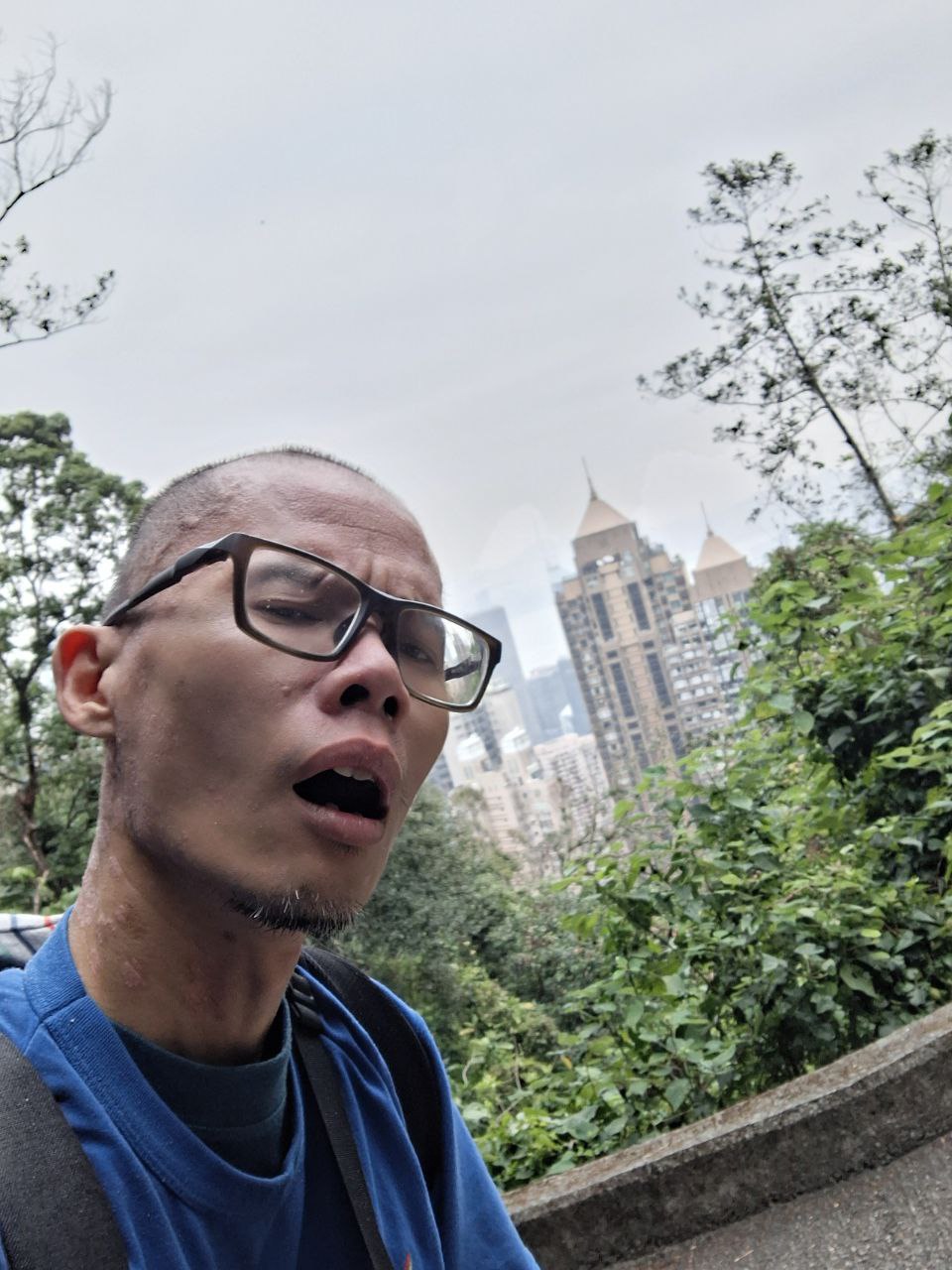
Ken wanted to go see how the top of Victoria Peak looks like. We took the Mid-level Escalator which will take us to the edge of the Victoria peak and then we walk up. You have the option to take the tram up if you want a more less sweaty experience.

We walked up, after eating half a goose between us and it was not easy. Here is Ken and I taking a break, among the don’t-know-how-many breaks we did, in an effort to get there.

It is one of the time that we are pretty glad the weather is near 12 degrees than 30 degrees.
Our head of investment Chye Hsern told us he ran up Victoria peak once 10 years ago and nearly died doing it. That is just insane considering how steep some parts were.
I guess what made it more challenging for us was also the unfamiliarity and I would think many nearby Hong Kong people would do this hike as a regular exercise.

Scaling up Victoria peak gives Ken and I both the Ganbaru kind of feeling. Doesn’t feel that great when you see a bunch of people up there in the shopping mall (yes there is a mall on top at Victoria peak) all damn chill.
My first comment to Ken was “Why is there a Bakehouse on top of the peak!”
And so you know. If you hike up you can buy great egg tart as a reward!
We managed to take some pretty good photos.
You can choose to go in the morning but Ken wanted the opportunity to see Hong Kong in this manner.
Ganbaru means to persevere, to do one’s absolute best, or to “stand firm” with tenacity through difficult times.
If you want to trade these stocks I mentioned, you can open an account with Interactive Brokers. Interactive Brokers is the leading low-cost and efficient broker I use and trust to invest & trade my holdings in Singapore, the United States, London Stock Exchange and Hong Kong Stock Exchange. They allow you to trade stocks, ETFs, options, futures, forex, bonds and funds worldwide from a single integrated account.
You can read more about my thoughts about Interactive Brokers in this Interactive Brokers Deep Dive Series, starting with how to create & fund your Interactive Brokers account easily.

Kyith is the Owner and Sole Writer behind Investment Moats. Readers tune in to Investment Moats to learn and build stronger, firmer wealth foundations, how to have a Passive investment strategy, know more about investing in REITs and the nuts and bolts of Active Investing.
Readers also follow Kyith to learn how to plan well for Financial Security and Financial Independence.
Kyith worked as an IT operations engineer from 2004 to 2019. Currently, he works as a Senior Solutions Specialist in Insurance Start-up Havend. All opinions on Investment Moats are his own and does not represent the views of Providend.
You can view Kyith’s current portfolio here, which uses his Free Google Stock Portfolio Tracker.
His investment broker of choice is Interactive Brokers, which allows him to invest in securities from different exchanges all over the world, at very low commission rates, without custodian fees, near spot currency rates.
You can read more about Kyith here.