
Let’s go through a lot of these funds that distributes income and see the nature and quality of the income.
These funds can be unit trust that you buy from the the banks, or Poems, Singlife DollarDex or iFAST. Or they can be exchange traded funds list for a long enough period.
This allow us to see a few things:
- Mainly, how is the nature of their natural distribution? Not selling the units to get the income but just by what the fund manager decides to pay out.
- Is it in a way that many of you prefer, which is consistent income, and keeps up with inflation? I think just these two is a challenge that you hope to overcome.
- How does the overall performance look like.
I been saying for the longest time:
- The natural distribution from most products is not as consistent in a way you imagine mentally.
- They also don’t adjust with inflation.
- God knows if they keep up with inflation.
- It is not in the interest of the manager, or the product provider to give you that consistent inflation adjusted income because the obligation is too much for them to handle.
- Many just don’t want to spend the capital. Like sell the units because they feel that if you sell the units, the fund doesn’t last. But they would frequently mentally check off that if they only take the natural income distribution, they have consistent income. Wrong. By #1, your income is not as consistent. It is your mind wanting the income to be consistent but rarely are they like this.
- The way to solve all of these things is to have enough income, such that if the income decreases because either you misjudge, your mental model is wrong, or you are unlucky with your market returns, you can still have the income to be consistent. This is essentially a Withdrawal Rate which the Safe Withdrawal Rate (SWR) seeks to figure out. But just so many cannot see it.
So the best way is to regularly go through fund by fund.
I coded Skadi at home to help me review these funds in the future with less mental resistance.
First Fund: Allianz Global High Payout Fund Class AM USD Dis
You can find the fund listed here:
This fund was incepted in 21 Feb 2006 so you have 20 year of history.
A long history allows you to imagine: If I retire with $1 million then I put 100% of my portfolio into this, and I want a stream of consistent income that keeps up with inflation, how would it do. The yield on Net Asset Value per unit (NAV) is 8% then.
So you can get $80,000 in income. Suppose you need every cent of this income for your spending. If you don’t have at least that, your wife will beat you to death. And since this fund has 20 years of history, you can imagine how your retirement would be like.
Today, the yield on NAV is nearer to 5.2%.
This fund is not the most popular Allianz Income and Growth, which I wrote and got so much brickbats here. The fund aims to provide total return from dividend income, option premiums, and capital appreciation, by investing in a globally diversified portfolio of equities with attractive and sustainable dividend yields, and selling call options to generate option premiums, which enhance income and reduce overall portfolio risk.
It is best described as an equity income + covered call (buy-write) strategy, not a pure 100% equity income fund. The options overlay is a core part of how it generates its distributions.
With effect from 1 December 2023, the benchmark was changed to the MSCI World Index (in SGD or USD depending on share class). The previous blended benchmark (60% MSCI World + 40% Dividend Yield/MSCI World) was deemed no longer representative of the current investment strategy.
In a way, folks who likes funds that sprinkled their income with options writing would like this but this used to be perhaps a more tame fund. In the last 2 years, they want you to look at it more as an equity income fund.
Which is what many of you likes.
The Nature of Allianz Global High Payout’s Natural Income Stream.
If you go to any of the site above you can get their historical income distribution. I tallied them up by calendar year and they would look like this:

Total DPU tallies up the distribution for the calendar year. The next one shows the number of distributions. Notice that this used to be 2 times a year, then become 4 times, then now is monthly lol. The first and last year doesn’t have full year distribution so do adjust your lens when you review them.
I have also provided the Net Asset Value per unit at 1st Jun of each year.
Notice the NAV was $1 and then now its $0.77. It means that if you start with $1 million, and you don’t want to sell the units, your capital is left with $770,000.
Prevailing Yield shows us at every year in 1st June, what is the yield.
The way to read this is that if you decide to invest any year, what is the roughly yield you will get. Some years 7-8%, then some 10%, some 4-5%.
Lastly, Yield on Initial NAV will show if you invest at the start, did your yield on cost actually grow over time?
The answer for this is probably no. In 2007 you would get a distribution of $0.092. In 2025, your distribution is $0.04797.
Not only did the distribution not keep up with inflation, it actually went down.
Your yield on cost went from closer to 9% to 4.8%.
So this means that your wife will really beat you to death.
The bar chart would give you an idea of whether the income is as consistent as you like.
Performance – All Returns include the Performance of Distributions.
Here is the overall performance summary:

The fund since inception earns 6.66% p.a. after the expense ratio. Even the recent performance is pretty good with 1 year return of 28%, and 3 year annualized at 22% p.a.
Would this be a turn around?
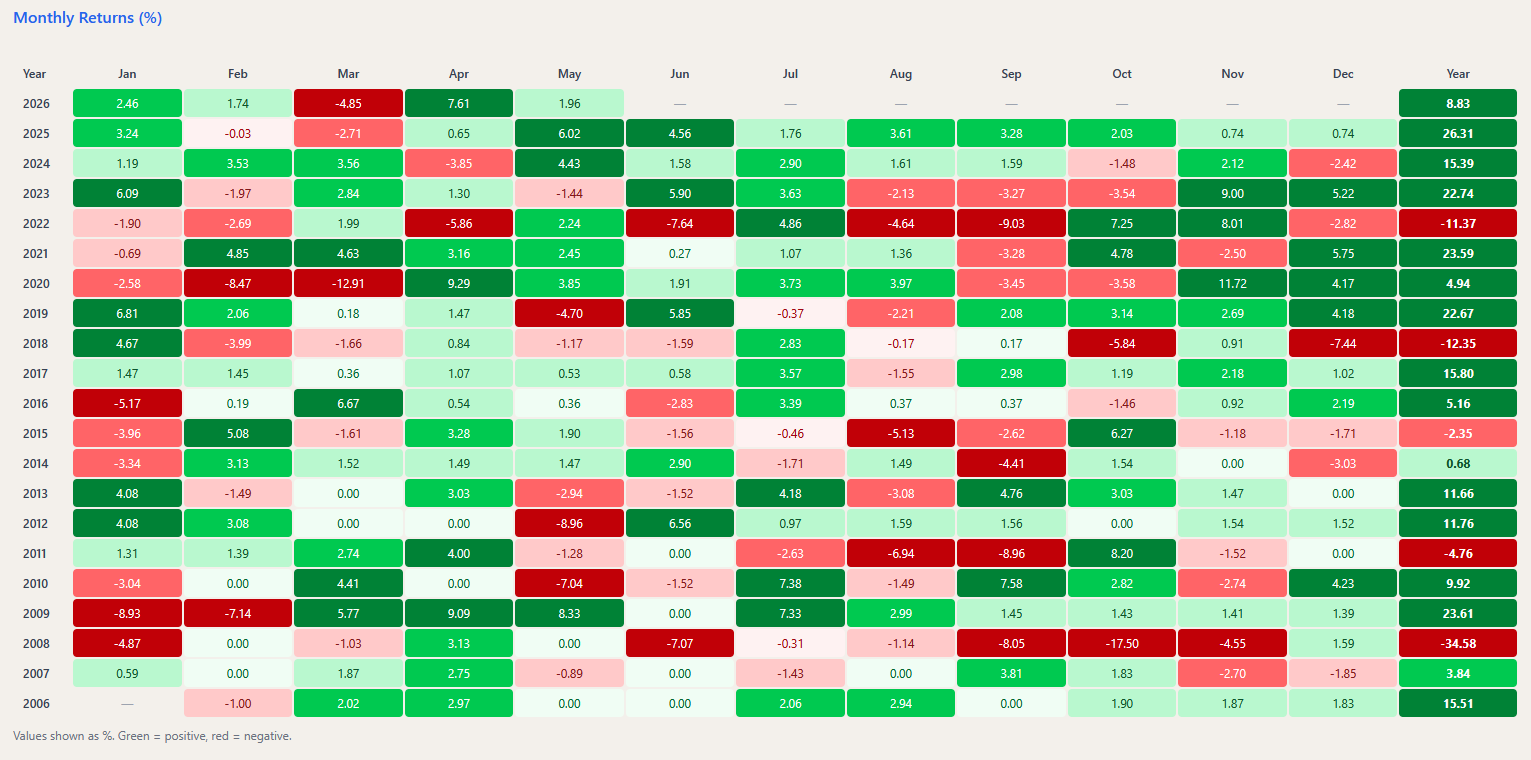
This heat map shows the performance month by month:

You can see the yearly performance at the last right column. In GFC it went down 34% but i wonder if it is more of a balanced portfolio and I guess that is inline with a balanced portfolio.
8.8% this year so far is pretty good.
This chart shows the rolling annualized return:

Rolling returns show that if you invest at any point with all your money, how would the returns be like.
Short term, you can get -47%, or 47% or 8.38% depending on when you invest, but as you increase the holding period that narrows.
The 10 year is a good reference. Even at 10 years, you could get 1.18% p.a. just as to get 11.44% p.a.
NAV Growth over Time
Here is how the NAV looks like:

Epilogue
So would you invest in this fund?
You might say no if you review it this way, but you have to think deeper about it. The ones who invested in this fund in 2007, 2008, they may also not invest in this had they seen this.
But yet they did.
Which kind of makes you wonder: The stuff that you choose today, why are you so confident they don’t end up the same way?
In a way, I am not beating up on this fund (or any of the funds that I am going to review). What I am saying is that this is the very nature of things.
If you have your own income portfolio, its also good to think in a different way: The managers at different points would likely feel pretty confident about what they selected. And this is the result. So what makes you different?
Here are your other Higher Return, Safe and Short-Term Savings & Investment Options for Singaporeans in 2026
You may be wondering whether other savings & investment options give you higher returns but are still relatively safe and liquid enough.
Here are different other categories of securities to consider:
| Security Type | Range of Returns | Lock-in | Minimum | Remarks |
|---|---|---|---|---|
| Fixed & Time Deposits on Promotional Rates | 4% | 12M -24M | > $20,000 | |
| Singapore Savings Bonds (SSB) | 2.9% – 3.4% | 1M | > $1,000 | A good SSB Example.” data-order=”Max $200k per person. When in demand, it can be challenging to get an allocation. A good SSB Example.”>Max $200k per person. When in demand, it can be challenging to get an allocation. A good SSB Example. |
| SGS 6-month Treasury Bills | 2.5% – 4.19% | 6M | > $1,000 | How to buy T-bills guide.” data-order=”Suitable if you have a lot of money to deploy. How to buy T-bills guide.”>Suitable if you have a lot of money to deploy. How to buy T-bills guide. |
| SGS 1-Year Bond | 3.72% | 12M | > $1,000 | How to buy T-bills guide.” data-order=”Suitable if you have a lot of money to deploy. How to buy T-bills guide.”>Suitable if you have a lot of money to deploy. How to buy T-bills guide. |
| Short-term Insurance Endowment | 1.8-4.3% | 2Y – 3Y | > $10,000 | A good example Gro Capital Ease” data-order=”Make sure they are capital guaranteed. Usually, there is a maximum amount you can buy. A good example Gro Capital Ease“>Make sure they are capital guaranteed. Usually, there is a maximum amount you can buy. A good example Gro Capital Ease |
| Money-Market Funds | 4.2% | 1W | > $100 | Suitable if you have a lot of money to deploy. A fund that invests in fixed deposits will actively help you capture the highest prevailing interest rates. Do read up the factsheet or prospectus to ensure the fund only invests in fixed deposits & equivalents. |
This table is updated as of 17th November 2022.
There are other securities or products that may fail to meet the criteria to give back your principal, high liquidity and good returns. Structured deposits contain derivatives that increase the degree of risk. Many cash management portfolios of Robo-advisers and banks contain short-duration bond funds. Their values may fluctuate in the short term and may not be ideal if you require a 100% return of your principal amount.
The returns provided are not cast in stone and will fluctuate based on the current short-term interest rates. You should adopt more goal-based planning and use the most suitable instruments/securities to help you accumulate or spend down your wealth instead of having all your money in short-term savings & investment options.

Kyith is the Owner and Sole Writer behind Investment Moats. Readers tune in to Investment Moats to learn and build stronger, firmer wealth foundations, how to have a Passive investment strategy, know more about investing in REITs and the nuts and bolts of Active Investing.
Readers also follow Kyith to learn how to plan well for Financial Security and Financial Independence.
Kyith worked as an IT operations engineer from 2004 to 2019. Currently, he works as a Senior Solutions Specialist in Fee-only Wealth Advisory Firm Providend. All opinions on Investment Moats are his own and does not represent the views of Providend.
You can view Kyith’s current portfolio here, which uses his Free Google Stock Portfolio Tracker.
His investment broker of choice is Interactive Brokers, which allows him to invest in securities from different exchanges all over the world, at very low commission rates, without custodian fees, near spot currency rates.
You can read more about Kyith here.