
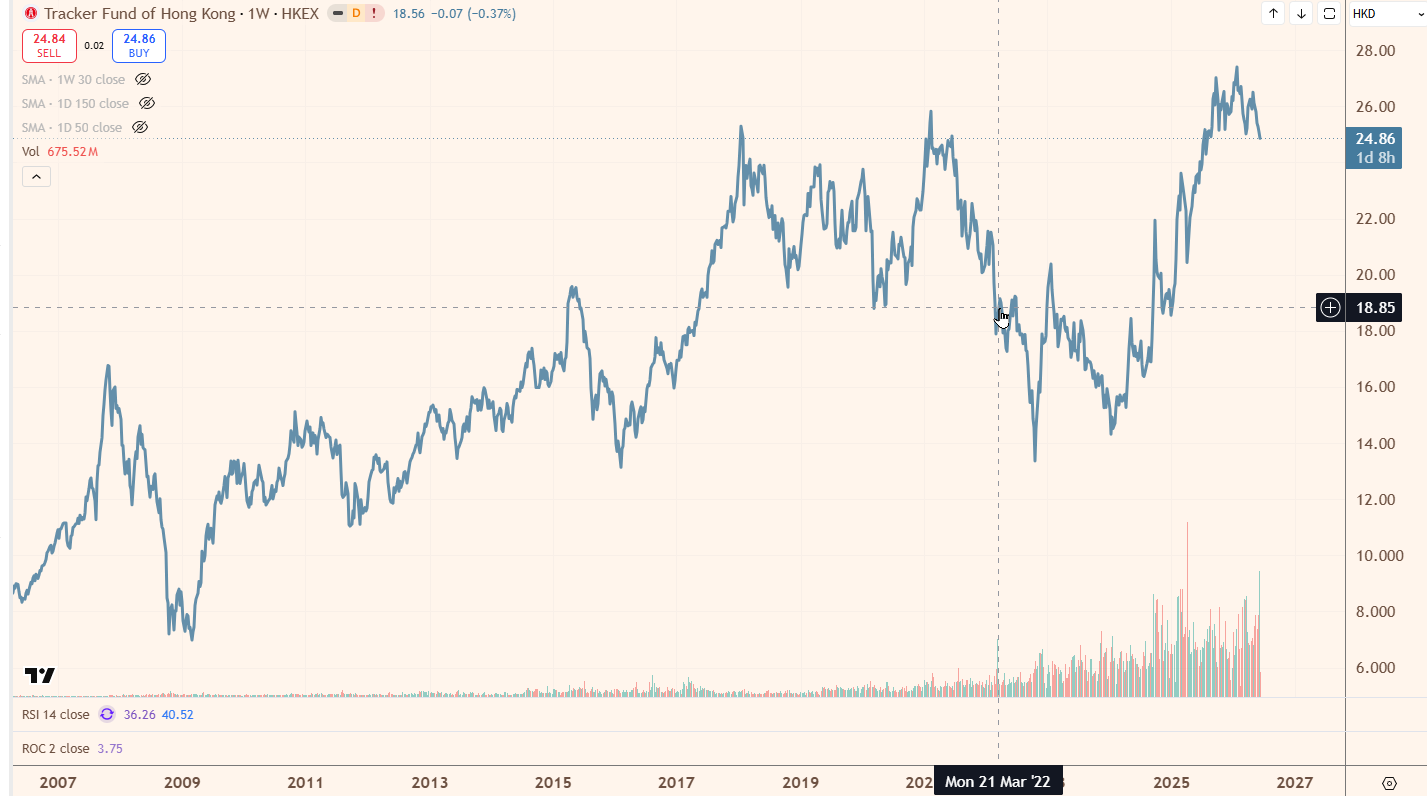
One of the underlying lessons for my profile on the recent short term banking movement is to have some humility that things can turn out very differently, even if there are strong rational views.
I think another good reminder for some of us older ones is to remember the unrests in Hong Kong and then Covid. Then came the hard clampdown by the China Government on China firms. All in all, it has been challenging for Hong Kong.
Aside from the gains and losses, my reflection brings me to the things that people say and how they apply to investing.
The most prominent is how much institutions and retail investor deduce that Hong Kong and China are not investable, as long as you have the China Government there. More so, we also seen articles, videos of “many” expats, and Hong Kong residents leaving Hong Kong.
Adam Clermont writes Five Years Ago, They Said Hong Kong Was Finished to reflect upon what he observes:
I’m not saying those years were easy. They weren’t. I sat in the same apartment for months during COVID while the rest of the world reopened and planes flew over my building to somewhere I couldn’t go. I watched friends leave. Some for good reasons, some for bad ones, some for reasons they couldn’t articulate but felt in their chest. The WhatsApp groups thinned. The farewell dinners came in clusters. There was a period where every Sunday was a going-away brunch, and the mimosas started tasting like something other than celebration.
The actual situation from what he observe on the ground is different:
I watched the people who stayed keep building.
Not loudly. Not with press releases aimed at Bloomberg terminals. Quietly, in the way this city has always done its actual work, in factory buildings converted to labs in Wong Chuk Hang, in university departments that kept publishing, in Cyberport offices where the lights stayed on past midnight.
And now it’s 2026, and the data has arrived, and the data doesn’t care about your narrative. The Shenzhen-Hong Kong-Guangzhou cluster was ranked the number one innovation cluster on earth in 2025, above Tokyo, above San Francisco, above every cluster that wasn’t being eulogised in English-language newspapers three years prior. The number of startups in the city hit a record 5,221, and one in three was founded by someone who came here from somewhere else, which is a strange pattern for a city that everyone supposedly left. And the IPO market, the one declared dead, posted a 489 percent increase in funds raised in the first quarter of this year. Four hundred and eighty-nine percent. If your portfolio did that, you would not describe the underlying asset as “finished.”
Perhaps if we can see the equivalent of this, it is what people say about Dubai and UAE.
They are finished.
Singapore is going to be the main beneficiary.
The weird fxxk is that Hong Kong STILL retains its status as Asia’s top financial center and was THIRD globally. They are actually closing ranks with New York and distancing themselves from Singapore. The report is published by think tanks Z/Yen Group in London and the China Development Institute in Shenzhen. They rated 119 financial centres based on 140 factors plus assessments by 4,946 respondents to a questionnaire.
Hong Kong ranks in:
- Human capital
- Infrastructure
- Financial sector development rose to second globally.
- Business environment and reputation rose to third globally.
- Number 1 in investment management
- Number 1 in insurance
- Number 1 in finance
- Number 3 in banking
- Rose from 9th to 4th in Fintech offering, behind only New York, London and Shenzhen.
Hong Kong last month also launched a gold clearing system that will be ready in July, trying to have first mover in being a gold hub.
And you wonder… what is the likelihood that Dubai money will ONLY go to Singapore?
I like some of the person stories shared including this:
A founder I know opened a biotech lab in Tai Po in 2022. The exact year you were supposedly not supposed to open anything in Hong Kong. I asked him once why he didn’t go to Singapore. He looked at me like I’d asked why he didn’t open a seafood restaurant in a desert. “My supply chain is in Shenzhen,” he said. “My clinical partners are at HKU and CUHK. My Series A came from a fund on Queen’s Road. Why would I leave?” He wasn’t making a political statement. He was making a logistical observation. His company has fourteen employees now and a product in trials.
Then there’s a woman I met at a Cyberport event last year who had moved here from London in 2023. I asked her the question everyone asks, some version of why. She said she’d spent six months reading about how Hong Kong was over and then came for a week to visit a friend and couldn’t reconcile what she’d read with what she saw. The restaurants were full. The coworking spaces were full. People were hiring. She went back to London, gave notice, and was here within two months. She runs a fintech startup now with a team split between Hong Kong and Shenzhen. She told me the only hard part was finding an apartment, which is not exactly the problem a dying city has.
These people aren’t outliers. They aren’t contrarians performing optimism. They just looked at the fundamentals, the proximity to Shenzhen, forty minutes on the high-speed rail, the capital markets, the five research universities within thirty kilometres, the tax structure that still makes CFOs weep, and made a logistical decision. The fundamentals didn’t leave. They don’t fit in a suitcase. You can’t take the proximity to Shenzhen with you to Toronto.
I think the lesson learn is whether we should hold that strong of a view… especially when the range of outcomes is wide.
Morgan Housel writes about Germany’s Great Reset after the first world war:
Part of the Armistice that ended the war forced the dismantling of Germany’s military. This included virtually every weapon it owned. In the years after World War I the Allies undertook one of the largest industrial demolition campaigns in history. Six million rifles, 38 million projectiles, half a billion rounds of ammunition, 17 million grenades, 16,000 airplanes, 450 ships, and millions of tons of other war equipment was destroyed or stripped from Germany’s possession.
But 20 years later, Germany had one of the largest and most sophisticated militaries in the world.
It had the fastest tanks. The strongest air force. The most powerful artillery. The most sophisticated communication equipment, and the first missiles – all of which went on to inflict more suffering than the world had ever known.
A catastrophic irony of Germany’s military resurgence is that it partly took place not in spite of, but because of, its earlier disarmament.
As war in Europe began in 1939, George Marshall, Army Chief of Staff, made a critical point to President Roosevelt about the Nazi’s technological capabilities:
“After the [first] World War practically everything was taken away from Germany in the way of materiel. So when Germany rearmed, it was necessary to produce a complete set of materiel for the troops. As a result, Germany has an army equipped with the most modern weapons that could be turned out. That is a situation that has never occurred before in the history of the world.”
Supplying a military is one of the most expensive and logistically complicated things a country does. So it tries to get as much use out of its equipment as it can.
Many investors are far too dismissive:
- “It will definitely be like that”
- “Dubai is gone case”
- “Greece is gone case”
- “China is uninvestable”
- “STI is a terrible index”
They might be, but what you need to contend with is to consider what is the Base Case here?
The base case is that if we zoomed out all these “gone case” could just be unlucky or poor short sequences. In the long run, you would get decent returns. Another critical base rate can be that things on their own failed easily individually. Be diversified so that you don’t get impaired, but also you have a higher potential to harvesting great returns.

Living through periods when the market is down, may validate the talk that some markets are uninvestable. That you have made the wrong choice in investment. That there are “correct” ETFs and there are “incorrect” ETFs to invest in.
Those of us who have been through the upswing would notice something interesting:
The newspaper publication went from “This is not investable”, to “It is investable for the nimble.”, to “this is a market that is different and cannot be avoided”
I just want you to take a moment and consider is it China, Greece, Hong Kong, Singapore or is it the investing frame of reference you are reviewing this from?
Who is screwed up one here?

Do Like Me on Facebook. I share some tidbits that are not on the blog post there often. You can also choose to subscribe to my content via the email below.
If you’re thinking of opening an Interactive Brokers account, my referral link is here.
As the new account holder, you’ll receive USD 1 in IBKR stock for every USD 100 you deposit, up to USD 1,000 in shares — so a USD 10,000 deposit gets you USD 100 in IBKR stock, and the bonus is capped at USD 1,000 for deposits of USD 100,000 or more. A few other things to know: the minimum deposit to qualify is USD 10,000, done within 30 days of opening, and the bonus shares are locked up for one year from the award date. The promotion is currently active, and using the link costs you nothing extra. On a separate note, if you haven’t already, it’s worth taking a look at how IBKR’s share price has performed over the past five years — the stock you receive as a bonus isn’t just a token; it’s a stake in a company that has done quite well for its shareholders.
I break down my resources according to these topics:
- All my personal notes about how my philosophy behind my own money and how I manage it.
- Building Your Wealth Foundation – If you know and apply these simple financial concepts, your long term wealth should be pretty well managed. Find out what they are
- Active Investing – For active stock investors. My deeper thoughts from my stock investing experience
- Learning about REITs – My Free “Course” on REIT Investing for Beginners and Seasoned Investors
- Dividend Stock Tracker – Track all the common 4-10% yielding dividend stocks in SG
- Free Stock Portfolio Tracking Google Sheets that many love
- Retirement Planning, Financial Independence and Spending down money – My deep dive into how much you need to achieve these, and the different ways you can be financially free
- Providend – Where I work and do research. Fee-Only Advisory. No Commissions. Financial Independence Advisers and Retirement Specialists. No charge for the first meeting to understand how it works

Kyith is the Owner and Sole Writer behind Investment Moats. Readers tune in to Investment Moats to learn and build stronger, firmer wealth foundations, how to have a Passive investment strategy, know more about investing in REITs and the nuts and bolts of Active Investing.
Readers also follow Kyith to learn how to plan well for Financial Security and Financial Independence.
Kyith worked as an IT operations engineer from 2004 to 2019. Currently, he works as a Senior Solutions Specialist in Fee-only Wealth Advisory Firm Providend. All opinions on Investment Moats are his own and does not represent the views of Providend.
You can view Kyith’s current portfolio here, which uses his Free Google Stock Portfolio Tracker.
His investment broker of choice is Interactive Brokers, which allows him to invest in securities from different exchanges all over the world, at very low commission rates, without custodian fees, near spot currency rates.
You can read more about Kyith here.