
Last week, I did a round of review about the small regional US banks. The goal is to see their loan exposure to non-depository financial institutions (NDFI). These are the bank kind of institution but are lending based on the lending from other banks. The goal is to see how many cockroaches that can be hidden about the private credit situation.
This time we have another set of banks:
- First Citizens Bancshares (FCNCA)
- Bank of Hawaii (BOH)
- BOK Financial (BOKF)
- Servisfirst Bancshares (SFBS)
- EastWestBank (EWBC)
- BankUnited (EBC)
- Customers Bank (CUBI)
- Byline Bank (BY)
- Columbia Bank (COLB)
- AssociatedBank (ASB)
- Glacier Bank (GBCI)
I think the most exposed could be Customers Bank (CUBI) because they made NDFI lending a main part of the business. They happen to have the most to say. The other one with potentially higher exposure is First Citizens Bancshares (FCNCA), which happens to be in Crystalys.
But generally, we find a few banks with very low net charge-offs, and minimal exposure to NDFI or private credit exposure.
You can find the Interactive HTML on this batch of banks here >>
We will go through some of the more private credit and NDFI related stuff but also highlight a few interesting banks to keep track of.

Exposure to Loans made to NDFI

CUBI
The bank with the biggest exposure of loans made to NDFI is Customers Bancorp (CUBI). CFO Mark McCollom explained in the Q3 2025 call that CUBI’s NDFI exposure falls into three buckets:
Bucket 1 — Mortgage Warehouse (~25% of NDFI) Lending to mortgage originators who hold loans temporarily before selling them. The collateral is actual mortgages. Very short-duration, self-liquidating. Broadly understood as low risk.
Bucket 2 — Capital Call / Fund Finance (~25% of NDFI) Loans to private equity and private credit funds secured against the uncalled capital commitments of their limited partners (typically large institutions like pension funds, sovereign wealth funds, endowments). The bank isn’t betting on the fund’s portfolio companies — it’s betting that CalPERS or a sovereign fund will wire money when called. Historically near-zero loss rates industry-wide.
Bucket 3 — Lender Finance (~50% of NDFI) This is the one getting the most scrutiny. CUBI lends to private credit lenders themselves — i.e., they provide a credit facility to a direct lending firm that then re-lends to small/mid-sized companies. Think of it as: CUBI is the warehouse bank behind the private credit fund’s deployment. This is where the “contagion” worry concentrates.
They think that NDFI is one of their lower risk credit risk portions of their overall C&I portfolio. They have been in this for over 10 years. CUBI have “look through” LTVs which means they have the view of the underlying loan collateral. They have collateral substitution rights, and if the collateral deteriorates, they can demand replacement collateral.
Since inception, they have 0 delinquencies and 0 net-charge-offs.
CEO Sam Sidhu addressed the most detail in the Q1 2026 Q&A. There was a pullback in lender finance in Q1 broadly across the whole market. CUBI management stated default rates would need to exceed 4x GFC observed default rates to impair the bank’s facility. That is a significant structural protection — but the GFC is also the most stressed environment in modern history.
FCNCA
FCNCA was able to have a once in a life time opportunity to buy Silicon Valley Bank (SVB) at a big discount and it changed their trajectory. It does mean that SVB would like be very expose to loans to software and start up business.
JPMorgn analyst Anthony Elian asked: “Could you help us quantify your exposure to companies in the software industry for both loans and deposits? I don’t think this has been disclosed since you acquired SVB a few years ago.”
FCNCA’s Chief Credit Officer said that they have $8.1 billion in loans that are on-balance sheet software exposure. If they add the off-balance sheet commitment, then its $14.4 billion. This is 10% of their loan book. Roughly 25-30% of the $8.1 billion loan are cash-secured or asset-based lending (ABL).
On top of these software loans $38.8 billion are loans to NDFI. They are mainly capital call lines (83%). These are short-term loans made to the funds, not to invest, but to bridge the period before the investors such as pension funds send their money to the private fund.
Their year to date net charge off on their Early Stage book is 8.5% annualized and they have 35% criticized loan ratio. 8.5% is a high number which means they are charging off losses at a high rate. If they have a 15.28% loan loss research, they are expecting to lose 1 in 7 dollars. This means that they are expecting some serious pain from this section and are provisioning appropriately for it. The year to date net charge off for the Growth Stage book is better at 0.94% and 17% criticized loans.
Their reserve ratio for the Early Stage book is 15.3% and Growth Stage is 4.3%. This means they are catering for 2 times and 4 times the current charge off rate for both books accordingly.

Aside from those direct and indirect software exposure, FCNCA have a high 32B exposure to capital call lines. These are short term loans made to funds to execute on deals, before their investors (the Limited Partners) released the money.
A private equity or private credit fund raises money from large institutional investors — pension funds, sovereign wealth funds, university endowments, insurance companies, family offices. These investors sign a legal commitment to contribute a fixed amount of capital over the life of the fund, say $500M from CalPERS, $200M from GIC Singapore, $100M from Harvard endowment.
But the fund manager doesn’t call all that money on day one. They call it in tranches as they find deals to deploy into. In the meantime, the fund needs to move quickly when a deal is available — signing a purchase agreement, closing an acquisition, wiring funds. That process can take days to weeks. The LP capital call notice period is typically 10 business days.
So the fund borrows from a bank to bridge the gap. The bank lends against the uncalled LP commitments as collateral. When the LP capital arrives, it repays the loan. The loan is typically short-duration — 90 days to 6 months. The bank is essentially a payment timing service.
Traditionally this section is “Very Low Risk”. This is because of a few reasons:
The borrower quality is exceptional. The LPs backstopping repayment are not software startups. They are CalPERS ($500B+ in assets), sovereign wealth funds, Ivy League endowments. These are among the most creditworthy entities on the planet. They have legal contractual obligations to fund. Defaulting on a capital call is extraordinarily rare and carries severe reputational and legal consequences — you get kicked out of future funds, sued, and blacklisted in the industry.
The structure is clean. The loan is not backed by the fund’s portfolio companies or their valuations. It doesn’t matter if the fund’s underlying investments are performing poorly. The repayment comes from the LP wire, not from selling assets. The loan is structurally insulated from the fund’s investment performance.
Historical losses are genuinely near zero. The industry-wide track record on capital call lines going back decades has almost no credit losses. This is not what the management says but what it is.
If we take a “what’s possible” lens then the risks in this segment is:
- LP Inability or Refusal to Fund (Low but Non-Zero). In a severe stress scenario, an LP could find itself unable to fund a capital call. This happened at the margin during the 2008–2009 crisis when some smaller endowments and family offices faced liquidity crunches from other parts of their portfolios and struggled to meet capital calls simultaneously across many fund commitments. The mitigation is that most capital call facilities have LP concentration limits — no single LP can represent more than 25–30% of the borrowing base, so one defaulting LP doesn’t sink the whole thing. But if multiple LPs simultaneously face liquidity stress — which is exactly what happens in a correlated market crisis — the diversification protection weakens.
- Fund Manager Misconduct or Fraud. The fund manager controls the capital call process. If a manager fraudulently draws on the facility for purposes other than legitimate investments — or if the subscription agreements the bank relies on as collateral turn out to be forged or disputed — the bank’s claim against LP commitments could be contested. This is rare but has happened. The most cited example in the industry was the Abraaj Group collapse in 2018-2019, where a prominent EM private equity manager misappropriated investor funds. Lenders discovered their collateral wasn’t as clean as they thought.
- LP Dispute Over the Capital Call Itself. An LP can legally contest a capital call if they believe the fund manager breached the Limited Partnership Agreement — say, by calling capital for purposes outside the fund’s mandate, or after the investment period expired, or in violation of concentration limits. If the LP disputes the call, they don’t wire the money, and the bank’s primary repayment source evaporates temporarily while legal processes play out.
- Concentration in a Single Stressed Fund Manager. Capital call facilities are often structured around the best-known, most reputable managers. If a bank’s portfolio is heavily concentrated in facilities for funds run by the same general partner, and that GP faces reputational or legal problems (fraud, key person departure, regulatory action), multiple facilities could simultaneously experience stress.
- The “Structural Insulation” Assumption Breaking Down at Scale. The entire thesis rests on the separation between “fund portfolio performance” and “LP payment obligation.” Under normal market conditions, that separation holds. But consider an extreme scenario: a severe, prolonged economic depression where institutional LP portfolios have fallen dramatically in value, multiple PE funds are simultaneously struggling, and regulatory pressure on pension funds restricts their ability to honour private market commitments.
The worst case for FCNCA:
- PE fundraising freezes for 2-3 years.
- Fund managers cannot deploy capital.
- LP base simultaneously faces sustained drawdowns.
The Credit Quality
Here is a table that shows the current credit quality for each bank:

What you will realize is… Bank of Hawaii (BOH), BOK Financial (BOKF), EastWest Bancorp (EWBC), ASB and GBCI has very very very low net charge off rates!
Again under 0.5% is generally healthy for a broad commercial bank, anything over 1.5% signals significant stress. Basically all of them are very low.
NPL are loans where borrowers have stopped paying or are unlikely to repay. Under 1% is healthy for most banks. The most risky here is Byline Bancorp and ServisFirst Bancshares.
ACL/Loan is how much provisioning for non-performing loans that the banks have build up over time, so that this does not kill their profits for the year. This gets build up over time. You will see a range from 0.87% to 1.44%. You would always look at this against the NCO rate of the bank.
If in a normal economy, NCO of 0.5% is reasonable (the highest here is FCNCA and COLB at 0.30%) but in recession naturally we would see the NCO is higher. So an ACL/Loan kind of showing how many years of “normal” loss absorption with zero additional provisioning. 1.5% is conservative but none of the banks are there. BKU looks bad but that is 2 times.
ACL/NPL allows us a view of how much the provision covers non-performing loans at this point. The higher the better. Because BOH, BOKF, EWBC, CUBI, ASB, GBCI is so so low, they look like a lot of provisioning.


Some of the More Interesting Regional Banks
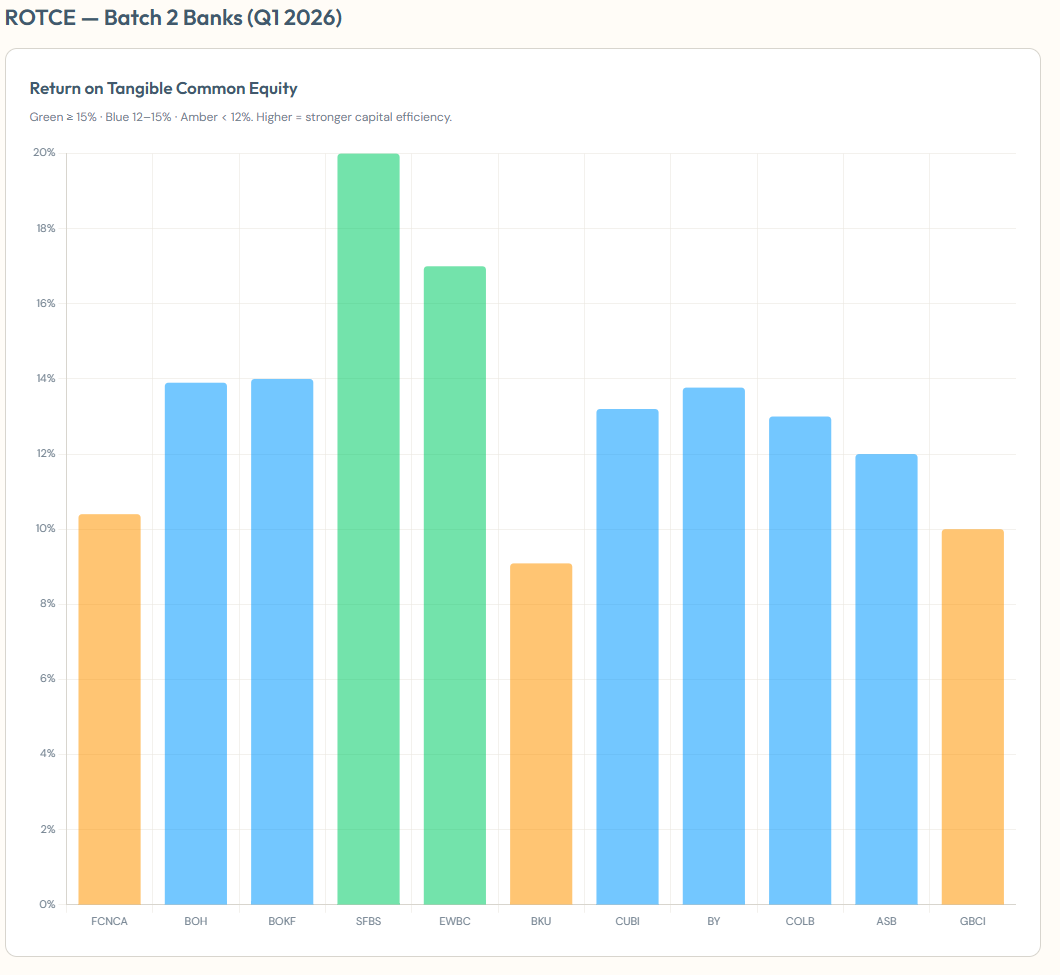
Aside from risks, this batch of regional banks have quite a few with 14% and above return on tangible equity:

ServisFirst Bancorp (SFBS)
ServisFirst Bancorp (SFBS) stood out with such a high 20% ROTCE.
I was initially thinking that they ought to have a high percentage of their earnings that is non-interest based, in wealth management where the ROE can be higher. It’s not. their non-interest revenue is less than 1% of overall revenue. The reason is that it’s efficiency ratio is less than 30%.
Efficiency ratio takes the non-interest banking expense divide by the net revenue (net interest revenue and non-interest revenue). The lower it is the more efficient. UOB, DBS, OCBC is at 40%. Typical US banks is at 50% or more. A 50% efficiency ratio means $0.50 of every revenue disappears as cost. 30% vs FCNCA 60% can be a big difference.
Most banks carry enormous fixed cost structures — hundreds of branches, thousands of tellers, lease obligations, ATM networks. ServisFirst deliberately built the opposite.
Their model is “branch light,” with $575 million average deposits per banking centre, leveraging technology and centralised infrastructure, with headcount focused purely on production and risk management.
Instead of building branches to attract deposits passively, ServisFirst hires experienced commercial bankers from larger banks — people who already have deep relationships with privately-held businesses, professionals, and wealthy individuals in their local market — and lets them bring their client book.
Tom Broughton hires local bankers but doesn’t build branches — this allows for best-in-class efficiency metrics while maintaining a strong and conservative lending culture.
The banker carries the relationship. When they move to ServisFirst, the deposit follows. This means ServisFirst acquires deposits at close to zero incremental infrastructure cost. The bank pays the banker’s salary, not the branch lease, the teller staff, and the facilities team.
ServisFirst doesn’t chase consumer lending, mortgage banking, or complex structured products. Their target customers are privately held businesses with $2 to $250 million in annual sales, professionals, and affluent consumers.
This segment is attractive for several reasons. Business owners tend to keep large operating balances in checking accounts that pay little or no interest — those are extremely cheap deposits for the bank. Business lending also tends to have better risk-adjusted returns than consumer lending when done well, because commercial borrowers are more transparent about their financial position and the bank can monitor the business relationship closely.
Their NPA ratio has consistently sat around 0.11–0.15% of assets, and NPLs around 0.16–0.20% of loans — extraordinarily clean even by conservative bank standards. When you don’t lose money on loans, you don’t need to provision aggressively, which means more earnings flow through to equity.
its no wonder their price-to-book is 2.28 times!
East West Bancorp (EWBC)
EWBC also has pretty high 17% ROTCE.
Their efficiency ratio is very good at 35.6%. You can see that its not just deposit growth, but if you can keep your operation cost low, you can earn a lot based on a dollar. The goal of acquisition may be to get a bunch of relationships, and then reduce the operation cost so that you achieve efficiency. Your ROE goes from high to low (and likely your share price)
Dominic Ng, CEO, joined EWBC in 1991 and grew $600 million in savings to $80 billion in assets today over 33 years. East West hit a new earnings record every single year from 1991 to 2017, with just three exceptions: 1996, and 2008-2009 during the financial crisis.
Uniquely among US-based regional banks, East West has a commercial business operating license in China, allowing it to open branches, make loans and collect deposits there — with four full-service branches in Hong Kong, Shanghai, Shantou and Shenzhen. You cannot replicate that today. Getting a full banking license in China as a foreign institution is essentially impossible under current regulations. EWBC has a 20+ year head start that is permanently locked in.
The Asian American immigrant community is culturally one of the most savings-oriented demographics in the US. They hold large balances, churn slowly, and refer family and business networks to their trusted bank. The CFO said: “when things start to go sideways for other banks, you become an attractive alternative, a place where people go when things get rocky for others.”
The cross-border focus makes the bank’s profitability highly sensitive to volatile geopolitical relations, trade tariffs, and regulatory actions.
EWBC trades at 1.9 times price to book.
BOK Financial (BOKF)
BOKF has a pretty respectable 14% ROTCE. Its Efficiency is 63%. Its Net charge off rates is very low.
BOKF can be described as a 115-year-old energy trust company that happens to be a bank. They have a substantial amount of fee income from their long institutional knowledge in energy credit. They possess one of the largest in-house petroleum engineering groups in the banking industry. This allows them to perform detailed reserve-based lending (RBL), where they evaluate the actual geological reserves of a client to determine loan values, rather than relying solely on corporate balance sheets.
Another part of their fee income business is mineral management. They manage 12,000 accounts and 100,000 mineral, oil, gas, and real estate assets nationwide, and are one of the largest and most established North American specialty asset managers in this space. They began fiduciary management of oil and gas minerals in 1949. Think about what this means practically. When Oklahoma and Texas families own mineral rights under land such as oil royalties, gas interests, they need someone to manage the paperwork, track production, collect royalties, handle the trust structures. BOKF has been doing this for 75+ years. You cannot wake up tomorrow and compete with that. The relationships are multigenerational and deeply sticky.
During the 2015-2016 oil crash when energy banks were blowing up everywhere, BOKF’s through-the-cycle credit losses in energy were remarkably contained precisely because their engineering team knew which borrowers were actually viable.
George Kaiser, chairman of BOKF, owns 65% of it.
Their price-to-book is 1.35 times.

Do Like Me on Facebook. I share some tidbits that are not on the blog post there often. You can also choose to subscribe to my content via the email below.
I break down my resources according to these topics:
- All my personal notes about how my philosophy behind my own money and how I manage it.
- Building Your Wealth Foundation – If you know and apply these simple financial concepts, your long term wealth should be pretty well managed. Find out what they are
- Active Investing – For active stock investors. My deeper thoughts from my stock investing experience
- Learning about REITs – My Free “Course” on REIT Investing for Beginners and Seasoned Investors
- Dividend Stock Tracker – Track all the common 4-10% yielding dividend stocks in SG
- Free Stock Portfolio Tracking Google Sheets that many love
- Retirement Planning, Financial Independence and Spending down money – My deep dive into how much you need to achieve these, and the different ways you can be financially free
- Providend – Where I used to work doing research. Fee-Only Advisory. No Commissions. Financial Independence Advisers and Retirement Specialists. No charge for the first meeting to understand how it works
- Havend – Where I currently work. We wish to deliver commission-based insurance advice in a better way.

Kyith is the Owner and Sole Writer behind Investment Moats. Readers tune in to Investment Moats to learn and build stronger, firmer wealth foundations, how to have a Passive investment strategy, know more about investing in REITs and the nuts and bolts of Active Investing.
Readers also follow Kyith to learn how to plan well for Financial Security and Financial Independence.
Kyith worked as an IT operations engineer from 2004 to 2019. Currently, he works as a Senior Solutions Specialist in Fee-only Wealth Advisory Firm Providend. All opinions on Investment Moats are his own and does not represent the views of Providend.
You can view Kyith’s current portfolio here, which uses his Free Google Stock Portfolio Tracker.
His investment broker of choice is Interactive Brokers, which allows him to invest in securities from different exchanges all over the world, at very low commission rates, without custodian fees, near spot currency rates.
You can read more about Kyith here.