
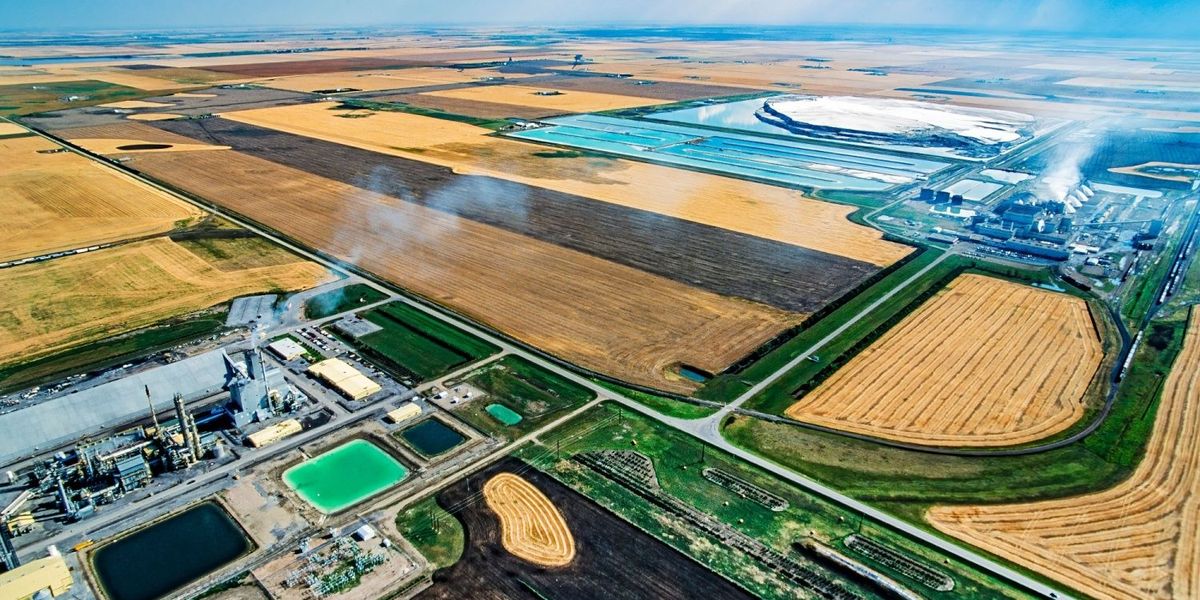
The potash sector was largely in balance in 2025, leading to stable supply and predictable prices.
While the market stabilized in the first half of 2024, lower cost inputs for potash production and improved crop production placed downward pressure on potash prices in the second half of the year.
The World Bank expects fertilizer prices to rise significantly in 2026 owing to conflict-related pressures stemming from the outbreak of war in the Middle East and the closure of the Strait of Hormuz, a critical shipping bottleneck. While the agency is expecting the largest rises in the prices of fertilizers that are dependent on natural gas, it’s still predicting a moderate rise in potash prices.
According to the World Bank’s data, potash prices are anticipated to rise to an average of US$390 per metric ton in 2026 before falling to US$365 in 2027.
This may be welcome news for potash investors — many potash-mining operations have closed or scaled back plans in recent years, and some are waiting on the sidelines for better days and sustainable improvements in potash prices.
According to the 2026 Mineral Commodity Summary from the US Geological Survey (USGS), global potash consumption increased to 41.6 million metric tons in 2025, up from 40.6 million metric tons in 2024. By 2029, the USGS predicts it will rise to 45.3 million metric tons. As seen in 2024, the biggest gains in potash usage came from Asia and South America.
The USGS anticipates production capacity rising to 77.4 million metric tons in 2029 from 66.1 million metric tons in 2025. Most of the increase will come from new muriate of potash (MOP) mines and project expansions in Laos and Russia. New MOP mines are expected to come online in Belarus, Brazil, Canada, Ethiopia, Morocco and Spain.
In terms of total output, the USGS estimates that global potash production totaled 49 million metric tons in 2025, while world potash reserves exceeded 5.9 billion metric tons of potassium oxide, or potash, equivalent.
Here, the Investing News Network provides a look at world potash production by country. All production and reserves data is reported in metric tons of potassium oxide equivalent.
1. Canada
Potash production: 15 million metric tons
Potash reserves: 1.1 billion metric tons
Leading the list of the top potash countries by production is Canada, which produced 15 million metric tons of potash in 2025, an increase of 600,000 metric tons compared to 2024. The prairie province of Saskatchewan is home to all of Canada’s potash production.
Canada also contains one of the world’s largest land-based potash reserves, with 1.1 billion metric tons of potash in its soil.
Canada is one of the world’s largest potash exporters and the primary provider to the United States. In 2025, Canada supplied 79 percent of US potash imports. Although concern over tariffs has waned since the start of 2025, there is still some uncertainty ahead of CUSMA negotiations in summer 2026.
There are several major players in Canada’s potash mining industry, such as Nutrien (TSX:NTR,NYSE:NTR), the world’s largest potash company. It was born from a 2018 merger between two major crop nutrient companies, Potash Corporation of Saskatchewan and Agrium. Today, the company has six operating potash facilities in Saskatchewan.
The world’s largest potash mine, the Mosaic Company’s (NYSE:MOS) Esterhazy K3 operation, is capable of producing nearly 8 million metric tons of the fertilizer mineral each year. Esterhazy K3 has a mine life that extends out to 2049, while the Esterhazy complex is expected to operate until 2084.
Additionally, BHP (ASX:BHP,NYSE:BHP,LSE:BHP) is currently building the Jansen mine in Saskatchewan. The first phase of the mine was originally slated to begin its production ramp up in late 2026, however, due to a surge in development costs and well supplied market, BHP pushed its timeline to mid-2027. Once both phases are complete, the mine will be one of the largest in the world and will produce an estimated 8.5 million metric tons of potash per year.
2. Russia
Potash production: 10 million metric tons
Potash reserves: 2 billion metric tons
Russia, the world’s second-largest producer of potash, mined 10 million metric tons of potash in 2025. The country holds the largest land-based reserves as well, with 2 billion metric tons of potash in Russia.
Uralkali is Russia’s premier potash company and one of the world’s leading potash producers, accounting for roughly 20 percent of global supply pre-war. The company has five mines and seven ore treatment and processing mills.
In response to Russia beginning its invasion of Ukraine in February 2022, the EU placed import quotas on potash from Russia, and the US sanctioned specific companies, limiting potash imports. Both the EU and US had eased their restrictions on Russian fertilizer imports in late 2022 in reaction to growing concerns about global food insecurity.
In 2025, Russian exports to the United States accounted for 12 percent of potash supply.
Despite the lifting of sanctions, Russia has maintained export controls on many of its fertilizer products, and in 2026 is limiting the amount of complex fertilizers, which includes MOP, to 7 million metric tons.
3. China
Potash production: 6.3 million metric tons
Potash reserves: 200 million metric tons
China ranks third in global potash production, in 2025 its output remained flat compared to 2024 at 6.3 million metric tons.
Potash is extremely vital for China — the country is the largest consumer of the fertilizer, accounting for approximately 20 percent of world potash consumption. China’s domestic demand for the material is higher than its homegrown potash supply, making the country reliant on potash imports, especially when it comes to MOP. In 2025 the country imported an estimated 12.61 million metric tons.
The provinces of Xinjiang and Qinghai are home to China’s primary potash deposits, and the Qinghai Salt Lake Potash Company (SZSE:000792) is the country’s largest potash producer.
4. Belarus
Potash production: 6 million metric tons
Potash reserves: 750 million metric tons
Potash production in Belarus totaled 6 million metric tons in 2025, up from an estimated 5 million metric tons in 2024. The country hosts 750 million metric tons of potash reserves.
Potash fertilizers are Belarus’ top export, making the sector very important to the Belarusian economy. Belaruskali is the country’s largest industry operator, with seven mines and five processing factories across Soligorsk, Minsk, and Petrikov, Gomel. Most recently, the mining company brought the Petrikovsky production unit online in 2021.
Prior to 2021, output from the Eastern European country had been on an upward trajectory since 2016, and reached as high as 8 million metric tons in 2020.
Human rights violations and political crackdowns by the Belarusian government under Lukashenko in 2021 led the EU and US to place an array of sanctions on Belarus, including its potash companies. These measures included blocking transit of Belarus’ potash to ports via Lithuania, Poland and Ukraine, a move that limited the land-locked country and forced it to reroute exports through Russia.
In March 2026, the US announced it would ease financial sanctions on Belaruskali in exchange for Belarus releasing 250 prisoners. As sanctions by the European Union remain in place, this has had minimal effect on Belarusian potash exports. In May, the US government reportedly wrote Lithuania, Poland and Ukraine to propose they lift sanctions and allow transport.
5. Germany
Potash production: 3 million metric tons
Potash reserves: 150 million metric tons
Germany’s potash production came in at 3 million metric tons in 2025, up from 2.5 million metric tons in 2024. The European country hosts 150 million metric tons of potash reserves.
The world’s first potash deposits were discovered in Staßfurt in Saxony-Anhalt, now a German state, in 1856, and potash mining began at Staßfurt five years later. Germany was the world’s only potash producer until the beginning of the 20th century.
K+S (OTCQX:KPLUF) is one of Germany’s leading potash miners, operating several mines in the country, including the Werra potash operations. The country is also home to DEUSA International, a private company that mines and markets salt-based products, including potash fertilizers.
6. Laos
Potash production: 2.4 million metric tons
Potash reserves: 1 billion metric tons
The Southeast Asian nation of Laos had an output of 2.4 million metric tons of potash in 2025, on par with its output in 2024. Its current output levels represent a massive leap from the 260,000 metric tons of potash produced in 2021. Laos also hosts the world’s third largest reserves after Canada and Russia with 1 billion metric tons.
Asia-Potash International Investment (SZSE:000893), one of the largest potassium fertilizer producers in Asia, is at the helm of the country’s potash industry. It is one of the Belt and Road cooperation projects operated by Chinese companies.
Laos is continuing to increase its potash production. Argus reports that in March of 2024, Laos-based potash producer Lao Kaiyuan began construction on its third MOP unit. The company successfully completed the expansion as of the end of 2025, doubling the company’s production capacity to 2 million metric tons per year.
In mid-2025, the country placed a temporary freeze on approvals for potash mining activities in the capital of Vientiane following a landslide and sinkholes. However, this does not affect Lao Kaiyuan’s operations, which are in the Khammouane province.
7. Israel
Potash production: 2 million metric tons
Potash reserves: large*
In 2025, Israel produced 2 million metric tons of potash. Annual potash production in Israel has remained in the 2 million to 2.5 million metric tons range since 2017. The country recovers potash from the Dead Sea.
Israel is seventh in terms of global potash output, and also hosts one of the world’s largest potash-producing companies, ICL Group (NYSE:ICL). Aside from potash, the company produces roughly a third of the world’s bromine, which is often extracted from the same salt water and brine deposits that produce potash.
The outbreak of war between Israel and Hamas in October 2023 created some concerns over potash supply disruptions. However, because demand was lower than it was when the Russia-Ukraine war broke out, a similar price shock didn’t hit the potash market.
On the other hand, in 2026, potash prices have increased significantly amid the US-Israel led war against Iran and Israel’s war against Hezbollah. This isn’t a result of potash supply concerns, though, as in terms of Israel’s potash production, ICL hasn’t suffered significant disruptions. There were reports of a drone crashing near one ICL facility near the port of Ashdod south of Tel Aviv, but shipping from the port was unaffected.
* Per the US Geological Survey, “Israel and Jordan recover potash from the Dead Sea, which contains nearly 2 billion tons of potassium chloride.”
8. Jordan
Potash production: 1.8 million metric tons
Potash reserves: large*
Potash production in Jordan increased marginally to 1.8 million metric tons in 2025 from 1.73 million metric tons the prior year. Like Israel, Jordan also recovers potash from the Dead Sea.
Arab Potash Company, located in Jordan, is among the world’s largest producers of potash by volume and the sole producer of potash in the Arab world. It has helped make Jordan a key potash supplier for India and Asia.
As APC’s potash shipments are routed through Mediterranean ports and the Port of Aqaba in the Red Sea, it has avoided the bottlenecks seen with the closure of the Strait of Hormuz.
* As per the US Geological Survey, “Israel and Jordan recover potash from the Dead Sea, which contains nearly 2 billion tons of potassium chloride.”
9. Chile
Potash production: 600,000 metric tons
Potash reserves: 100 million metric tons
Chile recorded production of 600,000 metric tons of potash in 2025, slightly up from 564,000 metric tons the prior year.
The South American country was previously a much larger producer, producing 1.2 million metric tons of potash in 2018, but its production dropped below 1 million metric tons in 2019 and has slipped further since then.
Chile’s potash reserves, which are located in salt flats, total 100 million metric tons.
One of the largest producers of potash in the country is SQM (NYSE:SQM), also a leading producer of lithium in Chile. The company produces potash from the Salar de Atacama in Chile’s Antofagasta region. In May 2026, the Errázuriz Group received environmental approval for its own potash operations in the salar, which are anticipated to produce 200,000 metric tons per year.
Over the last few years, South American consumers have played a critical role in potash demand, with South American and Asian markets seeing the biggest growth of potash use, according to the USGS. This positions Chile as a potential supplier to help meet this demand.
10. United States
Potash production: 500,000 metric tons
Potash reserves: 220 million metric tons
In 2025, US potash output totaled 500,000 metric tons, up 90,000 metric tons from its 2024 level. The US has potash reserves of 220 million metric tons.
New Mexico is the source for the majority of US potash production, according to the US Geological Survey. The state is home to two underground mines and one deep-well solution mine. Utah is also a sizeable contributor to the nation’s potash industry, with three operations.
Potassium sulfate or sulfate of potash (SOP) and potassium magnesium sulfate (SOPM) represent about 70 percent of the country’s total potash production, with MOP accounting for the remainder of production.
The US’s most prolific potash producers include Intrepid Potash (NYSE:IPI). Intrepid, which bills itself as the only producer of MOP in the country, operates an underground mine and a solar evaporation mine in Carlsbad, New Mexico, as well as solar evaporation mines in Wendover and Moab, Utah.
While the Mosaic Company previously operated a separate potash mine in Carlsbad, New Mexico, the company sold the operations to fertilizer company International Minerals Carlsbad in April 2026.
While New Mexico accounts for significant amounts of production volume, the USGS notes that an estimated 7 billion metric tons of reserves lie within the Williston Basin that runs from Manitoba and Saskatchewan, Canada into Montana and North Dakota, US. An additional 2 billion metric tons is hosted in the Paradox Basin in Utah.
Don’t forget to follow us @INN_Resource for real-time news updates!
Securities Disclosure: I, Dean Belder, hold no direct investment interest in any company mentioned in this article.
From Your Site Articles
Related Articles Around the Web