
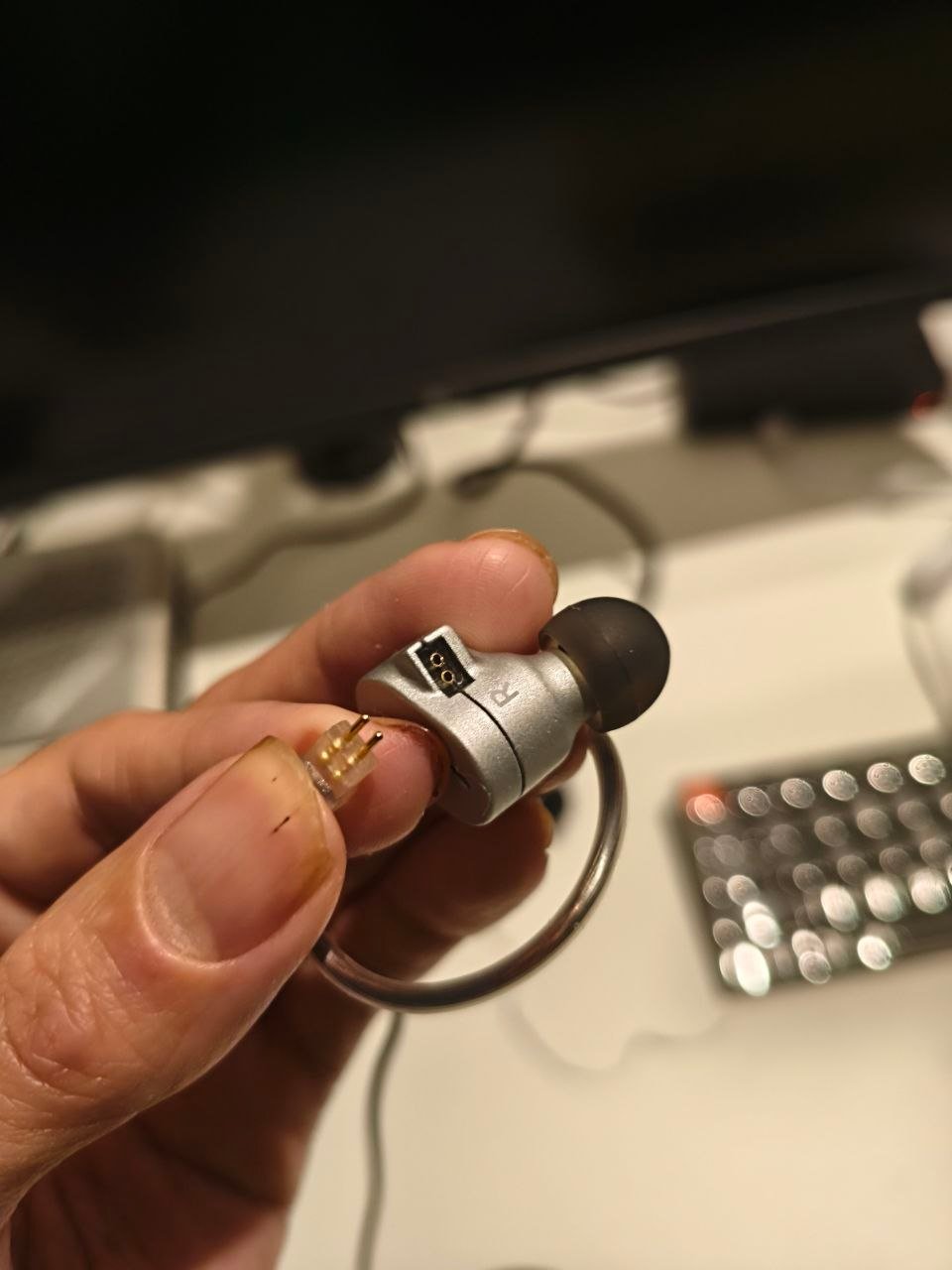
At S$28, the Moondrop Chu 3 wired earbuds are a value purchase worth your money.
YouTube’s algorithm recently put a review of these wired earbuds in front of me. I went looking for them on AliExpress, and I found them, so I decided to buy a pair just to give them a try. I have to say, I really like them a lot.
The earbuds come from a company called Moondrop, and I’d call them value IEMs. IEM stands for in-ear monitor, but to a lot of us it’s less of an audiophile thing and more of an everyday earbud.
I say “value” because they hit a sweet spot. They sound good, and there’s a lot to like about them and fewer things I don’t like.
They cost about Singapore $28. That’s not the cheapest you can get, but once you look at the whole package, which I’m going to talk about today, I think you’ll see why the price makes sense.
Why would you want a wired earbud in this time and age?
I think that’s a good question. At this point in my life, I felt that a wireless earbud with a good microphone was all I needed. It makes me a lot more productive, especially these days, because I can talk to my AI directly. It’s easier than typing so much, and wires can really get in the way. So why would anyone still want a wired one?
I can think of a few reasons. Sometimes people just want a backup, because some of them struggle to get their wireless earbuds to connect. My own microphone also needs an earphone connection, so a wired pair makes sense for me too.
Another reason might be that a lot of people buy wired earbuds because they want to stand out. And some people may be worried about Bluetooth radiation, so they stay away from wireless ones.
Where to buy the Moondrop Chu 3 as a Singapore-based person (about S$28)

You can get the MoonDrop Chu 3 through the link I’ve shared here. If you’re buying it on AliExpress, a normal credit card works fine, so you don’t need anything special to pay.
Purchases like this usually come with no shipping fee. There may be some tax on top, but that’s about it. The whole process is pretty straightforward.
What the Chu 3 Package comes with
Moondrop is a Chinese audio brand based in Chengdu, Sichuan. Its parent company, Chengdu Shuiyueyu Technology (水月雨), was founded around 2015, and the brand grew out of a small group of hobbyist engineers who started with earbuds. It moved into in-ear monitors (IEMs) in 2017, and the 2018 Blessing was the model that first brought it wide attention among enthusiasts.
What set Moondrop apart was its focus on measurement. It was one of the earlier “Chi-Fi” (Chinese hi-fi) makers to tune its IEMs toward the Harman target response, and it later developed its own target, VDSF (virtual diffuse sound field), a blend of Harman and diffuse-field neutral tuning. The company backs this up with an in-house lab and a dust-free production facility in Chengdu’s Wenjiang district.
Today, Moondrop is best known for affordable, well-tuned IEMs like the Chu, Aria and Starfield lines, along with its anime-inspired packaging. It has also expanded into DACs, headphones, wireless earbuds and even an audiophile-focused smartphone.

One of the distinct thing about MoonDrop is their distinct anime-style artwork in packaging. This is the packaging that came with my Chu3. The black velvet pouch is what they give you to carry the earbud with you.

The cable is reasonable in length and is Y style.

The madness is that at this price range, you can get a earbud that can have a detachable cable.
Chu 3 has a detachable 0.78 mm 2-pin cable and a 3.5 mm single-ended plug, so any standard 0.78 mm 2-pin IEM cable should fit. Changing the cable do nothing much to the sound but it can give you better length and less microphonics. Microphonics would be the cable noise.
On that note, I bought cheap earbud before and they do come with cables with a fair bit of cable noise.
The Chu 3 one is pretty not bad.
If the cable is detachable… it also means that if your cable spoil (which is usually the case as the earbud is okay), you can buy a cable to replace it (but it is also not too expensive to replace).
There are some budget choices according to my LLM: Generic 0.78 mm cables from Linsoul, HiFiGo, KZ, TRN or Tripowin.
These cables are about $5-$15.
Moondrop Chu 3 sound: warm, bassy and V-shaped

You might be curious what this curve profile tells you about the earbud.
Here is what the LLM interpret.
This curve points to a warm, bassy, V-leaning sound with a lively upper-mid and a soft top end. It’s fairly close to the Harman-style target drawn over it.
Reading the curve (roughly, from the chart):
- Bass (20-200 Hz): It starts around 94 dB at 20 Hz and slopes down. That’s about 8-10 dB above the midrange, so expect strong sub-bass and mid-bass impact and a rumbly, full low end. It’s a gentle shelf, not a sharp mid-bass hump, so it should feel full rather than boomy.
- Low-mids and mids (200-1 kHz): The curve bottoms out around 84 dB near 400-500 Hz. That relative dip keeps muddiness down and gives clean separation. The cost is that male vocals, guitars and piano bodies can sound a bit thinner and further back than the bass.
- Upper mids (2-4 kHz): There’s a peak of about 95 dB around 3 kHz. That’s the typical ear-gain bump, and it puts vocals, snares and guitar attack forward and gives clarity. If you’re sensitive, it may be a touch forward or shouty on loud, poorly mastered tracks.
- Treble (5-10 kHz): It’s smooth and gently declining, with a mild dip into the presence region. That generally keeps sibilance in check but means less sparkle.
- Above 10 kHz: It drops to about 75-80 dB with some ripples. Expect a darker, less airy top end. The wiggles here are mostly resonances and measurement artifacts, since the B&K 5128 gets unreliable in this region.
Overall: It’s a warm, bass-forward U/V-shaped signature that’s easy to listen to and non-fatiguing. It suits pop, EDM, hip-hop and rock, and vocals stay present because of the 3 kHz lift. It’s less ideal if you want an airy, neutral or analytical sound for classical or acoustic music.
Caveats:
- This is the manufacturer’s own graph, so unit variation, ear tips and fit will change what you actually hear, especially the bass.
- The overlaid target (the label looks like a PopAvg-style curve with 0.8 dB/oct tilt and +5 dB bass) is the tuning goal, not a measurement of another IEM. The two lines tracking closely is Moondrop saying it hit the target.
- At 16 Ω and 118 dB/Vrms, they’re very easy to drive, so a phone dongle is fine.
I collated some individual reviews.
Reception is mixed to positive. Most people agree on the sound, but they split on whether it’s a bargain or just fine.
Reviewers interpretation of the curve:
- Bass: One reviewer calls it boomy but not loose or muddy, with firm, full, weighty notes. Another says it’s plodding and woofy on kick drums, a bit muffled and congested.
- Mids: SoundGuys notes that the biggest departure from their target curve is a dip around 500 Hz, which can make lower-pitched voices sound slightly underemphasized. That’s the same recess you see on your box. Other listeners say the extra warmth makes vocals thick and pleasant, especially male vocals, though bass bleed hurts separation on busy tracks.
- Treble: Opinions differ here. Several describe it as subdued and relaxed. Others find it bright and fatiguing for treble-sensitive listeners. This probably comes from the 3 kHz peak against the roll-off above it.
Positive takes:
- Headphones.com’s headline calls it one of the best budget IEMs of 2026. Their reviewer also prefers it to the Truthear Gate, saying the Gate’s bass is weak by comparison.
- SoundGuys says it’s a solid starting point, especially for the price, and most people will enjoy how they sound.
- One aggregated review summary describes an engaging mild V-shaped tuning with solid bass punch, relaxed treble and good versatility, strong value at $25.
Critical takes:
- The IEMRanking aggregate gives it only about 5.7-5.8/10 from experts and 5.9 from the community, and it labels the average “Mixed”. Those scores are harsh partly because they rank it against other budget sets.
- Its main weaknesses are limited clarity and separation, plus a stock-tip fit that compromises the low-profile design.
- One review suggests that if you prioritize mid-bass slam and relaxed treble over everything else, the Chu 3 is best skipped or bought around $15. I couldn’t open the full text, so treat that as a secondhand snippet.
Versus the Chu 2: SoundGuys says that if you want vocals more front and center you’ll prefer the Chu III, while the Chu II is closer to a slightly bass-heavy sound. Another source suggests the Chu 3 makes sense for people who found the Chu 2 too bright and want a relaxed, warm sound without heavy sub-bass. That fits your curve, where the sub-bass is lifted but not extreme.
Should you get the MoonDrop Chu 3?
I don’t see a reason not to given that it is priced at an affordable S$28 and it sounds pretty good. Not so much if you want something wireless.
The Moondrop Chu3 reminds me of the Sony MDR-EX71 earbuds from my school days, somewhere around the 1990s to 2000s.
Back then we didn’t have a lot of choices, and the good ones sat in a certain price range. I was already aware that earbuds came in different grades. The Sony cost about Singapore $70, which was not small money for a student. I wasn’t sure if the sound quality was really nice, but its frequency range went down to about 18 Hz. That meant the bass could reach much lower than in normal earbuds.
When I first got it, I felt it was a real value purchase. The sound was nice and I didn’t have to break the bank for it.
What amazes me now is that Moondrop probably isn’t the only brand doing this. The whole earbud feels solid, and the sound is pretty tight by my standard, not muddled. Listening to YouTube Music on it is good enough for me. If you find the Chu 3 doesn’t have enough bass for you, you could try the Chu 2.
I’m going to buy the Chu 2 after this.
I think many of you are around my age, so these won’t break your bank. Buying the Chu 3 is about 0.0015% of my Daedalus income portfolio, so it won’t hurt anything. What you get for that price is something reliable. By reliable, I mean that you don’t sit there halfway through a song wishing it were better or wishing it didn’t have a certain problem. I know we always crave something better, whatever we buy. Still, I feel this one is a sweet spot and good value.
You can look at it from both sides. The Chu 2 is about $23 something dollars and the Chu 3 is about $28. Christmas is coming, so if you want to give a friend a gift that is reliable but a bit out of the ordinary, this is a good option. Your friends might prefer wireless earbuds. Still, I think a wired pair like this is pretty unique, and they would appreciate it. That’s why I like the Chu 3 as a sweet spot.
There are other things to like about it too. You can swap the cable if you aren’t happy with the one that comes with it. You could change to a $30 or $40 cable. Maybe it won’t make a real difference, but it answers a certain question.
This is where I am with the Chu 3.
I’ve been down these roads before, and I know that with cheap earbuds there’s always a flaw here and a flaw there. This time I really don’t see a lot of flaws. Even the cable noise isn’t like the cable noise I remember from before. The whole thing feels solid, and that’s where I stand on it.

Kyith is the Owner and Sole Writer behind Investment Moats. Readers tune in to Investment Moats to learn and build stronger, firmer wealth foundations, how to have a Passive investment strategy, know more about investing in REITs and the nuts and bolts of Active Investing.
Readers also follow Kyith to learn how to plan well for Financial Security and Financial Independence.
Kyith worked as an IT operations engineer from 2004 to 2019. Currently, he works as a Senior Solutions Specialist in Fee-only Wealth Advisory Firm Providend. All opinions on Investment Moats are his own and does not represent the views of Providend.
You can view Kyith’s current portfolio here, which uses his Free Google Stock Portfolio Tracker.
His investment broker of choice is Interactive Brokers, which allows him to invest in securities from different exchanges all over the world, at very low commission rates, without custodian fees, near spot currency rates.
You can read more about Kyith here.