
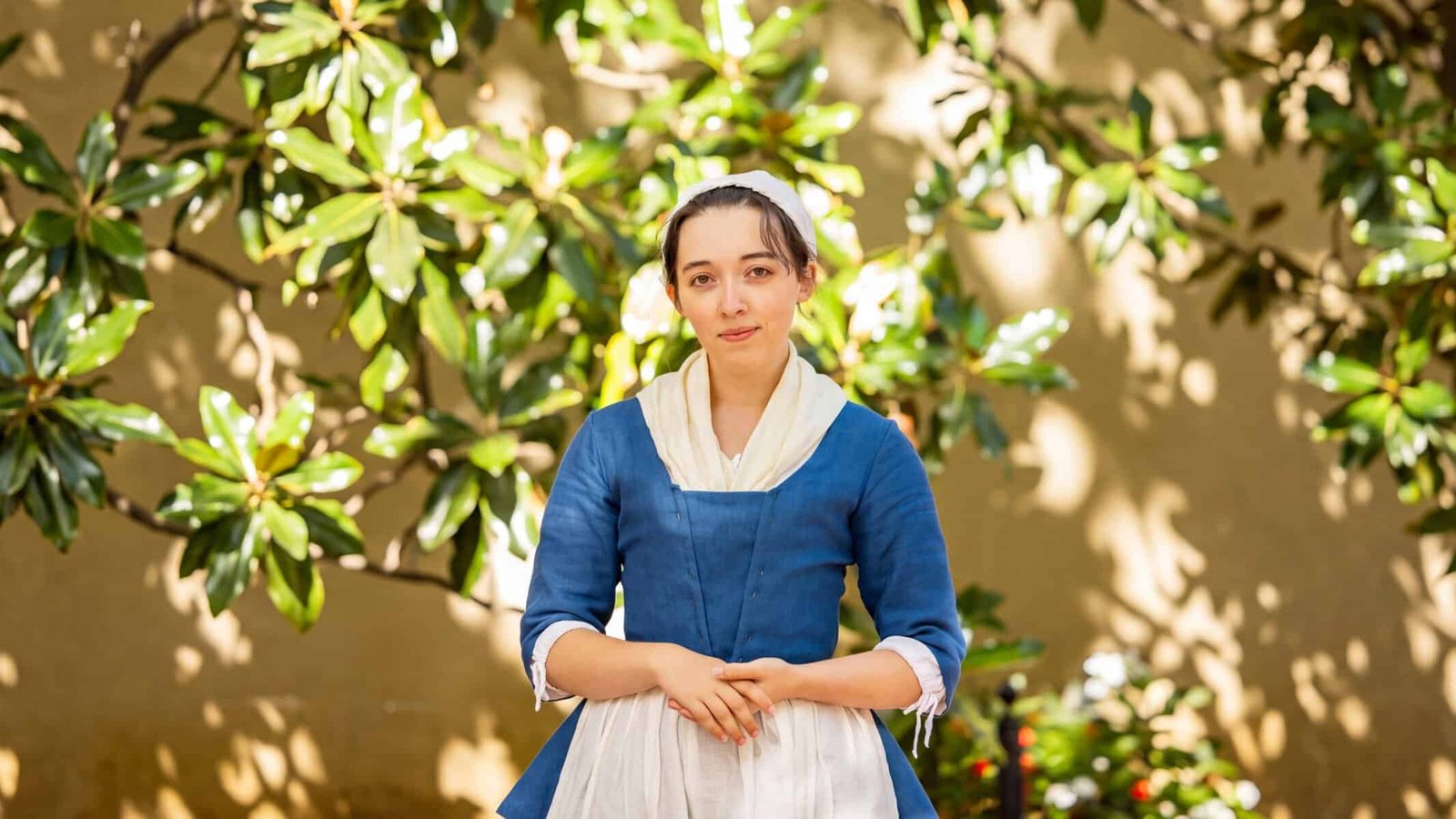
Like thousands of students across the country, my first introduction to the Betsy Ross House was on a 5th-grade school field trip. Standing in that modest Philadelphia courtyard with my grandma, surrounded by weathered brick walls and streets, I remember craning my neck to take in every detail, fascinated by the idea that an ordinary woman from the 1700s could leave such an enduring mark on American history. Back then, history often felt frozen behind textbook pages, but seeing a costumed interpreter felt like stepping directly through a portal into the past.
Now, working with Redfin, my journey has taken me back to 239 Arch Street. It’s a true full-circle moment: stepping into the Betsy Ross House once again, but this time going behind the scenes to discover how the 18th century is brought to life.
Preserving one of America’s most famous stories doesn’t happen by accident. It takes rigorous training, immersive period costuming, and authentic handcraftsmanship. We sat down with Madeline Burk, one of Historic Philadelphia’s Betsy Ross History Makers, to uncover what it’s really like to step into Betsy’s shoes, from passing a nerve-wracking sewing audition to understanding the mindset of an 18th-century icon.
Visit the Betsy Ross House with Redfin
Want to step inside living history for yourself? Head over to the Betsy Ross House on Redfin to learn more about the home and sign up for free admission on November 7, courtesy of Redfin.
To explore other iconic properties across the country, visit Redfin Presents Iconic Homes of America.
What was the audition and casting process like to step into the role of Betsy Ross?
I already worked for Historic Philadelphia as a storyteller, and they were looking to have someone else come into the role of Betsy. Oftentimes, they try to pull from people who are already in the company, and I was one of those people that they thought would be good for the role.
I did have to go through a little bit of an audition, just mostly to make sure that I’d be ready for it. I had to tell a historical story that I’d usually tell for the company. And I had to answer a few questions about: Do I play any instruments? What’s my experience with memorizing information?
And then the scariest part of my audition was I had to sew. I had to sew a straight running stitch on a piece of linen. I did not do very well, I confess.
What inspired you to take on this role?
Betsy is a normal woman who was living in the 1700s, but her story has spread so far and so wide that she can have a real impact. I love history and performances, and Betsy is a fascinating person. With as little information as we have about her, we know a lot about how she was as a person, the ways that she behaved, the things that she believed in, and how she was willing to fight for them. I think that’s really admirable.
How do you prepare mentally and physically each day to step into the 18th century?
It’s a lot of getting dressed. Getting into the corsetry certainly changes the way that I move, the way that I breathe a little bit, and the way that I talk sometimes. Putting my hair up all in the cap, I look at myself in the mirror and I feel like a different person.
There’s also something to the voice that shifts when I am Betsy. Everything is a bit more proper. I become a little bit more mindful of the way that I speak and the way that I hold myself, because it feels like the way to portray this kind of person to the world is to be thoughtful with the things that I say and the things that I do.
What is the most unexpected piece of history you’ve learned while portraying her?
Something that I didn’t really expect to learn so much about is 18th-century upholstery. We do so much work in the house and in the shop, sewing things and making things, both for our museum and for other museums.
I’ve become a much better stitcher in my time working here, and it’s a real skill that I can carry with me because there’s so much of it that obviously has changed and so much of it that hasn’t. There have been little pieces of furniture, clothing, and other things that I’m more able to repair with skill in my own home, so it’s wonderful to carry that with me now.
What do you and the other History Makers sew in the upholstery shop?
Two of my favorite things that we’ve made are sets for doll beds. We’ve made horsehair-stuffed mattresses for doll beds, and we’ve made curtains for doll beds using cotton chintz. You make the curtains and you make the valances that go around. And one of the things that I talk about with bed curtains is that they’re so specific to each person – and it’s true for the bed curtains we’ve made for the doll beds, too. They’re so different from one another and they employ different techniques, which is fun.
We’ve also made curtains for a camp bed for Fort Ticonderoga. We make flags as well, of course, which is always a fun time.
What is your pro tip for sewing a flag?
Use running stitches for the felled seams. If you do a traditional felled seam with a back stitch and then a whip stitch, it’s impossible to get out if you mess up. And by impossible, I mean more difficult than you want it to be. With those long stretches of fabric, you’re going to mess up at some point or another, and that’s okay. Be willing to go back and fix your mistakes.
How do you handle tricky or funny questions from modern visitors without breaking character?
We get a lot of training to be Betsy, so I have so much information in my head about her and about the time. It’s not often that I get questions that I have absolutely no idea how to answer. If it’s a funny question or if someone’s trying to make me break character, I simply think, “Well, how would Betsy respond to this?” And oftentimes, it’s with a bit of a tease, a bit of a scold, a bit of a laugh, and then we move on to the next thing.
If it is a question that I genuinely don’t know the answer to, that Betsy would’ve known, I’m pretty good at working my way around to giving an answer that I do know. And Betsy isn’t someone who would’ve known every single little thing about her time historically, so if someone asks me something about a ship captain’s job or a candle maker’s job, I can just say, “I haven’t a clue.” No one can be mad at that, because that wasn’t what she did.
What is your favorite story to share when welcoming people into Betsy Ross’ historic home?
I really love talking about Betsy’s first husband, John Ross. The two of them met when they were training to be upholsterers together. The way that I always tell it: They were young, she was very beautiful, he was very handsome, and it was the sort of situation where she would look up, notice him across the room, see that they were making eye contact, and then look away. Youthful things.
They became friends during their apprenticeship, but they knew that they wouldn’t be able to be together because she was a Quaker and he was an Anglican, and such things were forbidden. But eventually, they decided that they were going to get married. So they ran off, got married in a tavern in New Jersey, and came back to Philadelphia. Betsy was read out of meeting, and she became an Anglican for several years because of her marriage to John Ross.
I think it’s so telling about this woman who fiercely loved who she loved, and made her choices and stuck by them. She was stubborn, feisty, and rebellious. She believed what she believed, and she wasn’t willing to change herself without good reason.
Why do you think it’s important to preserve history in such a digital world, especially in the era of AI?
There’s so much we can learn from history about ourselves – obviously about our past, but also about our future. Patterns repeat themselves. Things come up and they change us, at least we think forever, and then we forget about them. And then similar things come up again and change the world again.
I think it’s really important that we remember the things that make us human: the art, literature, and connection that certain technological things can’t re-create for us. History emphasizes the importance of those very human things.
What is an unexpected or fun fact about Betsy Ross?
She was married three times, and she was buried three times. Clearly, she believed in the power of threes. She also never owned her own property; she was always a renter.
What do you think would be Betsy Ross’ dream home?
It would have to be someplace more luxurious than she could afford, because I think she would want someplace with a lot of upholstered goods – somewhere very soft, very comfortable. I think she would be happy with a modest place where she can make a home, be comfortable with the ones that she loves, and live her life simply. A place where she can work, a place where she can live. I don’t think she would’ve gone for anything too fancy, but a place to be herself with her family and with her work.