
There are some people I feel like I can’t help reach a good financial outcome, no matter which way things go, even with my skills.
Or perhaps I am just not that good at these financial stuff.
I got a message from someone who I have been messaging on and off for a while. He came across my Channel News Asia about my financial independence and have been sharing the financial dilemmas that he was dealing with.
He is 65 this year, and nearing another reemployment contract that will end in 11-months time. So he is seeking at advise about what should he do in his situation?
I wonder: What’s his situation?
From our past conversation, I found out that
- He has a child he needs to help pay for, 50% of a student loan. The loan comes to about $200,000, which is probably for a local medical degree. So he will need to help pay off around $100,000 once the child finishes tertiary education.
- He has already reached the Full Retirement Sum, and the spouse probably will too.
- We’ve also talked a lot about 1M65. He asked why I advocate 1M65 topping up CPF, and I told him that’s not the case. I’m only sharing information, and I’m sorry if it came across as pushing him one way.
- We also talked about whether he should top up the Enhanced Retirement Sum. That would give him $2,000 a month in income, and the spouse would get $2,000 a month too. What he’s really trying to work out is whether he should top up $77,000 for the spouse so they can reach the Enhanced Retirement Sum.
- On spending, he says his current household is about $2,100 a month.
- I do understand that he says he has a few dependents which would include one with special needs.
- His housing loan is left with $7,600.
Now that I’ve looked at this financial profile, my first thought is: Why do we need to push them to top up both accounts to the Enhanced Retirement Sum just to get $2,000 monthly? Say you top both up to $4,000 monthly, and their actual needs are only $2,100 monthly.
Having more income is good, of course.
But you’d be giving up access to your cash to get it, and they only need $2,100 a month anyway. Once the money goes in, it’s hard to get back out. The only real way to get it back is if they passed away, and then it goes to the next generation based on their wishes.
My thinking is that if they ever need a lump sum for an emergency, this becomes a real problem if this amount of money is all they have. Right now, the main thing we’re working with is that this person has very little cash.
Let me explain why I think he doesn’t have that many resources.
After about two and a half years of messaging, we still mostly talk about CPF. He doesn’t really share much else about himself.
When I ask a question, he answers just that question and nothing more. Other people usually share more without being asked. If I ask how their spending is, they tell me about their lifestyle. If I ask about their assets or resources, they tell me more, so I can get a sense of whether they have enough for what they need. With him, it’s not like that.
The links he shares also make me think he might be struggling. He sends a lot of articles about why the government doesn’t bring in universal basic income, and many HardwareZone posts that are quite anti-establishment. There are also pieces about people who got cheated as they got older, and about retirees who are still paying off their housing loans. I know I could be reading too much into it.
But without more information about his finances, it’s hard not to draw that conclusion. I
This time round, he said something that made me do a double-take.
If they top up their income to Enhanced Retirement Sum, they would have $2,000 monthly + $2,000 monthly + $1000 monthly coming from OA interest.
$1,000 monthly from OA interest?
If we work backwards of ($1,000 x 12)/0.025 = $480,000.
That’s a lot of CPF OA money!
Then I wonder, wouldn’t paying off the $7,600 outstanding loan, and $100k in student loan be not a problem? The spending is still $2,100 monthly with an income base of $4,000 monthly.
Turns out, he has like $800,000 in CPF OA.
“But my expenses are not just $2,100 monthly”
Now, I’m not sure about you, but when I hear that someone needs $2,100 a month and then finds out they have $800,000 in their CPF Ordinary Account, I think that’s a pretty good spot to be in.
On top of that, they should get about $3,500 a month from their CPF LIFE annuity once they turn 65 without having to top up the spouse’s CPF to the maximum of Enhanced Retirement Sum.
I think there should be a fair bit of margin of safety there.
He replies that $2,100 monthly is only the basic household expenses. But that does not include the ad-hoc expenses. He emphasized that he has a few dependents a few times.
And that while he gives $2,100 monthly to his spouse but his spouse says that is not enough, I have a feeling, that is not all the spending.
Does that include his own spending which he seem to be saying is separate from what he gives the spouse for the family?
I’ve noticed that the more I talk about this, the more it feels like I need to go into full financial planning mode on him just to dig out the information.
But I don’t really want to.
When a client comes in, whether it’s to Providend or Havend for financial planning, I think we should reach out before they arrive. We could send them a trigger list of their expenses so they can see what they usually spend money on.
During the discovery meeting, we can go through what they want and what they hope for. We can talk about the lifestyle they picture for themselves, both now and in retirement. I’d like to ask deeper questions, like why they spend on certain things. We should also let them think about which of these expenses might go away on their own. Children grow up and stop depending on their parents, for example.
The main thing is for both of us to bring out what they actually spend, so both sides can plan properly.
If most of these expenses come out clearly, the planning gets much simpler.
At its core, it’s about cash: how much money goes out, for how long, and how fast that amount grows with inflation. Then we compare that with the income they’ll have over the same period. Will the income be enough to cover it?
I tried my best to explain this idea to him.
I think we really need some clarity on the spending line items we’re talking about. It doesn’t help when he keeps saying that “I don’t understand their spending”, which implies he knows more than I do.
I know it’s not so simple, and maybe I’m missing something, but it’s hard when you keep going around that point without digging deeper or explaining why it’s not so simple.
You may have someone with special needs, and you have children, and your wife might not be working.
So what does that mean for the money?
Is there some recurring spending for the special needs? I understand it’s not simple, but how much is it?
Even if we know the number today, we also need to know what the expenses will look like when you’re perhaps not around anymore. Can the other kid take care of this one? Do you have that kind of clarity? Because it changes the whole plan.
If the other kid is studying medicine, and I would think they’ll become a doctor, there’s a good chance they’ll be pretty financially stable. So what’s the problem if that kid can take care of it, or at least help pay for it? Those things have to come into the picture.
If not, then what I keep doing is guessing. I’m guessing it’s 2,100 a month and that it covers everything the family spends, or maybe it’s just for the family and he has another spending on top of that.
How am I supposed to understand this well enough to help you plan if not everything is on the table?
I am just guess-planning here and that is not always going to be accurate.
How Much Income can Dual CPF LIFE and $615,400 in CPF Ordinary Income Give His Family?
Now we can do some financial planning math to help the reader understand the situation better.
If he wants a peace of mind in retirement then he should:
- Consider paying off that 50% kid medical tuition fee loan.
- Clearing the $7,600 outstanding mortgage loan
- Topping up the spouse CPF RA to Enhanced Retirement Sum to get $2,000 monthly. This would cost $77,000
What he can achieve is some peace of mind. I know a lot of people would want to optimize this kind of thing. But he has to think about whether he wants to optimize at all, especially given the way his mind works. It seems his mind is always clouded by worries. If your mind is full of worries, optimizing more could give you even more worries, because you’d keep wondering whether you’re optimizing the right way.
So all of us have to choose. Do we want some clarity and peace of mind? Or do we want a very well optimized plan? A plan like that has a lot of moving parts. I might be wrong about this, but for him, I think the best plan is one with as few moving parts as possible.
If we deduct all this, his CPF OA would be left with $615,400 that he can freely take out, else earning 2.5% p.a.
We can forward plan his $2,100 basic monthly expenses, without his so-call adhoc spending to grow like this:

The $25,200 yearly basic spending at 3% p.a. inflation will grow to $68,800 yearly basic spending at year 100.
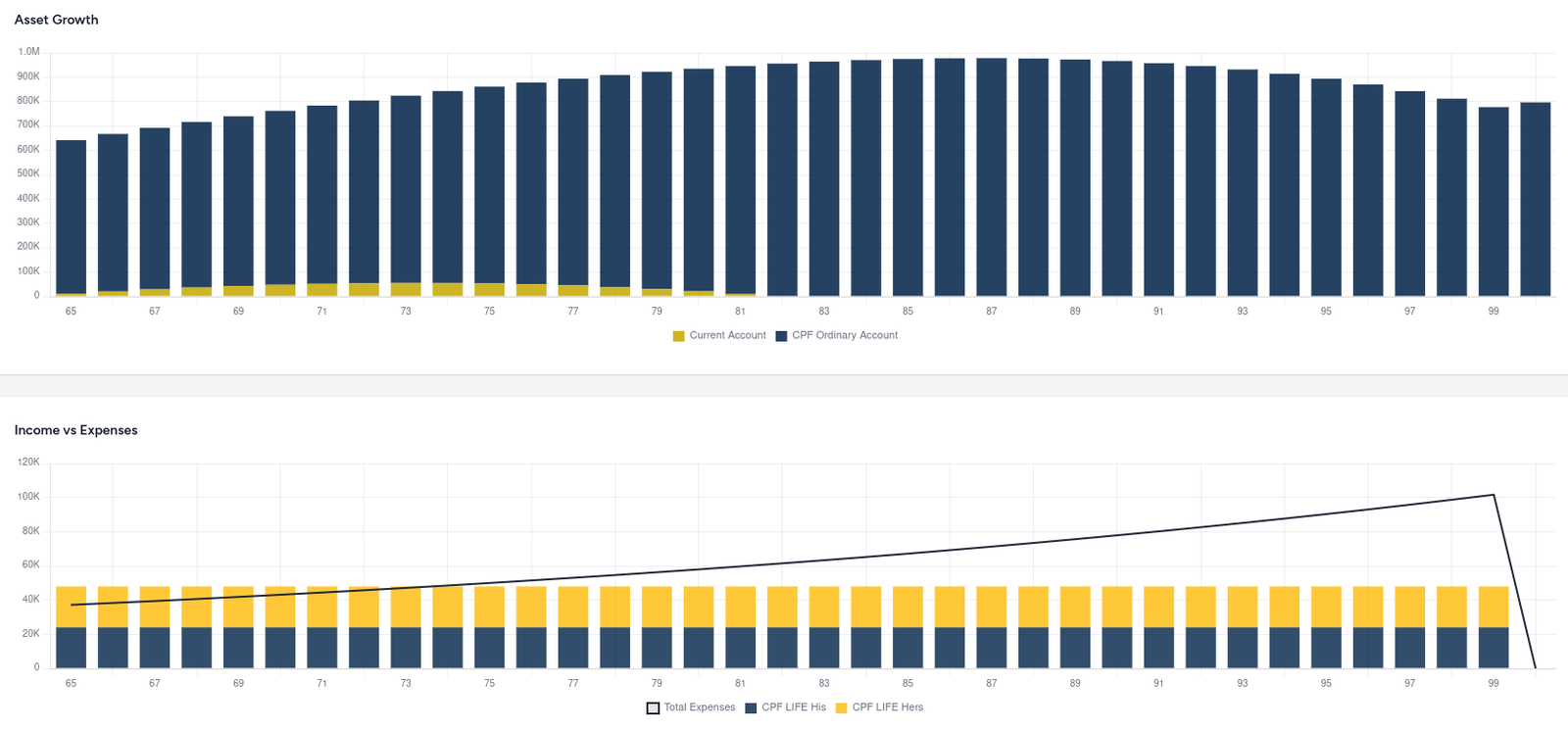
The chart below shows his and her CPF LIFE Annuity income against the growing expenses of the previous chart:

The income stream is 48,000 yearly but it does not grow over time. We can observe that at age 87, that is probably where these expense, which grew with inflation would outgrow these dual CPF LIFE Income stream.
What to do then?
He still have
- The untapped CPF OA.
- The income that is not spent in the earlier years.
The chart below show his CPF OA [Yellow] as well as Savings account which we call ‘Current Account’ [Dark blue] from age 65 till 100:

The starting balance at 65:
- CPF OA: $630.785 [Grew by 2.5% for 1 year from $615,400]
- Current Account (don’t confuse with CPF OA, this is like your wallet): $24,396 [The income not spent]
You may ask: Kyith why don’t put the money back into CPF OA to earn 2.5%? He could but I am not going to do it in this simulation. I am not sure someone can keep making so much voluntary housing refund for so long so I assume that those money in Current Account earn 0% p.a.
At age 80:
- CPF OA: $913,565
- Current Account: $524,009
- Total: $1.44 million
At age 90:
- CPF OA: $1,169,440
- Current Account: $1,056,245
- Total: $2.23 million
At age 100:
- CPF OA: $1,496,982
- Current Account: $1,925,558
- Total: $3.42 million
This amount is after that inflation-adjusted spending.
If he follows this plan until he’s 100, he’ll end up with about $3.42 million. To be honest, the cash part isn’t really optimized, so I’d say this is a fairly conservative plan.
I think you guys can see the lens I’m using when people tell me they spend $2,100 a month and have $800,000 in their CPF Ordinary Account. There’s a reason I think this is a simpler problem than my reader thought it was.
So How Much More Does His Spouse Need? How Would the Eventual Picture look like?
Throughout the messages, he keeps saying the situation is not so simple. His spouse gets 2,100 a month, but keeps asking for more, even though these are not really needs. I think we also have to consider that he probably hasn’t factored in some ad hoc spending either.
Looking at the whole picture, I think you can see some signs of flawed cash flow planning concepts that many have.
If you ask me, most people know that some spending only happens once a year. When something needs replacing or a touch up, there should be a maintenance fund set aside for it.
Some people only look at what leaves their wallet each month, so they can’t anticipate the other costs, or they just don’t think of them. I might be wrong, but I’ve spent a lot on aircon repairs in the past, and they came up every quarter. I pay my insurance premiums too, and some of them are annual. Then there are one-time costs, like a vacation.
These are not monthly costs.
So people need to look at things differently, and work out the income they really need compared to what they spend.
Why I say it is simple is because it simply boils down to:
- How much more spending line items do we need to consider? How much in today’s dollars does that add up?
- The additional spending will reduce the assets. So would the family run out of money?
Suppose let’s say the spending needs is $1,000 monthly more.

We can just add $12,000 a year, which grows at inflation.
His assets would be lower but how does it look like, after factoring these higher spending?

Instead of $3.4 million at 100 years old, he would have $933k left at 100.
It is definitely less money but if your spending is more, then either your investment rates go up, have a favorable sequence of return, or that your assets will go down.
How much more Additional Spending so that there is no Bequest at the End?
We can vary the $1,000 monthly additional 3% p.a. inflation adjusted spending upward so that we can see the point where the OA would completely run out.
It is probably about $1,700 monthly in additional spending more. So adding the $2,100 monthly, that will be $3,800 monthly.
The assets will look like this:

The assets will deplete to $45,000 a year.
Let me just say… I considered other scenarios.
What if the Current Account returns 1% p.a. instead of 0%?

This does not help much because at the start $3,800 spending is almost equal to the $4,000 monthly income. And since the cash and OA rate grows slower than inflation, the CPF OA will go down.
The Current Account (or Savings) won’t have any money to grow at 1%!
What if he doesn’t pay off the $100,000 in student loan but ask the kid to do it?
That does help the situation but not by much:

In that scenario of $3,800 monthly inflation adjusted spending, he would end up with $287,000 at 100 years old instead of $45,000 only.
But how much more can he bumped up his spending?
By $210 monthly.
In that scenario the ending bequest at 100 years old would be about the similar $45,000.
That would make total $4,010 instead of $3,800.
I think this could really help him see the long and short of some of these decisions, like whether to pay off their $100,000 or whether putting everything into CPF OA is worth it. Does it actually help or not?
I personally think $210 a month is quite a lot of money. It can cover some big ticket items. To me, it already feels like a monthly TCM expense.
“But if I spend from the OA then the OA will diminished.”
I’ll be honest, when someone says something like this after I’ve walked through an income solution with them, it’s the point where I really feel like giving up.
I’ve already spent a lot of time explaining the concepts, so it’s hard not to feel that way.
If you want more income, you have to expect that your assets won’t grow as much at the end, unless you already have a lot of assets. You already told me you don’t think you have many, so I’m worried that no matter what I do, the assets will have to go down.
That’s especially true when things keep feeling more complicated than we expected. You mentioned that your spending is actually higher and that your spouse needs more. But you couldn’t tell me exactly what that extra is.
What is that more?
I also get the feeling that I’m not sure whether he knows which of these things are really his own, or whether they actually sit with his spouse. His spouse knows better. He doesn’t. If that’s the case, I’m afraid I can’t help him much. The only way he can help himself is to figure out what these line items actually are. Are all of these line items really necessary? Do they drop off over time?
Again and again, I kept hearing about “more dependents,” and I don’t really understand his situation.
If so, let’s put it in perspective. One dependent who is starting a medical degree will probably stop being a dependent. That will free up some money. I’m not saying I don’t understand the special needs situation. At Providend, two of our client advisors have children with special needs. So I have about seven years of experience seeing the kind of care and concerns they need. I understand how challenging that is.
But it really comes down to how much you actually need for special needs person.
- Do you need a lifetime income stream for the special needs person? If you do, I don’t think that question was ever asked surfaced along the way. That’s something I keep in mind whenever someone says they have a special needs dependent.
- I also think about how to plan for the long run. Can the special needs person still stay in this place?
- Who will be the guardian for this special needs person when, let’s say, the current parents are no longer around?
There is a lot of concern there, and a lot to think about. I’m not brushing those things off.
I’ll be honest, it’s really tiring when all the information isn’t out in the open. There’s not much openness on this, and this is as much as I can do for now.
It’s also tiring to keep guessing and planning, guessing and planning, and then coming up with a solution over and over. I’m sorry if I come across more blunt than I mean to.
I’m not some kind of guru, like he says. This is just technical planning. I think someone with good integrity and solid technical skills could do what I can do, and maybe even do it better. Still, I do think I did a pretty good job here. But maybe this isn’t really helpful for him, and I’m sorry if that’s the case.
I don’t think it’s really about clarity or transparency for me. Maybe there’s some hesitation about telling me everything, and I can understand that.
But can he answer the challenge questions I’ve been asking him? Is he really sure which line items of spending he actually need? And for how long?
They matter a lot to his plan or his worries.
The numbers I showed you cover the long and short of it. How much would it cost? How would your CPF OA or your savings change from age 65 to 100 if you keep to this kind of spending? Those numbers are easier to settle.
I just can’t understand probably without some transparency. And if he isn’t ready to share that, that’s okay.
I just hope he can work out his own side of it, so it can match up with the numbers I’ve put out here.

Kyith is the Owner and Sole Writer behind Investment Moats. Readers tune in to Investment Moats to learn and build stronger, firmer wealth foundations, how to have a Passive investment strategy, know more about investing in REITs and the nuts and bolts of Active Investing.
Readers also follow Kyith to learn how to plan well for Financial Security and Financial Independence.
Kyith worked as an IT operations engineer from 2004 to 2019. Currently, he works as a Senior Solutions Specialist in Fee-only Wealth Advisory Firm Providend. All opinions on Investment Moats are his own and does not represent the views of Providend.
You can view Kyith’s current portfolio here, which uses his Free Google Stock Portfolio Tracker.
His investment broker of choice is Interactive Brokers, which allows him to invest in securities from different exchanges all over the world, at very low commission rates, without custodian fees, near spot currency rates.
You can read more about Kyith here.