
Amazon Web Services (AWS) is preparing to test whether its European Sovereign Cloud can operate independently of foreign infrastructure – challenging if Europe can maintain greater control over its digital infrastructure.
This also marks a clear effort on AWS’ behalf to protect the brand against the rising demand in Europe to move past foreign-based tech and promote home-grown alternatives.
The exercise, scheduled for 24 October 2026, comes as Europe continue to attract investment to develop alternative cloud platforms, computing infrastructure and AI technologies aimed at reducing dependence on non-European providers.
The demonstration will take place at the AWS European Sovereign Cloud in Brandenburg, Germany, where the company plans to disconnect its infrastructure from the AWS Global Network backbone for several hours.
The operation will be carried out entirely by EU-based personnel using hardware and software resources located within the European Sovereign Cloud.
This test represents an attempt to provide technical evidence of operational autonomy at a time when European cloud sovereignty is receiving increasing attention from regulators, public institutions and investors.
Cutting the cord
The AWS European Sovereign Cloud operates from data centres physically and logically separated from the company’s other cloud regions. According to AWS, customer content and customer-created metadata remain within the EU, while a local copy of its source code allows the European operation to function with reduced reliance on external systems.
Under normal circumstances, the infrastructure uses two global systems: the AWS Global Network backbone, which transfers operational data between AWS locations, and a dedicated mechanism for managing limited transfers of operational information and software updates.
During the exercise, AWS will disconnect from the global backbone and disable the operational data transfer mechanism. Connectivity will instead be maintained through European internet service providers, enabling the cloud to remain connected to the worldwide internet without relying on AWS’s private global network.
The company intends to generate evidence aligned with the European Commission’s EU Cloud Sovereignty Framework and Germany’s Federal Office for Information Security’s C3A criteria. These frameworks address requirements for assessing the independence and autonomy of cloud services.
However, the demonstration will test a specific dimension of sovereignty: whether a major cloud provider can maintain operations within Europe without depending on infrastructure elsewhere. It will not, on its own, settle wider questions concerning corporate ownership, legal jurisdiction or customers’ dependence on individual technology providers.
Those are precisely some of the questions European startups are approaching from different parts of the cloud infrastructure ecosystem.
Europe’s home-grown stack
Across Europe, new companies are developing technologies that give businesses greater control over the infrastructure supporting their applications, data and AI workloads.
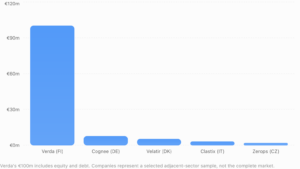
In September 2026, EU-Startups reported that Naples-based Clastix raised €2.9 million in Seed funding, for its Kubernetes infrastructure software that enables organisations to manage applications across their own computing environments. Its technology aims to reduce the operational complexity of cloud infrastructure while allowing customers to retain control over hardware and data.
Rather than operating its own sovereign cloud region, Clastix addresses the management layer, providing tools that can help organisations operate infrastructure without becoming dependent on a single hyperscaler.
A different approach comes from Cannes-based PoliCloud, who secured €7.5 million in 2025 to develop decentralised computing and storage infrastructure for cities, public institutions and enterprises. Its modular infrastructure can be deployed locally, offering an alternative to relying exclusively on large, centralised data centres operated by global cloud providers.
At the computing capacity level, Helsinki-based Verda, raised €100 million in April 2026 for its high-performance AI cloud infrastructure that gives developers and businesses access to computing resources at scale.
Its expansion reflects a broader European effort to develop computing capacity for increasingly demanding AI applications, although its international ambitions extend beyond Europe.
Meanwhile, Denmark’s Velatir, secured €5 million in August 2026 to develop an AI infrastructure and governance platform that helps businesses control how AI tools and agents interact with their systems.
The company says it has deliberately built its platform using European-owned and hosted infrastructure rather than relying on American hyperscalers.
Other startups are tackling adjacent challenges.
- Prague-based Zerops raised €1.7 million in May 2026 for a cloud platform that brings development and production environments together, giving developers greater visibility and control over application deployment.
- In Germany, Berlin-based Cognee secured €7.5 million in February 2026 for its structured memory infrastructure for AI systems, representing another layer of the wider European AI technology ecosystem rather than a direct sovereign-cloud alternative.
Together, the five 2026 financings give us a snapshot of €117.1 million in financing for companies looking to operate at different layers of the European cloud infrastructure ecosystem.
Sovereignty meets procurement
Beyond venture capital, European institutions are beginning to translate cloud sovereignty objectives into procurement decisions.
In September 2026, EU-Startups reported that Paris-based Cycloid would provide the developer-facing portal for the European Commission’s six-year, €180 million sovereign-cloud procurement framework.
Founded in 2015 by Benjamin Brial, a former Red Hat cloud executive, Cycloid develops an internal developer platform that enables organisations to access and manage cloud infrastructure, automation and development tools through a unified interface.
The European Commission’s framework, announced on 17 April 2026, provides access to cloud services through four European provider groups, including Post Telecom and its partners, STACKIT, Scaleway, and Proximus and its partners.
Cycloid’s technology is intended to give up to 5,000 European Commission developers a common interface for accessing these different providers, enabling institutions to manage workloads across multiple environments without depending on a single cloud platform.
Benjamin Brial, founder and CEO of Cycloid, said: “A sovereign cloud framework is only as sovereign as the choices it leaves open,”
Independence has layers
The sector context helps highlight that European cloud sovereignty is not a single technical challenge. It involves several interconnected questions about where computing infrastructure is located, who operates it, how data is managed, and whether customers can move applications between providers.
For European businesses and public institutions, the challenge is therefore not simply whether their data remains within EU borders. It is also whether they can maintain control over the systems that store, process and manage that data, and how easily they can change providers when requirements evolve.
AWS’s upcoming test may be enough to prove that its European Sovereign Cloud can operate without relying on non-EU infrastructure. However, it can also be read as an attempt soothe a growing distaste for reliance on foreign tech and protect the AWS brand.