
NVIDIA has had a busy week on this side of the pond.
From announcing new investments in British and French startups to launching collaborations in Sweden, supporting AI research and bringing developers together in Barcelona, Paris and London, the US chipmaker appears determined to play a bigger role in the continent’s technological future.
The activity comes ahead of NVIDIA GTC Berlin, taking place from 20 to 22 October 2026, where founder and CEO Jensen Huang will deliver a keynote.
But beyond the conference preparations, the announcements reveal a wider strategy involving startup funding, computing infrastructure, research partnerships and the development of AI applications across European industries.
NVIDIA’s 2026 European investment trail
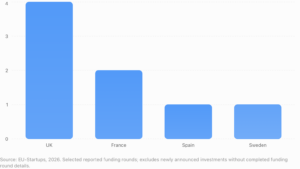
This week builds on an investment footprint already documented by EU-Startups throughout 2026. The company has participated in funding rounds involving French AI developers Mistral AI (€3 billion) and AMI (€890 million), alongside British companies Nscale (€1.7 billion), Wayve (€1 billion), Ineffable Intelligence (€937 million) and Orbital Industries (€43 million).
In Spain, Valencia-based iPronics secured €107.6 million with NVIDIA backing, while its venture arm, NVentures, joined a €42 million extension for Sweden’s Legora.
Together, these eight announcements represent approximately €7.72 billion in company financing, although NVIDIA’s individual contributions have not been disclosed. Earlier investments in British startup PhysicsX and France’s Scintil Photonics further illustrate its established involvement in European AI development.
Fresh bets on British and French startups
Continuing this investment commitment in Europe, NVIDIA unveiled planned investments in five startups: Boltz, Foresight, Hiverge, Prima Mente and Riverlane. Although the individual investment amounts have not been disclosed, the selection of companies provides an indication of where NVIDIA sees opportunities for technological development.
These companies join NVIDIA’s existing investment activity in the UK, where it has previously supported startups including Synthesia, Wayve, Basecamp Research and Ineffable Intelligence.
The announcement also highlighted the role of NVIDIA’s Inception programme, which now includes more than 3,100 UK companies. The programme provides eligible startups with access to technical resources, expertise and opportunities to connect with NVIDIA’s wider network.
Across the English Channel, NVIDIA announced planned minority investments in four French startups: Doctolib, Entalpic, Genesis AI and Pigment. As previously reported by EU-Startups.
On 13 October, Huang attended an AI ecosystem reception in Paris alongside founders, researchers and policymakers, including France’s Minister of the Economy, Roland Lescure. Later that evening, he met President Emmanuel Macron at the Élysée Palace to discuss AI infrastructure, investments in French technology companies, open-source development and AI safety.
Speaking at the Paris reception, Jensen Huang, founder and CEO of NVIDIA, said, “Europe is one of the great regions of industrial manufacturing,” adding, “This is the beginning of the AI journey for the EU.”
This week also saw the launch of the Startup Ireland AI Accelerator Programme, which aims to support 1,000 new startups by 2030. NVIDIA is among the technology partners associated with the initiative, further extending its involvement in Europe’s entrepreneurship networks.
Sweden’s AI ambitions take shape
Beyond France and the UK, the Nordics have emerged as another focus of NVIDIA’s European activities. The company highlighted how startups and technology companies across the region are building products using its computing platforms and open models. With several companies demonstrating applications ranging from intellectual property management to autonomous transportation.
Stockholm-based Stilta is using NVIDIA’s Nemotron models to analyse patent portfolios, helping businesses monitor intellectual property across large numbers of patents. Agaton is applying similar technology to real-time sales intelligence, while Swedish speech technology company Klang has developed Pianissimo, a transcription model trained on more than 50,000 hours of Swedish speech.
Meanwhile, Gothenburg-based Embedl, a member of NVIDIA Inception, has collaborated with Space Cargo Unlimited to develop an onboard AI prototype that monitors protein crystallisation experiments in space without requiring continuous connectivity to Earth.
Perhaps one of the most interesting Nordic announcements for founders was NVIDIA’s collaboration with the Norrsken Foundation to establish the Stockholm AI Lab.
Scheduled to open in 2027, the new hub will bring together AI-focused entrepreneurs working on challenges in healthcare, climate, food and society. Located in central Stockholm, it will also house NVIDIA’s local office, bringing the company physically closer to entrepreneurs developing AI technologies.
Another important development comes from Sweden AI Factory, one of Europe’s 19 EuroHPC-funded AI factories, which announced a collaboration with NVIDIA to open its infrastructure and expertise to startups and SMEs.
The expansion of AI infrastructure across the Nordics is also gathering pace. NVIDIA reports that regional cloud providers are working towards approximately one gigawatt of AI cloud capacity by the end of 2027, with companies including Nscale, Verda and Volta among those participating in the expansion.
“Physical AI is the next big opportunity,” said Deepu Talla, vice president of robotics and edge computing at NVIDIA. “Around 70% of GDP is in the physical world, and that makes physical AI one of the largest opportunities ahead of us. Europe can combine AI with its human capital, engineering expertise and industrial capabilities to create more value.”
Europe’s AI opportunity comes with a catch
Taken together, this week’s announcements suggest that NVIDIA’s strategy in Europe extends well beyond financial investments.
By supporting startups, offering access to computing resources, collaborating with research institutions and establishing closer relationships with developer communities, NVIDIA is positioning itself across multiple stages of the European AI development process.
At the same time, NVIDIA’s expansion raises questions about Europe’s technological independence. While access to funding, computing infrastructure and technical expertise could help European startups compete internationally, greater adoption of NVIDIA’s technology could also increase their dependence on a single US supplier.
The bigger question is whether Europe’s startups can use this momentum to build lasting, globally competitive companies of their own. If they succeed, NVIDIA could benefit from supplying the infrastructure behind their growth, while European founders have an opportunity to capture more of the value created by the next generation of AI technologies.