
I reached a small milestone this month.
I bought my Tokio Marine Asia LifeSecure policy in November 2006, when I was 26. Around my birthday this year, the last premium went out. After 20 years and 240 monthly payments, the policy is now fully paid up.
I thought this was a good time to stop and look back honestly at it. There’s good reason for that.
For years, I’ve carried a quiet feeling that I made a mistake with this policy. I wanted to know if that feeling was real, or if I was just being hard on my younger self.
The best way to clarify if I made a mistake is to take a look at the numbers. Which is not new to me. I know how to read a policy projection. It just never felt like the best use of my evenings. There was always something more urgent than sitting with a spreadsheet to check a policy that I had to pay even if I made a mistake.
With some help from AI, what used to take an evening now takes a much shorter period.
This article is my notes to myself.
We got a bit to get into and if you are unsure what we will get into, here is the breakdown:
- I got my money back, and not a dollar more. After 20 years, my surrender value is almost exactly what I paid in.
- The costs come first and the growth comes later. The policy looks terrible in the early years, and only starts to earn a reasonable return once the costs are behind it.
- A fixed $50,000 doesn’t survive inflation. By 75, it buys about a third of what it bought in 2006, and only about a quarter if inflation runs at 3%.
- Investing the difference would have done better, but only if I stayed invested. A conservative portfolio roughly matched the policy. Anything with more equities beat it, with some frightening falls along the way.
- It was a mistake, but a small one. And it’s one that I don’t think I could have seen at 26.
If you own a policy like this, or you’re thinking about buying one, I hope my 20 years save you some of yours.
I Knew Term Was Cheaper, but I Wanted Cover That Would Last
I want to be clear about one thing first. I wasn’t that uneducated about whole life policies back then.
I understood that term insurance is the better deal compared to whole life. It’s much cheaper, and you can invest the difference yourself. Term is much more optimised if you wish to cover adequately was less prevalent advice but those who read personal finance books would be able to pick those up.
So why did I buy a limited whole life policy anyway?
I was thinking about securing a potential pot of money for medical crisis the whole of my life, not just the next few years.
Term insurance has an end date. Most of the critical illness plans I could buy stop at 65 or 70. If you want to keep them going past the age of 65-70, the premiums climb steeply, and you end up paying a large chunk of the payout yourself through the premiums.
But 65 and beyond is exactly when serious illness becomes more likely.
The textbook answer is that by then:
- You should have done your financial planning properly.
- You should have saved enough so that if you fall seriously ill, whatever your hospital insurance doesn’t cover, you can pay from your own savings.
That’s true, and it’s what I’m trying to do today.
Not everyone feels comfortable paying a big medical bill out of their own pocket, especially after they’ve stopped working.
I didn’t want my own savings to be the only plan if there is a way to optimise this.
I didn’t buy this policy for the return. I wasn’t chasing a high number.
What I wanted was a sum of money that would still be there, and still be worth something, when I needed it. If I fell seriously ill at 75 or 85, I wanted to be able to count on about $50,000. I hoped the policy’s value would grow enough to keep up with the years.
I chose to pay for 20 years because I would be young and working. I’d get the paying done early, and then the policy would just sit there for me.
I think don’t ask me why I think that $50,000 is enough for medical crisis without covering income replacement after financial independence.
At 26, I just felt that $50,000 feels like a lot of money.
Some people will say that isn’t much for a serious illness, and they’d be right. Having $200,000 of cover would be wonderful.
But I’ve seen up close what it’s like. Both my parents went through cancer. What I learned is this. Having $50,000 versus having nothing makes a real difference. It’s one less thing to worry about at the very worst time.
That was the thinking. $50,000 of cover, paid over 20 years, meant to be there for me when I’m old.
Limited Whole Life Means Paying for 20 Years, Then Being Covered for Life
The policy is Asia LifeSecure, from Asia Life, which is now part of Tokio Marine. It’s what’s called a limited whole life policy.
The name sounds complicated, but the idea is simple. You pay premiums for a limited time, which was 20 years for me. After that, you stop paying, you still own the policy, and it covers you for the rest of your life.
It also builds up a cash value. This is money inside the policy that belongs to you. You can take it out by cashing in the policy (the “surrender value”), or borrow against it.
How the cover changes over time
In the early years, almost everything the policy would pay out is pure insurance. Think of it like a term plan with a little bonus added on top.
Later on, that changes. The bonuses keep adding up and the cash value keeps growing. By age 65, more than half of what the policy would pay on death is my own accumulated money, not the insurer’s.
| Policy year | Cash value | Death benefit | Share that is my own money |
|---|---|---|---|
| Year 20 (age 46) | $22,990 | $69,266 | 33% |
| Year 39 (age 65) | $52,411 | $91,485 | 57% |
Projected figures from the my own 2006 policy benefit illustration.
We can see it in my own policy that as we get closer to 65 then 85 years old, much of the death benefit will come from the cash value accumulated over time.
After 20 Years of Premiums, the Surrender Value Is Almost Exactly What I Paid In
Here is what I paid:
- The basic plan: $78.85 a month.
- The Dread Disease Accelerator Rider: $16.90 a month. This pays $50,000 if I’m diagnosed with one of the covered serious illnesses.
- Total: $95.75 a month, or about $1,149 a year.
- Over 20 years: $22,980.
And here is what I would get if I cashed it in today.

The surrender value is $23,005.41. Of that, $16,610.69 is guaranteed, and $6,394.72 comes from bonuses.
That’s $25 more than I paid in. Over 20 years.
I sat with that number for a while.
Twenty years of faithful monthly payments, through job changes, through 2008, through Covid. And if I walked away today, I’d get my money back and not a dollar more.
To be fair to the policy, I wasn’t paying only for savings. Part of my premium bought 20 years of protection. If I had died, my family would have received $50,000 plus bonuses. If I had been diagnosed with a serious illness, the rider would have paid $50,000. I’m grateful I never needed either.
But that’s also the point.
The protection came at a cost, and now I can see exactly how much it cost.
One more thing surprised me. The 2006 illustration projected a cash value of $22,990 at year 20, and bonuses of $19,266 added to the policy. My actual figures today are $23,005 and $19,266.61. After 20 years, the projection was off by about $15.
If I gotten a Term Plan instead, I would have gotten the Same Cover but would have Cost Almost 4 Times Less
Around the same time when I bought the LifeSecure, I also asked for a quotation for a term plan. I wanted the same $50,000 if I died, and the same $50,000 if I was diagnosed with a serious illness.
The term plan would have cost $24.95 a month. My limited whole life policy cost $95.75 a month.
That’s almost 4 times as much.
| Term plan (the quote) | Limited whole life (what I bought) | |
|---|---|---|
| Monthly premium | $24.95 | $95.75 |
| How long I would pay | 44 years, to age 70 | 20 years |
| Paid in the first 20 years | $5,988 | $22,980 |
| Pays on death | $50,000 | $50,000 plus bonuses |
| Pays on serious illness | $50,000 | $50,000 plus bonuses |
| Covers me until | Age 70 | For life |
| Cash value | None | $23,005 today |
Had I opted for the term plan, I will have to pay till age 70, which means I will still be paying another 24 years after today.
Today, my limited whole life policy would pay $69,267 if I died. The term plan would pay $50,000. That’s about $19,000 less.
I asked myself honestly whether my family would have felt that gap. I don’t think they would have noticed much given the magnitude.
Meanwhile, the money I would have saved, about $17,000 over 20 years, would have been mine to invest.
In a Limited Whole Life Policy Projection, the Costs Come First and the Growth Comes Later
Let me start with the number most people want: what return did I actually get?
If I take every premium I paid, month by month, and compare it with what I’d get if I cashed in today, the return is 0.01% a year.
I also calculated that if I leave out the rider, which is pure protection with no cash value, and count only the basic plan, it’s 1.9% a year.
We’re not supposed to judge insurance by its return. It’s protection, not an investment. But I don’t think we can run away from the number either. If you want enough cover for later in life, you need the money you put in to work as hard as it can. The return matters.
We calculate returns with money-weighted returns with the net cash flows using XIRR.
XIRR finds the one steady yearly rate that would turn all your payments, made at different times, into the amount you have today.
Imagine you put $95.75 into a savings account on the first of every month for 20 years. XIRR asks: what interest rate would that account need to pay so that today, it holds $23,005?
For me, the answer to that interest rate is almost zero.
You can do this yourself in Excel or Google Sheets. List each payment as a negative number with its date, put the surrender value as a positive number at today’s date, and use the XIRR function.
One thing we need to take note is that the return doesn’t move in a straight line
The return on a policy like this starts deeply negative, and then climbs very slowly.
Here’s what the projection table shows for the basic plan:
- Year 3: about -25% a year. Most of what I had paid went to costs.
- Year 10: about -1.6% a year.
- Around year 13: the cash value finally catches up with the premiums paid.
- Year 20: about +2.2% a year.
- Age 65: about +3.6% a year. The illustration itself says 3.58%, so the maths checks out.
You can take a look at how the return transitions as I age by reading the last column in the illustration table below:

So the policy looks terrible early, and better the longer you hold it. If you surrender in the early years, you lock in the worst of it. That’s something I wish more people knew before they buy, and before they cancel.
How to read the columns
Most people never read the projection table that comes with their policy. It’s a dense page of small numbers that nobody explains. Here’s what the main columns mean:
- Guaranteed. The insurer must pay this, no matter what happens to markets.
- Non-guaranteed. This comes from bonuses. The insurer projects it, but doesn’t promise it.
- Total cash value. The two added together. This is what you’d get if you cashed in.
- Death benefit. The sum assured plus the bonuses added so far.
I want folks to take note that the table above was a benefits illustration that was generated in 2006. Those bonus may not be what I eventually earn. It is actually a projection.
By year 20, the bonuses added to my policy came to $69,266. If I cashed in, I’d only get $22,990 of it. That’s about a third.
The bonus shows up in full when I die, but only partly when I cash in. By year 40, I’d get about 59% of it. The longer you wait, the more of the bonus becomes yours.
There are some value spikes at years 5, 10 and 15
If you look at how much bonus is added each year, there’s a pattern. For the first few years, it grows steadily by about $505, $510, $515. Then in year 5 it jumps to $1,158. In year 6 it falls back to $657, but now from a higher base.
The same thing happens at year 10, with a jump of $1,991, and at year 15, with $2,874. After that, it’s smooth.
This looks like a bonus step up. Some insurers add a larger bonus on certain policy anniversaries, or move your policy to a higher bonus rate once it has been in force long enough. Either way, you see a jump on that anniversary and a higher base afterwards.
It’s easy to miss unless you line the numbers up year by year.
I was curious what does this Limited Whole Life policy earn once I stop paying.
Once the premiums stop, the calculation is simpler because no money goes in, so I can use a plain growth rate between two values.
From year 20 to year 40, the cash value is projected to grow from $22,990 to $54,447.
If we calculate based on annualised return, that’s about 4.4% a year.
So I have two numbers for the same policy:
- 0.01% a year on everything I paid over 20 years, including the expensive early years and the cost of the rider.
- About 4.4% a year from here on, now that the costs are mostly behind me.
Both are true.
- The first tells me what the whole 20 years earned.
- The second tells me what waiting longer earns me. That growth slows gradually, from about 4.9% a year just after the premiums stop to about 3.9% a year by age 65.
Which brings up a question I’d never thought to ask before.
What did a 5.25% Assumed Return Mean in 2006?
The illustration assumes the insurer’s fund earns 5.25% a year, before costs. It states clearly that this isn’t guaranteed. After all the costs, what I see coming through to my policy is closer to 4% a year in the later years.
So I got curious. What was the starting point back then?
My policy is a participating policy. The insurer pools the premiums from many policyholders into one fund and invests it. When the fund does well, policyholders share in the profits through bonuses.
I don’t know exactly what Asia Life’s fund holds. My understanding is that funds like this lean heavily on fixed income, maybe 70% or so, partly because the insurer has to back the guarantees it makes.
If that’s roughly right, then what bonds were paying in 2006 matters a lot.

In 2006, Singapore government bonds yielded about 3% across almost every maturity, from 3 months to 15 years. The 10-year bond averaged 3.05%, and the 15-year 3.16%.
So 5.25% was about two percentage points above what government bonds paid. That extra return had to come from somewhere, such as shares, property or corporate bonds.
If 70% of the fund earned around 3% to 4%, the other 30% would need to earn roughly 8% to 10% a year to get the whole fund to 5.25%.
That’s not impossible. It is also likely that the assumed fixed income return is smoothed over the previous few years and so it will be higher (if you look at where the rates are at in 2006 and how it looks like a few years before)
I’m not drawing a conclusion here. I just found it useful to see where the starting line was.
An Opportunity Cost Analysis: A Conservative Portfolio Mix Would Have Roughly Matched the Policy. More Equities in Portfolio Would Have Beaten the Limited Whole Life Policy
Now back to the thought I asked you to hold.
What if I had bought the cheaper term plan in 2006 and invested the difference myself?
We got to decide what kind of portfolios I would have invested in. I would assume its a mixture of different allocation of fixed income and equities.
To keep it fair, I used simple model portfolios over exactly the same 20 years, November 2006 to October 2026:
- Equities: the MSCI All Country World IMI Index. This covers developed and emerging markets, in Singapore dollars, with dividends reinvested after withholding tax.
- Fixed income: the Bloomberg Global Aggregate Bond Index, hedged to Singapore dollars.
- We do 6 asset allocation mixes: from 100% fixed income to 100% equities, in steps of 20%.
- Costs: I took 0.5% a year off every portfolio, for fund fees and other costs.
- Rebalancing: back to the target mix every month.
This is a reasonable stand-in for a participating fund, with one difference. A participating fund likely holds more Singapore fixed income, and I don’t know how much of its equities are in emerging markets. So treat this as a comparison, not a copy.
How much money will go into this investment portfolio?
The policy cost me $95.75 a month. In the comparison, the same $95.75 goes out every month. $24.95 buys the term plan, and the remaining $70.80 is invested.
At age 46, when the policy is fully paid, I stop adding money to the portfolio too. From then on, each portfolio grows on its own at the same yearly return it earned over the past 20 years.
Table 1: the simple picture
First, let’s look at the portfolios as if they only need to grow the money I put in.

Each cell shows the value and the XIRR on all $95.75 a month paid. The policy’s value at 75 is my estimate, assuming its growth continues at about 4% a year after age 66.
In short:
- The policy: $23,005 at 46, $52,411 at 65, about $77,500 at 75.
- 60/40 mix: $27,688 at 46, $58,278 at 65, $86,221 at 75.
- 100% equities: $46,835 at 46, $152,098 at 65, $282,724 at 75.
If we invest in a portfolio with higher fixed income, the DIY portfolio value would not match the policy value based on projection. The portfolio mix that equals the policy is a 60% fixed income 40% equity.
That is pretty similar to the potential allocation mix of the participating funds that usually drive the returns of these cash value insurance policies.
But at 20 years mark, every mix from 80/20 upwards is already level with or ahead of the policy.
By 65 and 75, the gap in the value accumulated by DIY widens.
But in a way, I left something out.
After 20 years, my limited whole life policy won’t need me to pay more premiums. The term plan doesn’t stop. It keeps charging $24.95 a month until I’m 70, another 24 years.
That money has to come from somewhere.
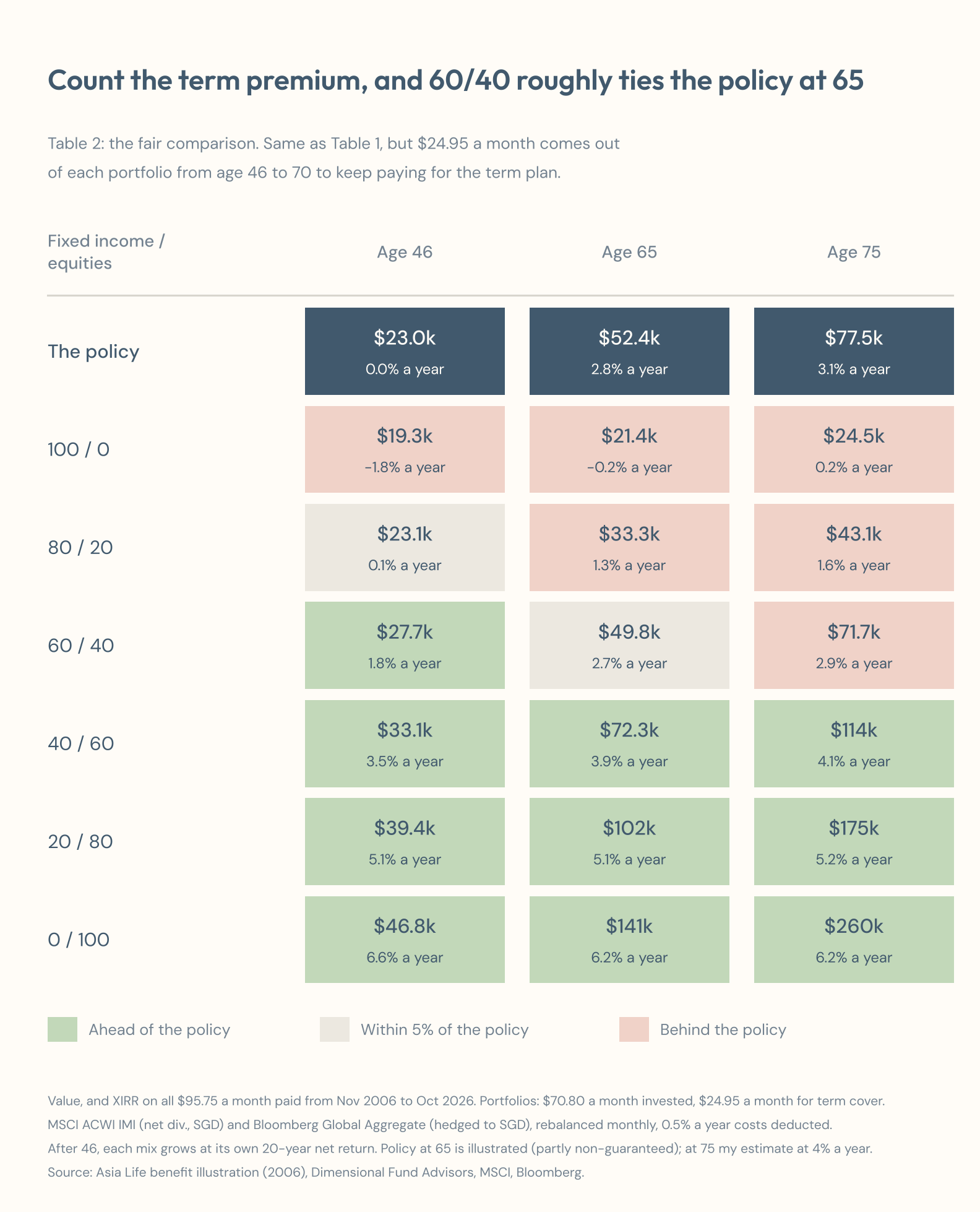
To make the comparison fair, I take the $24.95 out of the investment pot every month until age 70.
Table 2: the fair comparison

Same as Table 1, but $24.95 a month is taken out of each portfolio from age 46 to 70.
If we factor in the premiums that I have to continue to pay the picture shifts:
| Mix (fixed income / equities) | At 65 | XIRR | At 75 | XIRR |
|---|---|---|---|---|
| The policy | $52,411 | 2.8% | about $77,500 | 3.1% |
| 100 / 0 | $21,443 | -0.2% | $24,548 | 0.2% |
| 80 / 20 | $33,294 | 1.3% | $43,122 | 1.6% |
| 60 / 40 | $49,819 | 2.7% | $71,692 | 2.9% |
| 40 / 60 | $72,331 | 3.9% | $114,158 | 4.1% |
| 20 / 80 | $102,289 | 5.1% | $175,209 | 5.2% |
| 0 / 100 | $141,216 | 6.2% | $260,097 | 6.2% |
What I take from it
- A conservative 60/40 allocation mix lands almost exactly where the policy does. 2.7% against 2.8% at 65. It’s a tie, give or take.
- The safest mixes lose. A portfolio that’s all fixed income earns close to nothing once the term premiums are paid.
- Mixes with 40% or more in equities win, and win clearly. At 75, a 40/60 portfolio is worth about $114,000 against the policy’s $77,500.
Here’s something that surprised me. Once the costs are behind it, the policy grows at about 4% a year. That’s almost exactly what the 60/40 portfolio earned over the past 20 years. In the later years, the policy behaves a lot like a conservative balanced portfolio.
Its problem is the first 20 years.
So mathematically, investing the difference wins.
But I’ve learned to be suspicious of a result that looks this clean.
Investing the Difference Only Works If You Stay Invested Through the Bad Years
Some of you might say I picked a bad starting point. Had I use a better starting point then the returns of the DIY portfolio would not have been so poor.
Well, I cannot choose the time period I lived through (and neither could you).
I just happen to lived through a negative sequence (living through the 2008 crisis) follow by a positive sequence of return.
I somehow feel that with my mindset back then, even if a 100% equity allocation DIY mix do better, I might not have earned it had we review it today.
I would not have the right temperament to keep dollar cost average that $70.80.
A drawdown is how far your portfolio falls from its last high point.
Imagine you have been investing faithfully for two years, and your portfolio has grown to $3,000. Then the crisis hits. Within months, it’s worth $1,500. You have done nothing wrong. You kept paying in every month. But half of it is gone, and you have no idea when, or if, it will come back.
That’s what the 100% equity portfolio went through.

| Portfolio Allocation (fixed income / equities) | Worst fall | Time to get back to the old high |
|---|---|---|
| 100 / 0 | -13.7% | Not yet recovered (fell in 2021 to 2022) |
| 80 / 20 | -14.2% | 42 months |
| 60 / 40 | -22.9% | 40 months |
| 40 / 60 | -34.0% | 65 months |
| 20 / 80 | -43.7% | 72 months |
| 0 / 100 | -52.1% | 79 months |
At the bottom in February 2009, the all equity investor had 59 cents for every dollar they had put in. It took until May 2014, almost seven years from the previous high, to fully recover.
And the “safe” choice wasn’t safe from pain either. The all fixed income portfolio peaked in December 2020, fell 14% by late 2022, and still hasn’t got back to that high today.
What if I had started in 2011, after the crash?

Starting in 2011 skips the crash entirely. The equity heavy portfolios look much better. 100% equities would have earned 9.8% a year instead of 6.9%. But the all fixed income portfolio actually looks worse, 2.2% a year instead of 2.6%.
I would go back to an important point.
You touch your heart and ask yourself if it is easier to execute DIY over 2008 to 2013 without missing a single dollar cost average tranche or to just commit to a limited whole life insurance.
My limited whole policy’s cash value never showed me a crash. The bonuses inside a participating fund are smoothed over the years, so I never saw a 50% fall, and I never had a reason to panic.
I couldn’t see the drawdown, so I couldn’t run from it.
Many young people will look at the maths and think, “I’ll just put everything in equities and do much better.” That’s true on paper. But the return you actually get depends on what you do in the worst months, not the best ones.
A Fixed $50,000 Loses More Than Half Its Purchasing Power by Age 75
Now let me come back to the reason I bought this policy in the first place.
I wanted about $50,000 for a serious illness when I’m old, like 70, 75 or 85. For critical illness, the part of this policy that matters is the Dread Disease Accelerator Rider. It pays at least $50,000.
I was assuming it pays only that $50,000, and not the bonuses on top. If there is more, than it is a bonus.
The problem is inflation. I wonder if that $50,000 can retain its purchasing power.
I am hoping the returns over 40-50 years can do the heavy lifting to ensure that $50,000 at 26 retains its value at 86 years old.
Inflation means things cost more every year, so the same dollar buys less. If prices rise 2% a year, something that costs $100 today costs about $102 next year. It sounds tiny. Over 49 years, from 2006 to the year I turn 75, it adds up to something huge.
| If I’m diagnosed at | The rider pays | Worth in 2006 dollars, 2% inflation | Worth in 2006 dollars, 3% inflation |
|---|---|---|---|
| 46 (today) | $50,000 | about $28,000 | about $20,000 |
| 65 | $50,000 | about $23,000 | about $16,000 |
| 75 | $50,000 | about $19,000 | about $11,700 |
By 75, my $50,000 buys about 38% of what it bought in 2006. If inflation averages 3%, it’s about 23%.
To have the same buying power as $50,000 in 2006:
- I’d need about $132,000 at 75 if inflation averages 2%,
- and about $213,000 if it averages 3%.
- And medical costs have often risen faster than general prices, so this may be understating the problem.
Can the policy, if it pays out the cash values on top of the $50,000 benefit meet these amount?

Unfortunately, they fall short if we assume that the rate of return is similar to the rate of growth after fully paying up the limited whole life (4% p.a.)
It will reach a nominal value of $105,000 instead of $132,000 or $213,000.
But doesn’t the policy beat inflation in the later years?
It does. Growing at about 4% a year beats 2% or 3% inflation. The problem is the first 20 years, when my money barely grew at all, and the rider, which doesn’t grow at all.
So my original idea was a bit naive. Not because whole life is evil, but because I sized it for the wrong number. I bought what $50,000 meant at 26, not what it would need to be at 75.
If I really need a coverage of $50,000 in 2006, I could have solved the problem by buying a significantly larger limited whole life.
By my calculation, I would need roughly 2.6 to 4.3 times the cover. That’s about $130,000 to $210,000 of rider cover, instead of $50,000.
That’s a sobering number.
And that will mean more out of pocket costs.
It Was a Small Mistake, and One That Is Hard to See at 26
When I owned this policy, I often felt I had made the wrong call. I hadn’t run the numbers. I just sensed that a fixed sum, inside a fund that is mostly fixed income, couldn’t hold its real value for 50 years. Fixed income gives you certainty. It doesn’t protect you well from inflation.
Now the numbers agree. I’ll chalk this one down as a mistake.
I take solace it does not hurt that much thankfully.
I got my money back in dollars. In buying power, I got back about 80% of what I put in. If I had invested the difference sensibly, I would be maybe $5,000 to $10,000 better off today. That’s a lower return, not a disaster.
In another universe where I didn’t buy this, I’d probably have bought $100,000 of term cover instead. At 65, that term plan would pay $100,000, more than this policy’s $91,485 death benefit, for about half the monthly premium. If something had happened to me in those years, my family would have been better off.
What surprised me was not the numbers. It was the feeling.
The amount was never large. It went out of my pay every month, and most months I didn’t notice it. But every time I thought about it, a quiet voice said, “You’re still paying for that decision.”
That’s the strange thing about a long commitment. A bad purchase is over once you’ve bought it. A policy you regret keeps showing up, month after month, year after year.
I think this is why so many people stay stuck with insurance products they regret. The amount isn’t big enough to make you act, and it’s too steady to forget. If you’re in that position, I understand how heavy that small, quiet feeling can get.
I’m curious how I’ll feel now that I no longer have to pay. I suspect it will feel lighter than I expect.
What I would do differently
Looking at it objectively, if the goal is to have money for a medical crisis after you’re financially independent, I think you’ll do better building your own medical sinking fund over time than relying on a limited whole life policy. If you know how to invest, and you can stay invested, you can do better than an insurance company’s fund.
That’s my approach today. My term policies cover critical illness until 65 or 70. After that, I’ll lean on a medical sinking fund I’m building for exactly this. I wrote about how I plan it [here: link to the medical sinking fund article]. That’s a topic for another day.
Insurance still has a job. A sinking fund can cover a $50,000 bill at 75, but not at 35, when it’s still small. That’s what insurance is for.
But I was 26.
I could only take this policy apart at 46. At 26, I don’t think I would have seen all of this, and I’m not sure I’d have listened if someone had told me.
A medical sinking fund sounds sensible. But in your twenties, there are always a hundred other priorities: a home, a wedding, a career, maybe children. The money for a fund that you won’t touch for 40 years quietly gets spent on something else. Nobody notices until it matters.
A policy at least forces the habit. I paid every month for 20 years without thinking. That counts for something, even if the return was poor.
So my advice isn’t “never buy limited whole life”. It’s this:
- Know what you are buying. Some go through the whole process, commit a sum that hurts them enough, into something they later regretted. Try not to be like that.
- The Math tells us that if you felt that you can hold an allocation mix more than 60% fixed income 40% equity, the cash value you accumulated would likely be more worth it if you don’t commit to a limited whole life. Provided you can really hold it over long periods (I highly doubt for many of you given how trigger happy you are to change your course of action over the years)
- I doubt a whole life plan’s investment return can help retain real purchasing power of the sum assured over time. You may have to buffer that by covering more.
- Start your own medical sinking fund early, even if it’s small. Time is the one thing you can’t buy back later.
The last lesson is… be forgiving to your younger self. As a younger person you should try your very best to understand these stuff but life will teach you that there are lessons that you can only comprehend as you see life unfolds.
You can check out my other personal notes in Managing Kyith.

Kyith is the Owner and Sole Writer behind Investment Moats. Readers tune in to Investment Moats to learn and build stronger, firmer wealth foundations, how to have a Passive investment strategy, know more about investing in REITs and the nuts and bolts of Active Investing.
Readers also follow Kyith to learn how to plan well for Financial Security and Financial Independence.
Kyith worked as an IT operations engineer from 2004 to 2019. Currently, he works as a Senior Solutions Specialist in Fee-only Wealth Advisory Firm Providend. All opinions on Investment Moats are his own and does not represent the views of Providend.
You can view Kyith’s current portfolio here, which uses his Free Google Stock Portfolio Tracker.
His investment broker of choice is Interactive Brokers, which allows him to invest in securities from different exchanges all over the world, at very low commission rates, without custodian fees, near spot currency rates.
You can read more about Kyith here.