
I got to apologize firstly for the lack of post recently.
The mind has been tied up with too much thread of things at work that I don’t have time to write about anything. I do know the 2-year, 10-year and 20-year yields have been going up.
The tough thing is determining the cause of it. Is inflation too hot or future growth is too bright? It’s also how long this rise would last.
In any case I think many have all but given up on fixed income and REITs. I have seen pretty extended fixed income data and REIT return data to kind of know that there will be periods like this when they don’t perform very well.
When I see people saying “I won’t buy.”, “I decide to sell this {non performing REIT} for {this performing thing}”, “I would rather be in cash than fixed income.”, it is more of the sentiments that folks have this singular view that
- There are only good investments that do well in all economic conditions.
- There are investments that are flawed, that is not #1
You and I have this human flaw that what we are experiencing today hurts more than anything.
Most importantly, we felt that after this, this won’t change after lasting for “this long”
All of these are false. If we all look at history, we can see that there were inflation, then the discussion went away, to recession, then the discussion went away, then to some geopolitical issue, then the discussion went away.
Do you see the pattern?
The pattern is you trying to process each of these things, thinking they will last for don’t-know-how-long and what-magnitude.
I think objectively I have seen data model that says the SOFR can move to 5-5.5%. The SOFR is currently 3.6%.
Think a lot of finance lending is going to die.
It may hurt a lot.
It is not like my own portfolio is not going to hurt. It will.
Its just that I resigned that my portfolio can fall 20-30% from time to time. You may not have processed that.
I remember in 2023, when I was reallocating the bulk of Daedalus into 30% small caps, it feels like the most stupid thing to do because EVERYONE was saying recession is going to come next. Small caps is going to get killed there.
Now in 2026, we are still waiting for that recession.
I’m not saying that I am smart.
At some point, we have to resign our allocation to luck. I have this irritating colleague Chin Yu who would tell me his market timing luck when he move money from one account/custodian to another by selling high and buying low.
I don’t really have that bandwidth to think about these things. I just do what we do for our clients most of the time.
Anyway here is the 30-year yield chart of the US Treasury Inflation Protected Securities (TIPS):

HOOOOOOLLLLY Shit. It’s 2.96%.
In case you don’t realize why TIPS at 2.96% is a big deal… A regular Treasury bond pays a fixed coupon on a fixed principal, so inflation quietly eats into your real return. A TIPS instead keeps the principal adjusted for inflation (CPI-U), while the coupon rate stays fixed. So your coupon payments and your final principal repayment both grow with inflation.
Say you buy a 10-year TIPS with:
- Face value: $1,000
- Coupon rate: 1.0% (fixed for life, set at auction)
Year 1, no inflation adjustment yet:
- Principal: $1,000
- Coupon payment (annual equivalent): 1.0% × $1,000 = $10
Now suppose inflation runs at 3% over the next year. The Treasury adjusts the principal upward by the change in CPI:
- Adjusted principal: $1,000 × 1.03 = $1,030
- Next coupon payment: 1.0% × $1,030 = $10.30
Notice the coupon rate never changed — it’s still 1.0% — but because it’s applied to a bigger principal, the dollar amount you receive goes up.
If inflation continues at 3% for several years, the principal keeps compounding upward, and so do your coupon checks. At maturity, you get back the inflation-adjusted principal, not just the original $1,000.
Now if it is deflation (which means inflation is negative), there’s a floor: at maturity, you’re guaranteed to receive at least the original face value ($1,000).
Suffice to say, does this look like the ultimate retirement planning tool for US people (I confirm Singaporean is going to ask me about the currency stuff)?
Yea it is real good.
If you have U$1M and your expenses is $29k a year, you basically has an income indexed to inflation!
I worked in Providend for 7 years and in my time, I seen the yield of TIPS be at 1%, negative 0.5% and now almost 3%.
It kind of tells you about all these shifts in rate, valuation and earnings and if you are planning, plan with a frame of mind of less permanence.
If real interest rate is closer to 3%, then why would we need equities?
That is a good question.
Which one is more attractive: S&P 500 at 30 times PE or 3.3% earnings yield or TIPS at 3%?
You tell me.
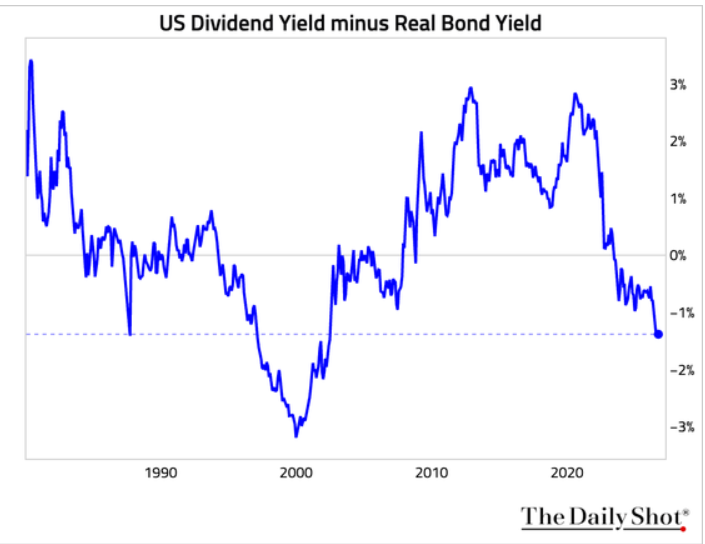
This morning, I saw a chart of Real Dividend Yield vs Real Interest Yield:

Real dividend yield (means adjusted for inflation) is lower than real bond yield. If you see the historical context it is kind of getting close to that 1990-2005 time period.
There are two other charts but I will talk about them tomorrow if I can.
We are in an environment where investors are choosing to take lower dividends compare to interest rates.
There are very negative interpretation and also a benign interpretation:
The chart’s spread was also near its historical lows, right before the dot-com bust.
When realized growth failed to keep pace with what was implied, the spread had to close, mostly likely through falling stock prices and rising dividend yields, not falling bond yields.
If real dividend growth decelerates back toward its long-run average (rolling 20Y is closer to 4%, not 5%+), the current low equity risk premium versus bonds would look expensive in hindsight.
The more benign interpretation:
Real bond yields today are unusually high by design and this is a restrictive-policy environment, not a 2000-style equity mania. Some of the negative spread in the chart reflects bonds being genuinely more competitive right now, rather than stocks being irrationally priced. If real rates fall from here (Fed cutting cycle), that alone could close the gap without dividend growth needing to disappoint.
I kind of think the benign situation is not happening.
Still, if you have Singapore TIPS at 2% (usually lower than US rates), would you find it attractive? Most would say probably not because the banks still give me 3% or 4% and they got growth. Well… we will see about that.

Kyith is the Owner and Sole Writer behind Investment Moats. Readers tune in to Investment Moats to learn and build stronger, firmer wealth foundations, how to have a Passive investment strategy, know more about investing in REITs and the nuts and bolts of Active Investing.
Readers also follow Kyith to learn how to plan well for Financial Security and Financial Independence.
Kyith worked as an IT operations engineer from 2004 to 2019. Currently, he works as a Senior Solutions Specialist in Fee-only Wealth Advisory Firm Providend. All opinions on Investment Moats are his own and does not represent the views of Providend.
You can view Kyith’s current portfolio here, which uses his Free Google Stock Portfolio Tracker.
His investment broker of choice is Interactive Brokers, which allows him to invest in securities from different exchanges all over the world, at very low commission rates, without custodian fees, near spot currency rates.
You can read more about Kyith here.