


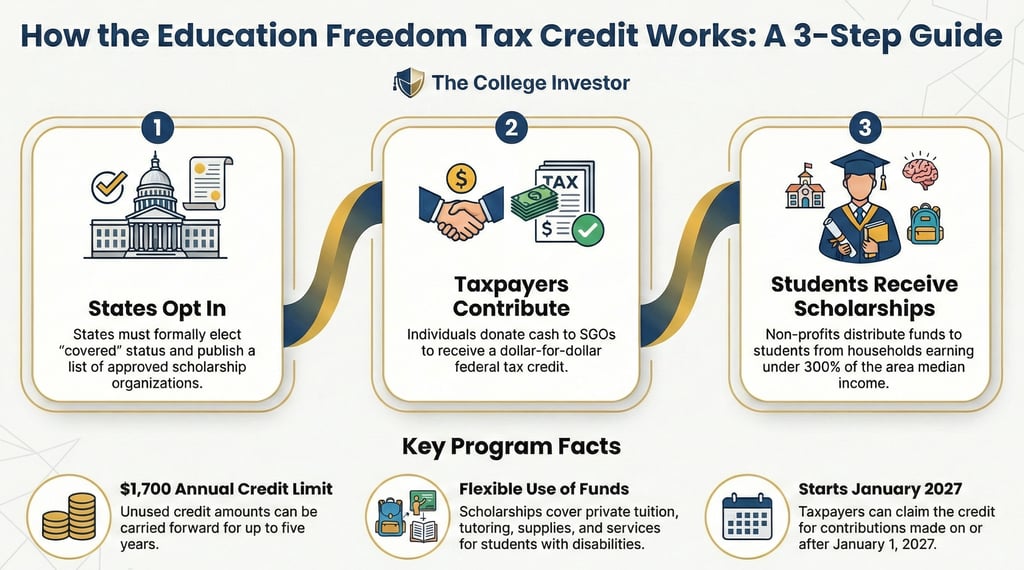
The Treasury Department and the IRS on October 1, 2026, issued proposed and temporary regulations for the Education Freedom Tax Credit, a new tax credit created under Section 25F of the tax code by last year’s One Big Beautiful Bill Act. The rules confirm what the Education Freedom Tax Credit will look like when it launches on January 1, 2027: individual taxpayers can claim a dollar-for-dollar, nonrefundable credit of up to $1,700 for cash donations to approved Scholarship Granting Organizations (SGOs), and married couples filing jointly can claim up to $3,400.
Treasury Secretary Scott Bessent called it “America’s first nationwide school choice program” in the IRS announcement, and said 30 states have already opted in.
Treasury and the IRS project that by 2030 the program could support 600 to 700 SGOs, draw nearly $26 billion in contributions from more than 11 million taxpayers each year, and fund as many as 2.2 million scholarships annually. That is a step up from the roughly $24 billion in potential annual funding we estimated when the credit was first enacted.
Why It Matters
The credit has been law since July 2025, but some of the mechanics were missing. States didn’t know exactly how to certify scholarship organizations, SGOs didn’t know how to report donations, and donors had no way to confirm a gift would count.
As we reported in August, Treasury and the IRS were still drafting those certification rules with less than five months to go. This update fixes that, and taxpayers, states, and SGOs can rely on the proposed rules for contributions made starting January 1, 2027.
The stakes for families are large. Our earlier analysis found that nearly 92% of U.S. school-age kids fall under the 300% of area median gross income threshold. Treasury’s new estimate is higher: under the proposed rules and safe harbors, roughly 96% of children in participating states would be eligible for scholarship funds. Scholarships can cover private school tuition, tutoring, special-needs services, books, supplies, computers, and other qualified expenses.
What The Regulations Settle
The proposed regulations and the companion temporary rules address most of the open questions from Treasury’s June preview. The biggest updates:
- No marriage penalty. Joint filers get a combined $3,400 credit, double the individual cap. The American Federation for Children pushed for this provision and estimates full participation could unlock up to $75.1 billion in additional donor funding.
- Donors can give across state lines. A taxpayer in a non-participating state can still contribute to an SGO in a participating state and claim the credit. Multistate SGOs can allocate a donation to any state where they appear on the approved list.
- Cash only, and no crypto. A qualified contribution means currency, check, money order, electronic transfer (including credit or debit card), or after-tax payroll deduction. Digital assets are excluded. The donor has to designate the gift as a Section 25F contribution at the time it’s made.
- States can’t narrow the program. Participating states may not impose SGO requirements stricter than the statute, including limits on what type of school a scholarship recipient attends or what expenses the money covers. States also can’t use discretionary certification standards to exclude otherwise-qualifying SGOs.
- A five-year carryforward and a taxpayer-friendly ordering rule. Unused credits carry forward for up to five years, and donors who qualify for both a state scholarship credit and the federal one get an ordering rule that favors the taxpayer.
- Safe harbor for multistate SGOs. Organizations whose activities are at least 85% scholarship-granting qualify under an operational safe harbor. Treasury estimates this could bring roughly 450 additional organizations into the program and add up to $3 billion in annual contributions.
- Income verification. Streamlined eligibility rules apply to families already in needs-based programs, foster children, and certain students receiving tutoring or special-needs services in low-income areas. Non-cash items like imputed return on home equity generally won’t count toward household income.
SGOs must register through a new IRS SGO portal, issue each donor a unique donor number (so SGOs never need to collect Social Security numbers), send donors a written acknowledgement by January 31 of the following year, and report contributions to the IRS by February 28.
States register through a separate IRS portal, with up to two designated officials, and must certify annually that every SGO on their list is located in the state, keeps a segregated Section 25F account, and meets the statute’s operational requirements. The IRS will publish a public list of approved SGOs, and donors can generally rely on an organization’s inclusion on that list.
The Deadlines That Matter
For 2027, a state must submit its advance election on Form 15714 on or before January 1, 2027, and can update that election by submitting its SGO list as late as February 15, 2027. Treasury clarified that “on or before January 1” means up to 11:59 pm on January 1, specifically to accommodate newly inaugurated governors. In future years, the advance election window runs from January 2 through September 30 of the prior year.
The Other Side
The National Education Association, the country’s largest teachers union, called the credit a “federal private school voucher” in a statement, and said the guidance “will contain all the most damaging features of existing state-funded voucher programs, while limiting states’ ability to protect students or ensure meaningful benefits for public schools.” That last point is a direct reaction to the provision barring states from imposing their own restrictions on SGOs, the same provision supporters count as a win.
NEA President Princess Moss framed the timing around household budgets. “Instead of helping families make ends meet, the Trump administration is once again putting its thumb on the scale for private school vouchers at the expense of the public schools that serve 90% of America’s students,” Moss said.
The union said it will “closely review” the regulations and keep pushing to keep “public funds invested in public schools,” an argument that tracks the repeal bill Senate Democrats introduced earlier this year.
How This Connects
This is the fourth major development on the credit we’ve tracked this year. The IRS reported 27 participating states in June, the count climbed to 29 by the time Senate Democrats introduced a repeal bill carrying a $25.9 billion ten-year cost estimate from the Joint Committee on Taxation, and Treasury now puts the number at 30.
AFC counts 31 states planning to participate and says nearly 21 million students still live in states that haven’t opted in. The repeal effort faces long odds in a Republican-controlled Congress, so the practical fight is now at the governor level. However, governors are stuck between a rock and a hard place because not opting in is effectively costing families in their state money, whether they agree with the law or not.
For families already paying K-12 tuition, this credit layers on top of the 529 plan rules that allow private school withdrawals, though the two work differently: a 529 is the family’s own money, while an EFTC scholarship is funded by other taxpayers’ donations and excluded from the student’s income under new Section 139K.
What’s Next
The proposed regulations are open for public comment, and Treasury will hold a public hearing before issuing final rules. Watch for the IRS to publish its list of states that have made advance elections, for SGO portal registration to open, and for the remaining governors to decide before the January 1 deadline.
Treasury also said it’s considering alternative temporary procedures in case states have trouble completing portal registration in the first year.

Robert Farrington is the founder of The College Investor and is widely recognized as one of the nation’s leading voices on student loan debt and saving for college. He holds an MBA from UC San Diego Rady School of Management and has spent over 15 years researching, writing, and advising on student loans, 529 plans, financial aid programs, and saving and investing for young professionals.
Robert has been featured in the The New York Times, The Wall Street Journal, The Washington Post, NBC News, and Forbes, where he has been a regular personal finance contributor for over a decade. His work combines both professional expertise and personal experience – he successfully navigated his own student loan repayment journey and has helped thousands of readers do the same.
He is committed to making the intersection of personal finance and education transparent and accessible. You can learn more about Robert on the About Page or on his personal site RobertFarrington.com.