
Newfound Research‘s Corey Hoffstein points out to his readers that different leverage funds may give you an incorrect impression that the cost of one is lower than the other.
Leverage ETFs are currently the rage because in my opinion, it allows people to easily speculate with leverage in some stuff they think would go up and make a lot of money.
Corgi funds launched a lot of leverage ETFs and Corey highlighted the VOOX as an example.

VOOX gives you a 50% loan-to-value that boost your exposure. What Corey would like us to note is that the expense ratio looks very low at 0.20% p.a.
This is certainly lower than the ProShares Ultra S&P 500 (SSO), which also gives you a 50% loan-to-value that boost your exposure.

But SSO looks much more expensive at 0.87% p.a.
Given this, most may choose Corgi’s implementation but Corey points out that when there is a difference in implementation, some may need to disclose some costs while others are not obligated to display some costs.
VOOX implements its 50% loan-to-value to give you 200% leverage exposure via swaps. The swap costs are not disclosed.
In contrast SSO holds 70% of the 200% exposure as physical S&P 500 stocks, so SSO’s leverage exposure is 130%.
If you wisht to know what are the costs that should be factored into an investors return it is something like this:
Investor’s net return = How many times leverage over equity x [S&P 500 return – dividends] – expense ratio – financing cost.
So for VOOX it will be roughly like:
Investor’s net return = 2 x [S&P 500 return – dividends] – 0.2% – financing cost.
While SSO it will be roughly like:
Investor’s net return = 2 x [S&P 500 return – dividends] – 0.87% – financing cost.
SSO’s semi-annual financial statements page 107 will give us some clues how much SSO is paying in financing cost:

The borrowing cost is usually SOFR + % spread. If we compare the rate then at 30th Nov 2025 then the spread is about 70 bps.
| Counterparty | Rate Paid | Implied SOFR + spread |
|---|---|---|
| Bank of America NA | 4.89% | SOFR + ~0.77% |
| Societe Generale | 4.89% | SOFR + ~0.77% |
| Barclays Bank PLC | 4.84% | SOFR + ~0.72% |
| UBS AG | 4.81% | SOFR + ~0.69% |
| BNP Paribas | 4.79% | SOFR + ~0.67% |
| Citibank NA | 4.79% | SOFR + ~0.67% |
| Morgan Stanley & Co. Int’l plc | 4.74% | SOFR + ~0.62% |
| Goldman Sachs Int’l (S&P 500 leg) | 4.64% | SOFR + ~0.52% |
| J.P. Morgan Securities, LLC | 4.64% | SOFR + ~0.52% |
| Goldman Sachs Int’l (SPDR ETF leg) | 4.55% | SOFR + ~0.43% |
Let’s say at the same point the total finance cost (SOFR + spread) is 4.5%.
Since VOOX is wholly using swaps, then its financing cost is 4.5% x 2 = 9%.
SSO is 4.5% x 1.3 = 5.85%.
So if we add the total expense ratio and financing cost:
The conclusion would be rather different!
But I guess to some of us, even knowing that we have to factor in the borrowing cost is a big deal!
Suppose the S&P 500 lost 10%. This means we incur a 20% loss (technically the number will be different since returns are compounded daily) AND this 9.2% or 6.7% financing cost.
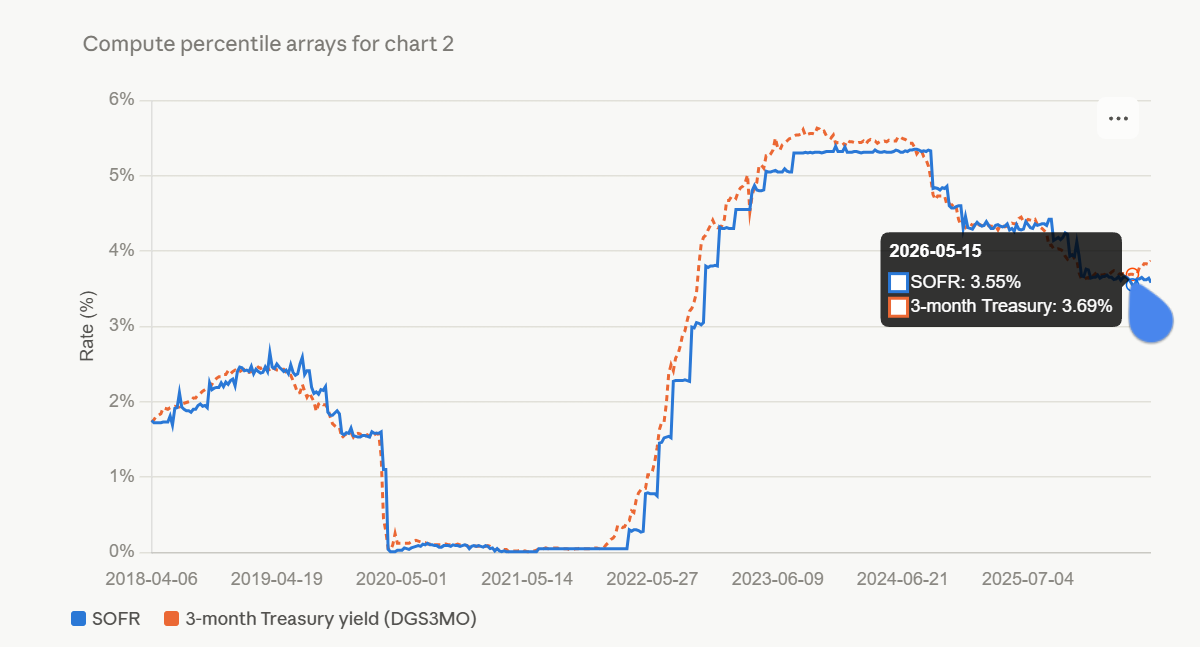
Do also note that SOFR changes as interest rate changes. This is a chart of the SOFR and 3-month US Treasury Rate:

You can see how SOFR and 3-month US Treasury tracks each other.
The important attribute to help decision making is to think your cost is a short-term interest rate and leverage. SOFR or not doesn’t matter.
But its important to note how implementation can change the whole picture.

Do Like Me on Facebook. I share some tidbits that are not on the blog post there often. You can also choose to subscribe to my content via the email below.
If you’re thinking of opening an Interactive Brokers account, my referral link is here.
As the new account holder, you’ll receive USD 1 in IBKR stock for every USD 100 you deposit, up to USD 1,000 in shares — so a USD 10,000 deposit gets you USD 100 in IBKR stock, and the bonus is capped at USD 1,000 for deposits of USD 100,000 or more. A few other things to know: the minimum deposit to qualify is USD 10,000, done within 30 days of opening, and the bonus shares are locked up for one year from the award date. The promotion is currently active, and using the link costs you nothing extra. On a separate note, if you haven’t already, it’s worth taking a look at how IBKR’s share price has performed over the past five years — the stock you receive as a bonus isn’t just a token; it’s a stake in a company that has done quite well for its shareholders.
I break down my resources according to these topics:
- All my personal notes about how my philosophy behind my own money and how I manage it.
- Building Your Wealth Foundation – If you know and apply these simple financial concepts, your long term wealth should be pretty well managed. Find out what they are
- Active Investing – For active stock investors. My deeper thoughts from my stock investing experience
- Learning about REITs – My Free “Course” on REIT Investing for Beginners and Seasoned Investors
- Dividend Stock Tracker – Track all the common 4-10% yielding dividend stocks in SG
- Free Stock Portfolio Tracking Google Sheets that many love
- Retirement Planning, Financial Independence and Spending down money – My deep dive into how much you need to achieve these, and the different ways you can be financially free
- Providend – Where I work and do research. Fee-Only Advisory. No Commissions. Financial Independence Advisers and Retirement Specialists. No charge for the first meeting to understand how it works

Kyith is the Owner and Sole Writer behind Investment Moats. Readers tune in to Investment Moats to learn and build stronger, firmer wealth foundations, how to have a Passive investment strategy, know more about investing in REITs and the nuts and bolts of Active Investing.
Readers also follow Kyith to learn how to plan well for Financial Security and Financial Independence.
Kyith worked as an IT operations engineer from 2004 to 2019. Currently, he works as a Senior Solutions Specialist in Fee-only Wealth Advisory Firm Providend. All opinions on Investment Moats are his own and does not represent the views of Providend.
You can view Kyith’s current portfolio here, which uses his Free Google Stock Portfolio Tracker.
His investment broker of choice is Interactive Brokers, which allows him to invest in securities from different exchanges all over the world, at very low commission rates, without custodian fees, near spot currency rates.
You can read more about Kyith here.