
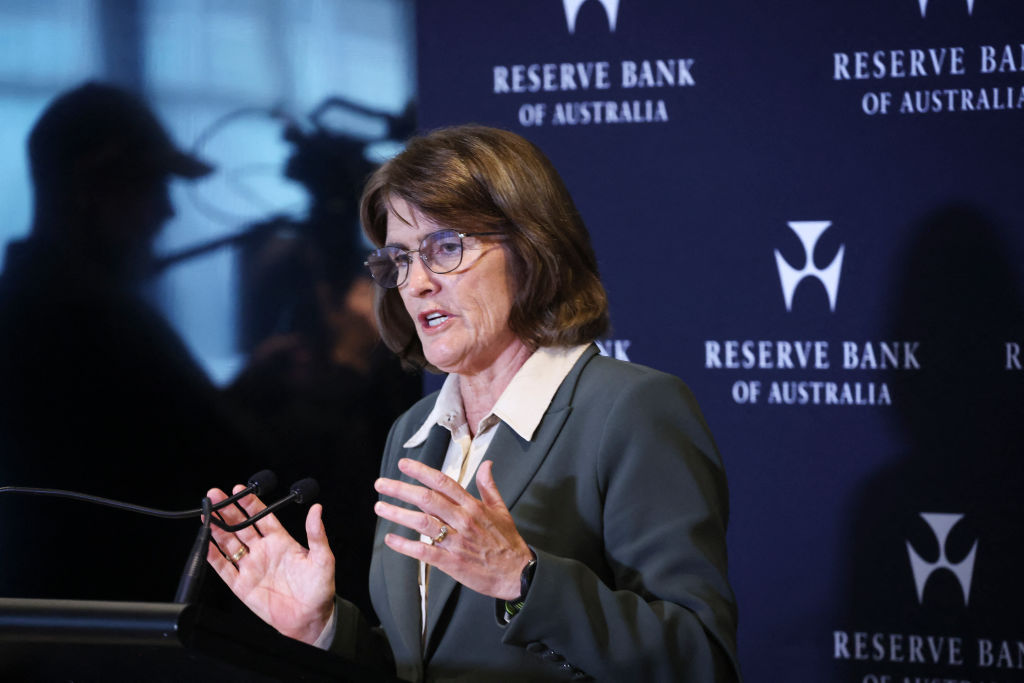
Weak productivity growth is leaving Aussies out in the cold with the economy set to stay stuck in a rut until the issue is addressed, the Reserve Bank says.
Governor Michele Bullock spoke on the bank’s expected interest rate trajectory in Sydney on Tuesday, warning the country is well into the grip of high inflation.
RBA governor Michele Bullock says Australia’s inflation is far too high. Picture: David Gray
Ms Bullock said further easing in the labour market – essentially fewer job opportunities and higher unemployment – will be necessary to help return inflation to the RBA’s 2-3% target range.
The comments come ahead of data to be published by the Australia Bureau of Statistics on Wednesday, which will be the major informer ahead of the next cash rate decision on 11 August.
Latest figures show the Consumer Price Index rose 4% for the 12 months to May, down slightly on April and March figures.
Underlying inflation, which strips out the most volatile price changes each month, saw a jump from 3.4% in the April reading to 3.6% in May.
| Month | Trimmed mean (%) |
| May | 3.6 |
| April | 3.4 |
| March | 3.3 |
| February | 3.3 |
| January | 3.3 |
“The key question in the period ahead is whether the tightening in monetary policy earlier in the year is sufficient,” Ms Bullock said.
“One thing monetary can’t do is address the economy’s slow productivity growth. While this persists, the ability of the economy to grow without generating inflation is constrainted and Australians will continue to experience limited growth in real wages.”
The best the bank can do for now is to focus on maintaining low inflation and supporting full employment, she added, signalling further rate hikes are very much still on the table.
“The board is prepared to act as required, including raising the cash rate further if needed,” she said.
“With continued weak productivity growth, the economy simply can’t grow without putting pressure on inflation.”
Ms Bullock called sluggish productivity a “fundamental challenge” for the Australian economy over the next few years, noting sudden unexpected events that quickly change the availability of goods and services, known as supply shocks, are becoming more frequent.
“A defining and recurring feature of the global economy in recent years has been the increasing frequency and impact of supply shocks,” she warned. “First, there was the shock associated with the Covid-19 pandemic, then the Russian invasion of Ukraine led to an energy price spike.
“The longer inflation is out of target, the more concerned the board becomes. It is at the front of their minds.”
Russia’s invasion of Ukraine was a major supply shock for the global and domestic Australian economy. Picture: Getty
The grim prediction will be disappointing news to borrowers already under pressure from the RBA’s three 2026 rate hikes, each of which add approximately $80 a month to minimum repayments on a $500,000 mortgage.
Despite this, Ms Bullock sounded a positive note on households’ resilience, noting savings rates appear to be relatively stable.
“While households remain cautious, spending has been more resilient than sentiment alone might suggest,” she added.
“Consumer sentiment remains very weak, though it has recovered somewhat.”
Ms Bullock said the world “has been more shock prone” in recent years, but softened the blow by saying the economy is “more resilient than it was in the past”.
“It remains too early to assess the full economy impact and in this environment, the impact remains uncertain,” she said.
“While the effect on fuel prices and headline inflation has so far been smaller than initially feared, headline inflation has remained well beyond the target. Underlying inflation, which is a better guide, has evolved broadly as expected but is still too high.”
The Reserve Bank warns it is poised to hike interest rates again if needed. Picture: Lisa Maree Williams
Market expectations for a rate hike in two weeks’ timed eased over the weekend, dropping from 43% on Friday to 28% on Monday.
What move the RBA chooses to make next will become clearer after tomorrow’s latest inflation data is released.
“The further inflation moves from target, the more embedded it becomes and the harder it becomes to reverse,” Ms Bullock said.
“Let’s hope there are no more shocks. The challenge is that if there is more coming on the oil price side of things, I personally worry things will get ingrained.”