
Precious metals prices are staring down the barrel of next week’s US Federal Reserve meeting
Justification for higher interest rates is rising, and prices for gold, platinum and palladium are bowing down to levels not seen since the fall of 2025. Meanwhile, silver has fallen back to a range it last reached in March of this year.
Key US economic reports showing a resilient labor market and higher inflation have been the biggest price drivers in the precious metals complex this week. A strong labor market is also an inflationary signal for the Fed as more employed people with paychecks to spend adds further demand to the economy, and hence more inflation.
The Fed has a dual mandate to keep both employment and prices at sustainable levels. When Fed board members meet next week, the market is mostly betting on rates staying steady for now.
However, CME Group’s (NASDAQ:CME) FedWatch tool shows the likelihood of a rate hike as early as September is now up to 38.9 percent, compared to just 4.9 percent a month earlier. By December 2026, the likelihood rises to 67.7 percent.
The geopolitical whiplash effect coming from the conflict in the Middle East also remains a significant headwind for precious metals as the back-and-forth war of words — as well as ammunition — continues to weigh on prices.
Let’s take a closer look at what’s got the precious metals moving over the past week.
Gold price news
The gold price dropped sharply at the end of last week, falling over 4 percent from roughly US$4,500 per ounce in morning trade on June 4 to as low as US$4,310 by the afternoon of June 5.
The massive slide was driven primarily by a US nonfarm payrolls report, which shows that the nation’s economy added more jobs than expected in May. The blockbuster report caused benchmark 10 year treasury yields to surge back above 4.5 percent, and led to a stronger US dollar — both of which are price negative for gold.
“Precious metals have been under increased pressure again this week after stronger‑than‑expected US jobs data reinforced the ‘higher for longer’ interest‑rate narrative and pushed the greenback up,” John Murillo, chief business officer at B2BROKER, a global fintech solutions provider for financial institutions, told the Investing News Network (INN).
“May nonfarm payrolls rose by 172,000 versus about 105,000 expected, while unemployment stayed at 4.3 percent. That surprise lifted Treasury yields and made markets price in more Fed tightening through the next few years, which hurts non‑yielding assets like gold and silver. Denting safe‑haven demand was further hurt by major inflation releases.”
The June 5 gold price decline was also notable from a technical trading standpoint, notes Gary Wagner, executive producer of the Gold Forecast, in a Kitco editorial. The heavy selling volume forced the yellow metal to break below its 200 day simple moving average for the first time since November 2023.
Monday (June 8) brought a bit of a reprieve for the gold price, which remained rangebound between US$4,330 and US$4,340 for much of the session. The calm came as traders anticipated the release of May US consumer price index (CPI) and producer price index (PPI) numbers later in the week.
By Tuesday (June 9), that anticipation had morphed into full-on expectations for higher inflation and increasing anticipation that next week’s Fed meeting will telegraph much tighter monetary policy. The spot price of gold hit an intraday low of US$4,237.03 in morning trade before finishing the day at US$4,259.56.
“Gold has pulled further down from its late‑May highs. Using the major gold ETF, SPDR Gold Shares, as a proxy, it’s enough to say that prices dropped about 6 percent from May 29 to Tuesday, falling from roughly US$420 to slightly above $US390, with the biggest move being posted exactly after the payrolls shock,” said Murillo.
The bleeding continuing on Wednesday (June 10) following the release of the May CPI report; it shows annual inflation at a three year high of 4.2 percent, and a monthly increase of 0.5 percent. Core CPI, which excludes the food and energy categories, rose 0.2 percent for the month, putting the 12 month core rate at 2.9 percent.
The hot inflation levels and ongoing Middle East conflict pushed markets down broadly, and sent gold off a cliff to close at US$4,071.38, down nearly 4.5 percent from the previous day’s close.
“Markets were already bracing for hotter inflation prints this week. The consensus forecast was for headline CPI to jump 0.5 percent on a monthly basis and 4.2 percent on an annual basis. That kind of acceleration appeared the fastest in roughly three years,” commented Murilloi. “Together with the jobs report, these data will be central to how the Fed times cuts later this year, keeping markets biased toward fewer and later rate cuts.”
Thursday morning brought the release of May US PPI data which revealed that wholesale inflation rose sharply by 1.1 percent month-on-month, outstripping economists’ expectations of a 0.6 to 0.7 percent advance.
Annual headline PPI rose to 6.5 percent, marking its highest year-on-year rate since late 2022. The energy price shocks caused by the Iran war were a major driver of this increase in inflation, signaling that the impact of the ongoing conflict is starting to have an outsized impact on the US economy.
By 10:00 a.m. PDT on Thursday, gold was trading at US$4,080.30, down nearly 9 percent from the same time last Thursday. Gold is down more than 27 percent from its all-time high of US$5,589.38, reached on January 28.
Gold price chart, June 3 to 11, 2026.
Chart via the Investing News Network.
What direction could gold take in the coming weeks?
A number of significant economic-related catalysts are on the docket for next week:
- June 16 — May US retail sales data. The primary gauge of consumer spending, representing two-thirds of the US economy. A stronger-than-expected retail report would imply economic resilience, which would push the greenback and treasury yields higher. On the flip side, weak retail data could flag a consumer slowdown, which would boost gold’s safe-haven appeal.
- June 16 — May US industrial production and capacity utilization data. Measures hard economic growth and manufacturing health. Hot industrial data would fuel fears of higher-for-longer interest rates, while signs of a macroeconomic slowdown would encourage safe-haven flows into gold.
- June 16 to 17 — Fed meeting. The board will need to weigh the latest economic data to determine the future course of US monetary policy. Any signals by the Fed that rate hikes are on the horizon will lead traders to further move out of gold and into yield-bearing assets.
- June 18 — Weekly initial jobless claims. A low jobless claims number signifies a tight labor market, giving the Fed room to hike or hold rates. If jobless claims spike, traders could to turn back to gold.
- June 19 — S&P Global Flash US Purchasing Managers’ Index data. Strong business activity expansion would strengthen the US dollar and drag gold down. A dip below 50 would trigger stagflation or recession fears, providing a pillar of support for the gold price.
For more insight into what’s moving the gold market, check out INN’s recent interviews:
In gold-mining news, GoGold Resources (TSX:GGD,OTCQX:GLGDF) received federal approval in Mexico to begin construction on its US$227 million Los Ricos South underground mine in Jalisco state.
Silver price news
While silver’s price trajectory was influenced by the same macroeconomic drivers as gold this past week, the white metal is also uniquely impacted by industrial demand, structural supply deficits and its own inherent price volatility. Silver also doesn’t have gold’s strong baseline of price support derived from central bank buying.
The silver spot price was trading just below US$74 per ounce on June 4, but outslid gold the following day by dropping more than 8 percent to an intraday low of US$67.58 in the afternoon session.
When precious metals prices fall, silver historically experiences a sharper percentage drop than gold. This is due in part to silver being a much smaller market and highly leveraged by speculative institutional investors; that means sudden macro shifts can trigger much larger waves of liquidation than seen in the gold market.
Silver traded sideways this Monday as the precious metals complex remained in a holding pattern, posting a close of US$68.17. Tuesday brought another steep drop as investor sentiment began to lean toward higher inflation and the probability of future Fed rate hikes. After trading as high as US$68.77 in the early morning, the price of silver fell by more than 6 percent to an intraday low of US$64.47 and later closed at US$65.33.
“Silver has nosedived even more sharply (than gold), shedding roughly 13 percent over the same span (May 29 to June 9) — partly because the silver market is much thinner, more sensitive to rates and the GDP growth outlook, and tied to industry demand,” said Murillo in his commentary.
Silver lost further ground on Wednesday following the release of May CPI data, falling to a close of US$63.41.
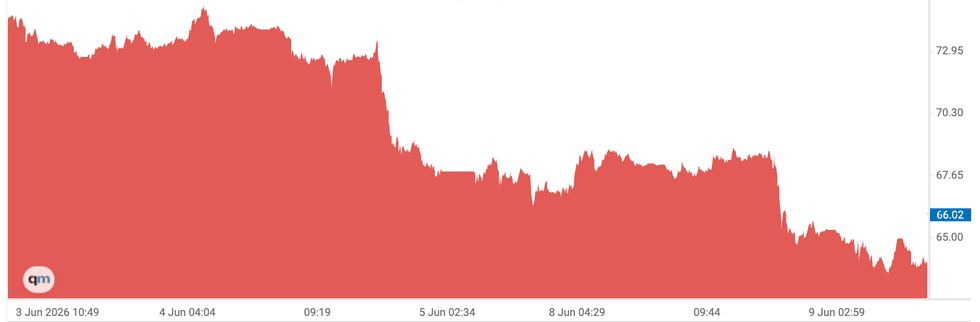
Silver price chart, June 3 to 11, 2026.
Chart via the Investing News Network.
Higher-for-longer rates are a double-edged sword for dual-natured silver. The metal must grapple with the same pressures placed on non-yielding assets, as well as with industrial headwinds — high rates pose a threat to capital-intensive projects such as solar installations and artificial intelligence data center buildouts.
Thursday morning saw silver fall as low as US$62.84. By 10:00 a.m. PDT that day, the silver price had rebounded slightly to US$63.83, but remained down more than 13.5 percent from the same time last week.
Silver has fallen more than 47 percent from its all-time high of US$121.62, which it set on January 29.
Citigroup’s (NYSE:C) commodities research team may have cut its gold price target for the next three months to US$4,000 from US$4,300, but its call for silver outperforming gold this year still stands.
“Our longstanding call for silver to outperform and for the precious metals bull market to broaden into industrial metals and for industrial metals to take centre stage over the same periods has worked well,” the analysts stated.
In silver-mining news, Sunshine Silver Mining & Refining Company (NYSE:SSMR) made its NYSE debut, raising US$270 million to bring the historic Sunshine mine in Idaho back into production. Located in the Coeur d’Alene Mining District, the property hosts one of the highest-grade silver assets in the US. The company is targeting early 2027 for the completion of a feasibility study with the goal of commencing production in late 2028.
Platinum price news
The platinum price has plummeted significantly this past week.
After trading around US$1,900 on June 4, the metal dropped to as low as US$1,770.50 per ounce the next day. Platinum remained rangebound with its precious metal sisters this Monday, trading mostly between US$1,750 and US$1,760. Tuesday morning saw platinum up as high as US$1,783, but those slight gains quickly evaporated as the metal fell to an intraday low of US$1,704.90 later in the morning before a close of US$1,725.60.
“Platinum and palladium have also tracked lower, down around 9-10 percent since late May, pummeled by their unattractive link to auto demand rather than a straightforward cyclical rebound,” stated Murillo.
The price of platinum fell below US$1,648.60 early in the day on Wednesday, marking its lowest levels since November 2025. However, the metal managed to close at US$1,663. On Thursday morning, the price slid to as low as US$1,649.60. But by 10:00 a.m. PDT, platinum was trading back up at US$1,665.30.
Platinum is down more than 12 percent over the period, and is sitting more than 43 percent below its all-time high near US$2,924, set this past January.
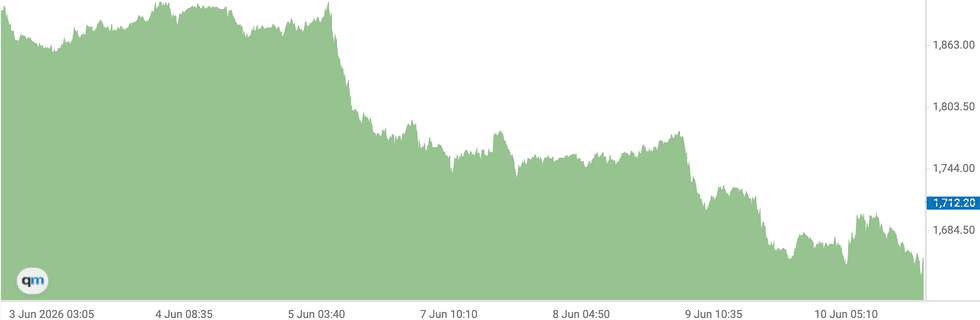
Platinum price chart, June 3 to 11, 2026.
Chart via the Investing News Network.
As for potential near-term catalysts for platinum outside of those on the horizon for the rest of the precious metals, investors should keep an eye out for Q2 reports from global automakers.
These will provide data revealing the exact scale of platinum-for-palladium substitution currently happening in gasoline autocatalysts. If vehicle manufacturers are still making the shift to control costs, it will cushion the blow of platinum’s structural supply deficit, while adding a boost to palladium’s long-term demand outlook.
For more insight into what’s driving the platinum market, check out INN’s recent interview: Edward Sterck: Platinum Drivers Intact, Will Price Break Out Again?
In platinum-mining news, Russian Platinum announced its revised operational timeline to launch production at its Arctic polymetallic project in November. This copper-nickel mine is extremely rich in platinum-group metals (PGMs). The project’s first phase was delayed from its original 2024 target due to western sanctions restricting equipment access.
Palladium price news
Palladium suffered this past week along with the rest of the precious metals complex.
The metal was trading at around US$1,330 per ounce on June 4, but by close to the end of the June 5 trading session its value had plunged to US$1,236.50. Palladium fell further this past Monday to hit eight month lows, trading in the range of US$1,210 and US$1,220. Although the palladium price had risen to as high as US$1,269 on Tuesday morning, by late morning the metal’s value was back down to US$1,227 before a close of US$1,239.
Following the release of CPI data on Wednesday, palladium’s price volatility continued as it see-sawed between the US$1,220 and US$1,260 level to eventually close out the day at US$1,225.
On Thursday, palladium was trading at US$1,249 as of 10:00 a.m. PDT. That’s down more than 6.5 percent from the same time last week, and trading at only about a third of its March 2022 all-time high near US$3,440.
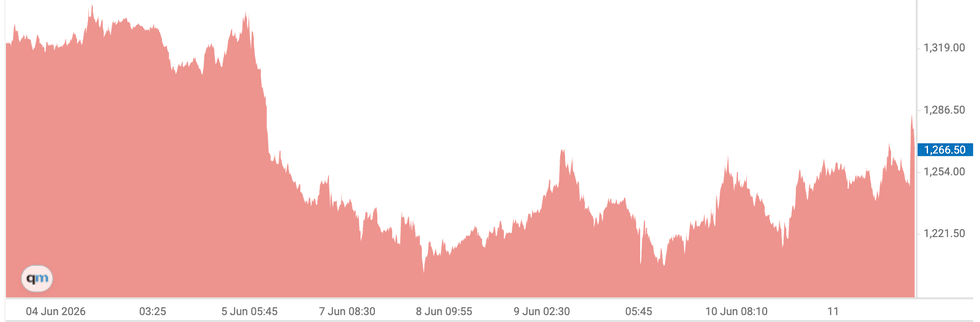
Palladium price chart, June 4 to 11, 2026.
Chart via the Investing News Network.
Despite the current volatility in the PGMs market, some analysts are still relatively bullish on the metals in the longer term. Bank of America (NYSE:BAC), for example, still sees the platinum price averaging about US$3,000 and the palladium price averaging about US$2,200 in the last quarter of 2026, as reported by Kitco.
“The rally in PGM prices has lost steam since late January, largely tracking moves in gold. Further, ongoing macro headwinds from the conflict in the Middle East add downside risk to demand for industrial metals,” said commodity analysts at the bank. “That said, we remain bullish on gold into 4Q, which we expect will draw investors back into the PGM market and add upward pressure to prices.”
Don’t forget to follow us @INN_Resource for real-time updates!
Securities Disclosure: I, Melissa Pistilli, hold no direct investment interest in any company mentioned in this article.
Editorial Disclosure: The Investing News Network does not guarantee the accuracy or thoroughness of the information reported in the interviews it conducts. The opinions expressed in these interviews do not reflect the opinions of the Investing News Network and do not constitute investment advice. All readers are encouraged to perform their own due diligence.
From Your Site Articles
Related Articles Around the Web