
I came across Todd Wenning’s article on Flyover Stocks, “Dividend Investing is Dead,” late last week. It’s a very good research piece overall.
But before people jump to the conclusion that dividend investing is dead, they need to understand how Todd is using the term.
For a lot of investors in Singapore, dividend investing is a way of investing in local stocks to generate income for financial independence.
There’s another school where it’s used more as a way to find stocks that will do well over the long or intermediate term. This second definition is what Todd is actually referring to. I want to make this clear because I’ve noticed a lot of people don’t get through these deep research pieces properly. They jump straight to the wrong conclusion and get agitated over it.
Todd has been deep in dividend investing for a long time. He originates from the UK and, being a conservative investor by nature, found the research compelling: companies raising dividend payouts over time tend to see faster earnings growth, since companies need real cash flow (not just GAAP accounting) to pay dividends, and boards need confidence in future cash generation to raise them.
A growing dividend is a signal of competitive advantage.
This led Todd to focus on dividend stocks yielding 3-4% with free cash flow per share growth of 6-7%, starting from a low payout ratio with room to expand.
I think this research holds up well. What we’ve observed is that low starting yield, high growth dividend stocks, as their payouts expand, tend to see their share prices rise too. As a portfolio, these tend to track the cap weighted benchmark index closely. It’s the higher payout ratio dividend stocks that tend to lag the market as a portfolio. That said, this also depends on the index you’re comparing against. Most indexes are diversified across sectors, unlike Singapore’s STI, which has been dominated by financials and telecoms for the past 5 years. Compare against that and the difference isn’t so stark.
There are a couple of points in the “dead” thesis I find harder to agree with.
Taking a 100 year view, is this really structural, or just a rough patch?

Todd points to consumer staples like Coca-Cola, Colgate-Palmolive, J.M. Smucker, and Clorox struggling due to influencer marketing, private label competition, and GLP-1s changing consumer habits.
Many of these products aren’t great for your health in the first place, and their pricing power came from habits that don’t change easily. Now that people are more health conscious, that’s shifting.

Todd also notes the average age of S&P 500 constituents has dropped from 57 to 15 years, as younger tech companies replace mature dividend payers like Campbell’s, Newell Brands, Macy’s, Xerox, and Harley-Davidson. True, but these companies still exist, just outside the index now. That just means you probably shouldn’t be investing in them at the moment, not that dividend investing itself is broken. Index composition also shifts constantly, in ways few people predict. Few expected some of 2025’s top S&P 500 performers, which shows how much the market can surprise even attentive investors.

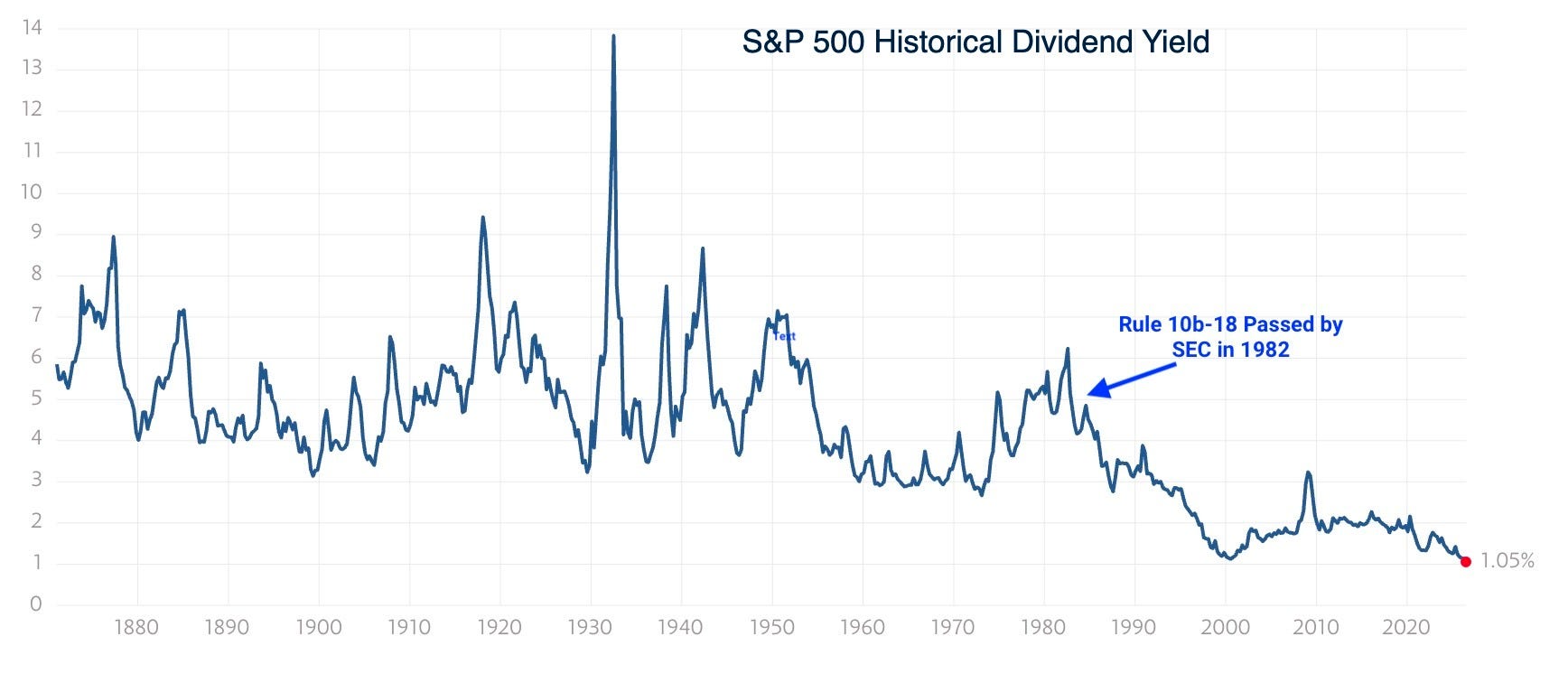
The point I do wholeheartedly agree with is the changing dynamics of shareholder rewards. Since SEC Rule 10b-18 passed in 1982, companies have steadily shifted from dividends toward buybacks. I don’t think one mechanism is inherently better. Buybacks, done well, lift share prices over time. Dividends signal quality: a company confident enough to raise its dividend is signaling confidence in future cash flow, and companies are ultimately valued on future cash flows anyway. Both are just different expressions of the same underlying driver. If you’re using dividends alone to screen for good companies, you risk missing a lot of good businesses that have simply chosen to return cash differently.
What matters, at the end of the day, is what drives the ability to pay dividends or buy back shares in the first place: cash flow. Investors should look for companies that grow cash flow quickly over many years, or that generate healthy cash flow relative to their valuation. This is essentially the profitability factor, similar to how Avantis, which I’m invested in, screens using operating cash flow divided by book value. It’s not a standalone stock picking tool, but the empirical evidence shows companies generating strong operating cash flow, adjusted for one off items, tend to perform better over time.
Todd, who ran a boutique fund before launching this Substack, has spent a long time researching and investing in dividend stocks. What I take from this piece isn’t really about finding companies that won’t die from poor management, it’s about finding management, boards, and business structures that are antifragile: able to make sound decisions in a fast changing environment. That’s really what good investors need in a world of trends that flare up every few months and fade within a year or two. You need a system to filter out the noise, or you’ll end up dumbfounded by the market, especially if you’re absorbing the wrong signals from what you see or who you listen to.
After reading this piece, there’s nothing particularly new to me. There have been a few other pieces of research that show the same thing.
The important takeaway for investors is that dividends should be viewed as a potential factor to help find stocks that outperform the benchmark index, not as a wealth management construct in itself. So don’t go too crazy about it.
There might come a time when government policy changes how management decides to reward shareholders. If your investing approach is dictated by this kind of mechanism, that’s a risk, because this isn’t just about the US. Different countries’ policies will change too, and who knows, perhaps more countries will follow the US’s lead toward share buybacks, especially if dividend income continues to be taxed more heavily. If that happens, you could see companies well beyond the US moving in the same direction.
So if your hunting ground for stocks is based on how management currently chooses to reward shareholders, whether through dividends or buybacks, that feels a bit flimsy to me. This is something investors should think about. I’m not saying it shouldn’t be a factor at all. I think most people would agree that if you want to find good stocks, whether they pay out through buybacks or dividends, the real focus should be on a strong free cash flow yield.

Kyith is the Owner and Sole Writer behind Investment Moats. Readers tune in to Investment Moats to learn and build stronger, firmer wealth foundations, how to have a Passive investment strategy, know more about investing in REITs and the nuts and bolts of Active Investing.
Readers also follow Kyith to learn how to plan well for Financial Security and Financial Independence.
Kyith worked as an IT operations engineer from 2004 to 2019. Currently, he works as a Senior Solutions Specialist in Fee-only Wealth Advisory Firm Providend. All opinions on Investment Moats are his own and does not represent the views of Providend.
You can view Kyith’s current portfolio here, which uses his Free Google Stock Portfolio Tracker.
His investment broker of choice is Interactive Brokers, which allows him to invest in securities from different exchanges all over the world, at very low commission rates, without custodian fees, near spot currency rates.
You can read more about Kyith here.