
Hawaii’s housing shortage has created an affordability crisis so severe that it now threatens the future of generational wealth on the islands.
“It was always a dream of mine to be a homeowner. Realistically, I could not have fulfilled that dream staying in Hawaii,” Johnette Fagaale, a former resident of Waialua, Oahu, chronicles in “Why We Left Hawaii.”
The series from the Grassroot Institute of Hawaii documents the stories of some of the more than 13,000 people who have left the Aloha State since 2019, many of whom report being driven out by high prices and locked out of opportunities—like homeownership—that are more readily available on the mainland.
Those lost opportunities pose a significant risk to the future of generational wealth for Hawaiian residents. Homeowners are 1.3 times more likely than renters to anticipate leaving assets to the next generation, and they hold a net worth of nearly 38 times that of renters, according to research from Realtor.com®.
In her account, Fagaale says that after watching her parents work hard and never become homeowners, she decided to move to Washington to pursue “bigger and better opportunities.”
The move proved to be decisive: In 2019, around the time of Fagaale’s move, the median home value in Hawaii was just under $690,000. In Washington state, it was just under $438,000.
“In June 2020 our dream of being homeowners came true,” writes Fagaale. “We own a home in Vancouver, Washington, and we are doing so much better. I miss Hawaii, but the cost of living there is crazy. I worked at a good-paying job and I was still having a tough time.”
Mixed migration signals
Hawaii ranked as the least affordable state in a recent analysis by the Common Sense Institute, driven in large part by the high cost of shelter and utilities there. Today, the median home price in Hawaii is $767,360.08—nearly double the national median of $403,000.
Many have blamed an influx of COVID-19 pandemic-era migrations for driving up prices, but the data reveals a more complicated truth.
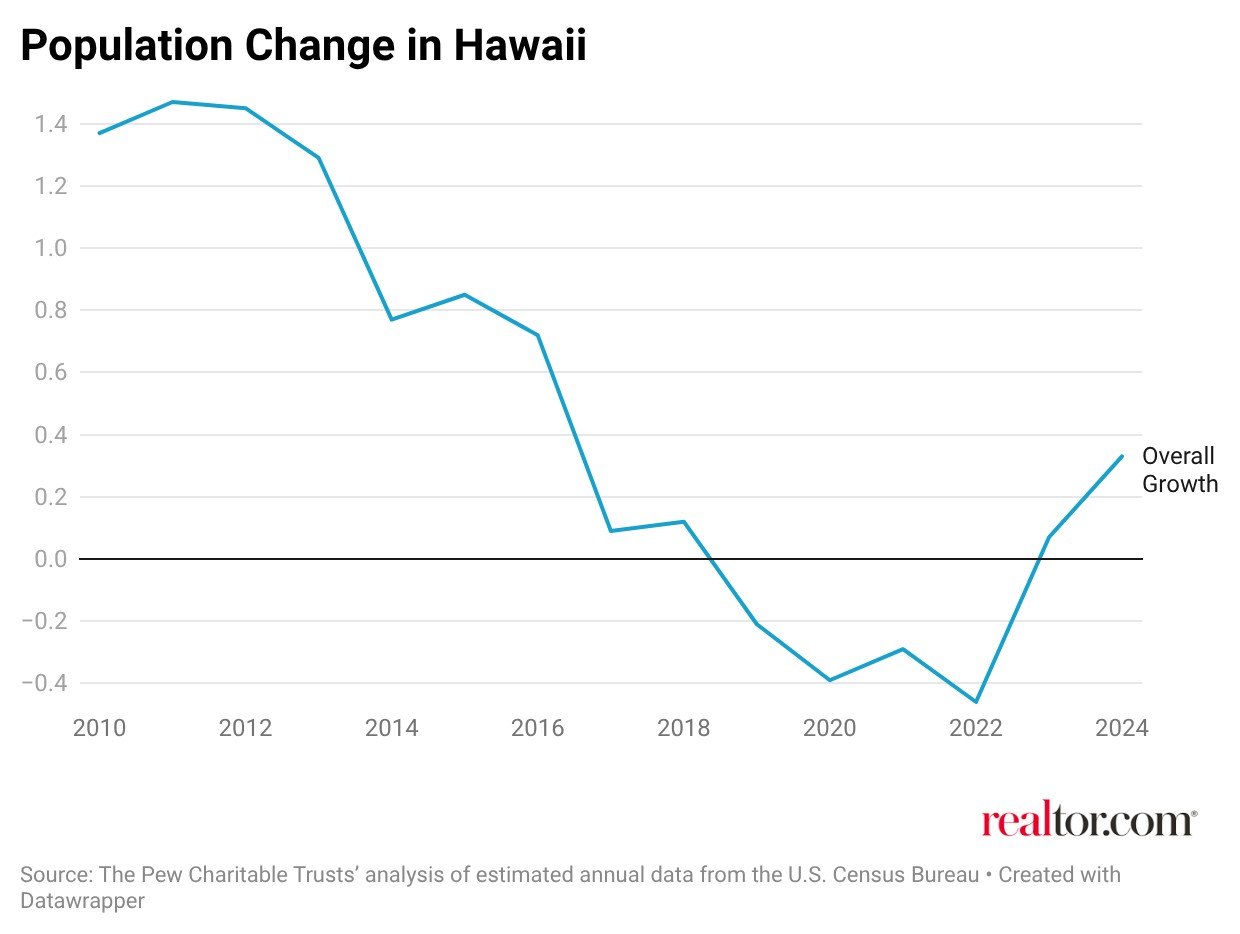
Between 2019 and 2023—during the height of these migration trends—Hawaii’s population actually shrank, before modestly rebounding in 2024.
During those years of population decline, net out-migration (or people moving out of the state) was the major driver—as opposed to natural changes like the number of deaths outpacing the number of births.

Even the people who moved to the state during this period weren’t particularly wealthy, with an average income between $65,700 and $100,000, according to an analysis of IRS data. That’s roughly on par with the state’s median household income of just over $100,000.
The average income of those who moved to Florida during the same period, for comparison, ranged between $110,000 and $157,000—compared to the state’s median household income of $78,000.
The housing crunch
That’s not to say that migration hasn’t put additional pressure on housing and prices in the state. Three out of 4 Hawaiian households can’t afford the typical single-family home today, according to a recent analysis from the University of Hawaii Economic Research Organization (UHERO).

Younger households appear to be the most affected, leading the pack of domestic out-migration, according to a separate UHERO study.
It’s a trend that tracks closely with housing, says Realtor.com® senior economist Joel Berner.
“The inflow of higher net worth individuals and the outflow of younger adults who are often squeezed by the cost of living means that Hawaii has a unique situation in which there is plenty of competition for buying homes at the top of the market, which has supported home prices despite the population contraction, while the entry level remains unaffordable to lower- and middle-income Hawaiians due to a lack of building and crowding out by vacation rentals,” says Berner.
The senior economist points to another piece of the puzzle driving up Hawaiian home prices: a shortage of available units. Nationally, the U.S. is short an estimated 4.03 million homes, and on an isolated island, that crunch just gets magnified.
Hawaii needs 60,000 additional housing units by 2050 to meet future demand, with the bulk of that burden (39,000 units) expected to hit by 2035, according to a recent report. Meanwhile, the state ranks 48th and earned an F grade in the State-by-State Affordability Report Cards from Realtor.com—due in large part to the low number of new-construction permits there.
In 2024, the state accounted for just 0.2% of the new-construction permits in the nation, despite being home to 0.4% of the population, the report shows.
But building their way out of the shortage is harder than in other parts of the country.
“There are a lot of barriers to building on Hawaii, ” explains Berner. “The main one is that land is scarce and highly protected, making it difficult to find anywhere to build homes.”
Nearly 95% of Hawaiian lands are classified as conservation or agricultural, both of which prohibit major developments.
“Much of the islands’ landmass is undevelopable, and what can be developed is subject to permitting and environmental approval processes that can take years. On top of all that, the materials for construction must be imported and labor is hard to come by, making homebuilding quite expensive,” Berner adds.
Better pay and lower costs elsewhere
Income is another factor driving people out of Hawaii, according to the UHERO analysis.
As high living costs push people out of the state, stagnant or slow-growing incomes drive them to other states where their earnings can grow.
That’s what led Colyn Slocum to leave.
“The costs of living in Hawaii and the lack of job prospects for someone without a degree, it felt like the decision was already made for me,” he writes.
Slocum relocated to Las Vegas, where he now works as an over-the-road truck driver and makes nearly double what he used to in Hawaii. He’s also closer to his daughter now and saves considerably on rent, taxes, and food.
Even so, it’s not the same.
“Unfortunately, there is no place like home,” he says. “One day, I do wish to return. But until the economic possibilities make it appealing enough, there is little to incentivize.”