
I have a Telegram member Rootie was considering adding US 20-year long term treasuries as a buffer from equity drawdown (when equities fall basically).
This is because I shared a Meketa paper titled Long Term Treasuries in Diversified portfolios.
He is also thinking of it as a buffer for an equity portfolio meant more for flexible Safe Withdrawal Rate spending that is meant for spending before retirement.
I have a few short thoughts regarding his requirements:
- The correlations of a fixed income changes from periods to periods. Some times that can be low sometimes can be high. It is not always zero correlation. Sometimes correlation can be negative and sometimes it can be positive.
- Aside from a 20-year duration treasury, a lot of shorter duration government bonds also exhibit the low correlation that is useful for what he needs to achieve.
- If your income plan is a flexible spending strategy, then do you really need so much buffer? By adopting such a strategy, you already set your mind that your income is going to be volatile, so what exactly does a buffer do? If you add more fixed income compare to equities, your portfolio becomes less volatile, and you potentially lose upside income if it happens. Is that what Rootie want?
I think these are the main considerations.
But from a financial planning perspective, I scratch my head why investors would consider putting such a long 20-year duration fixed income into their portfolio.
- The downside and upside volatility of fixed income is based on their duration, the long it is the more volatile.
- The duration also shows you how long it takes to recover your capital with high confidence. Those who owns a 20-year duration fixed income ETF at the high 2020 would tell you they are 50% down and still down while those with shorter duration have already recovered and made positive returns. Perhaps you think you are the lucky one that will never encounter something that happen five years ago.
The most scratch head thing is… why won’t you use a shorter duration fixed income that does not have so much risk? A 20-year treasury is useful if you are running some strategy that needs the fixed income to be rather volatile, at a very specific period. Usually in speculative strategies.
In any case, since I have 20-year US Treasury and also 5-year US Treasury data, among other data and I have Gilgamesh, my pet software, I thought I will show Rootie something.
Comparing the Historical Rolling Annualized Return between Two Balanced Portfolio Implementation.
The table below shows the annualized rolling return of a 60% S&P 500 and 40% 5-year US Treasury bond portfolio over many different rolling periods:

This allows you to see the range of annualized return if you invest over different tenure. The US fixed income and equity data starts in 1926, so we can see the return since Great depression, high inflation, boom town Charlie periods, recessions, Great Financial Crisis and Covid.
There will be 5-year periods of negative returns but the nice thing about a Balanced portfolio is that even in pessimistic bucket of annualized return (10th and 20th percentile) the returns are still pretty good.
The table below swaps the 5-year US Treasury with 20-year US Treasury:

What you will notice is that you change this, there will be poor years and there will be good years. The worst 5-year annualized return will still be -8.8% p.a. which is not too far from -8.7% p.a. for the 5-year Treasury.
The returns for the balanced portfolio containing 20-year US Treasury data is higher because… 20-year duration means term risk premium is higher, and if you invest long enough to harvest the return, your returns are higher.
Does Having 20-Year US Treasury instead of 5-Year US Treasury Improve the Worst Historical Drawdowns?
Drawdowns is when the value of a portfolio fall from a certain high point.
If you are new to investing, whatever kind of portfolio will have a drawdown. The worst drawdown are those in private equity. The value can be $1 mil and if the assets aren’t worth any shit during the next revalue, then it becomes $0.
Gilgamesh is able to generate all the historical drawdowns since 1926 for a balanced portfolio with a 5-year US Treasury fixed income:

You can see the start and end date, when the drawdown recovered fully, and the total number of months from start to recovery, as well as how long it takes to go to the deepest and how long the recovery.
The worst is with fixed income you still ate a 62% drawdown that lasted 82 months (6.8 years). This is better than a full 86% drawdown with 100% S&P 500 that last 14 years.
So lets acknowledge that having 5-year US Treasury help damp the volatility and make the investment experience more livable.
Secondly, you got to acknowledge that 3 out of the last 100 years of drawdown is 30%, the rest is 20% or less. A balanced portfolio is a much more livable experience.
It is not just which portfolio has the highest median return but whether you get thrown off so early you don’t even get that return at all.
What happens if we replace the 5-year US Treasury with 20-year US Treasury?

Your worse drawdown doesn’t improve. Perhaps it takes 3 months faster in recovery. Generally, the drawdowns are slightly deeper more because the longer duration fixed income is just more volatile.
The drawdowns are deeper for the periods that experienced high inflation.
Does the 20-Year US Treasury Improve your Income Strategy Success Rate?
Finally, lets talk about long term income success for a conservative income investor.
While I understand that Rootie is more looking at adding a 20-year US Treasury to improve a flexible spending strategy instead of a constant-inflation-adjusting income strategy, I will still evaluate this using the traditional Safe Withdrawal Rate (SWR) framework.
Why Kyith?
You want to see if the sole reason that we improve long term income success is because we use 20-year fixed income instead of shorter duration fixed income.
I am quite sure if you use either, a flexible spending strategy will have high chance of survival if you don’t go too crazy with the floor income spending (in some flexible strategy, you can put in a low floor income that you want to have even in the worse market conditions).
The clearest way to test is through a traditional retirement where you need a constant inflation-adjusting income.
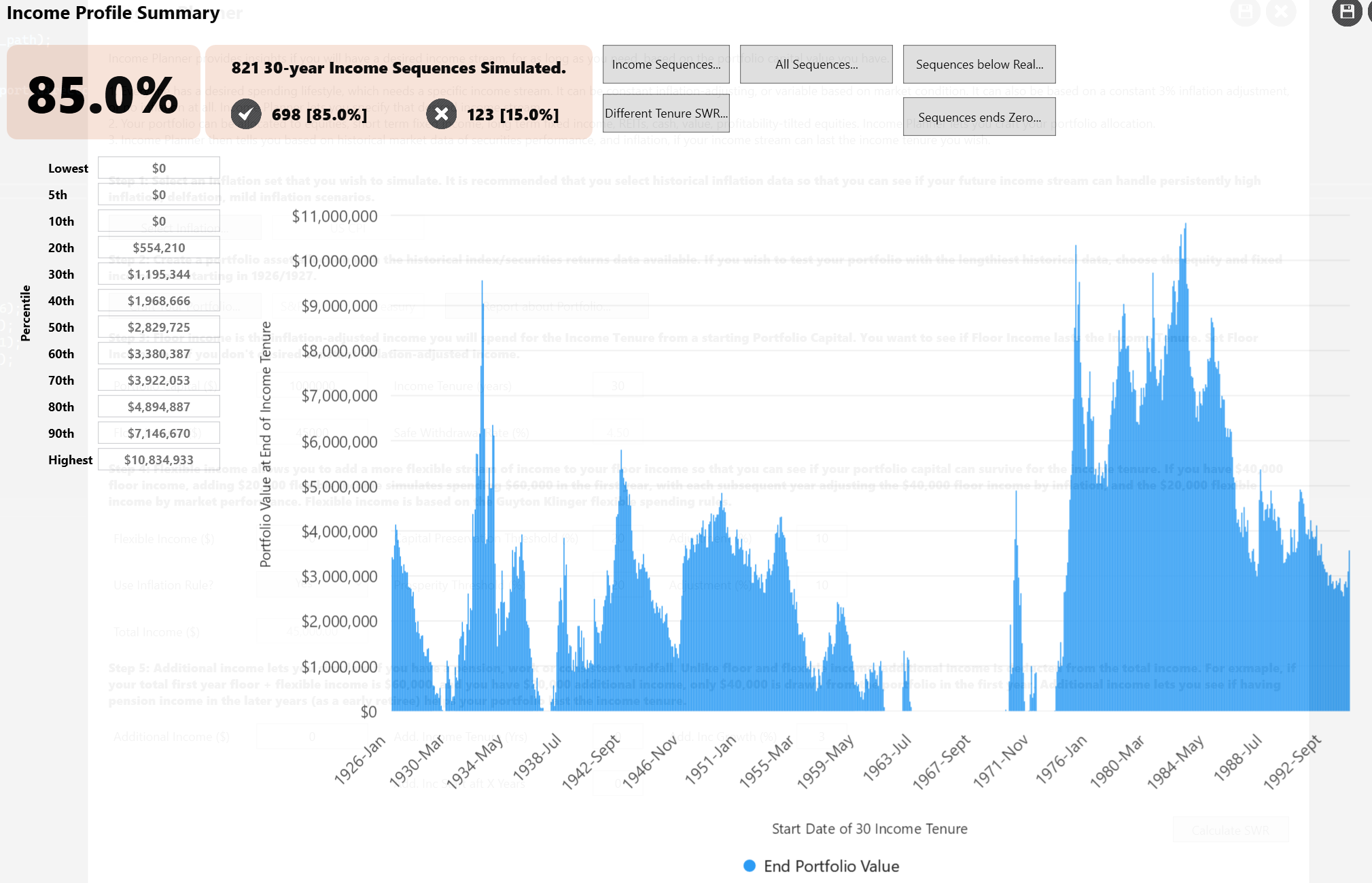
We try to simulate 821 historical 30-year income sequence with the data we have for a 60% equity and 40% 5-year US Treasury portfolio. We start with spending $45,000 annually, adjusting for inflation every year on a starting $1 million portfolio.
We want to see how many of these 821 30-year period, we
- Get inflation-adjusted income over 30-years.
- The portfolio survives for 30-years.
The screen shot below show Gilgamesh’s simulation:

85% means out of the 821 30-year sequence about 123 30-year sequences died before 30-years.
It doesn’t mean that you will not have a good retirement, just that your outcome is dependent on your luck with the market and inflation sequences.
We can also show the growth of the portfolio, after spending the income in lines:

The red lines are the income sequences that died prematurely, the grey ones survive but the portfolio did not preserve its $1 million in inflation adjusted terms. The green lines are the 30-year income sequences that survive and preserve the $1 million in inflation adjusted terms. Pretty good right.
Kyith why did you start with $45,000 annually instead of a more conservative figure?
Because I want to see a situation where I know some challenging market and inflation sequences will kill your income plan.
Then we can contrast whether replacing a 20-year US Treasury will improve the outcome:

We do have more data so instead of 821 30-year sequence. we have 837 30-year sequences.
Replacing the 5-year US Treasury with 20-year US Treasury end up with worse income outcomes. [78.7% success vs 85% success]
Here is how the income sequences look in strands:

Conservatism in income planning does not come from putting into securities that give you higher return but also to acknowledge that there are negative sequence of returns, and you need to be conservative with your starting income, relative to portfolio value.
Epilogue.
This is probably a good exercise to show that what may seem good in idea probably don’t always work so well in planning.
This small data work with Gilgamesh does show that fixed income can damp volatility but you don’t have to go with something so long in duration.
I seriously wonder how many people can tolerate a 20-year US Treasury’s volatility. Perhaps most only think of the upside and that they won’t get into the downside.
For those who are not aware, I have kept $2,420 worth of DTLA which is a UCITS version of a 20-year US Treasury ETF that I bought before that Great Depression in bonds in Daedalus Income Portfolio.
I am still down 28% after 5 years btw.
If you want to trade these stocks I mentioned, you can open an account with Interactive Brokers. Interactive Brokers is the leading low-cost and efficient broker I use and trust to invest & trade my holdings in Singapore, the United States, London Stock Exchange and Hong Kong Stock Exchange. They allow you to trade stocks, ETFs, options, futures, forex, bonds and funds worldwide from a single integrated account.
You can read more about my thoughts about Interactive Brokers in this Interactive Brokers Deep Dive Series, starting with how to create & fund your Interactive Brokers account easily.

Kyith is the Owner and Sole Writer behind Investment Moats. Readers tune in to Investment Moats to learn and build stronger, firmer wealth foundations, how to have a Passive investment strategy, know more about investing in REITs and the nuts and bolts of Active Investing.
Readers also follow Kyith to learn how to plan well for Financial Security and Financial Independence.
Kyith worked as an IT operations engineer from 2004 to 2019. Currently, he works as a Senior Solutions Specialist in Insurance Start-up Havend. All opinions on Investment Moats are his own and does not represent the views of Providend.
You can view Kyith’s current portfolio here, which uses his Free Google Stock Portfolio Tracker.
His investment broker of choice is Interactive Brokers, which allows him to invest in securities from different exchanges all over the world, at very low commission rates, without custodian fees, near spot currency rates.
You can read more about Kyith here.