

At almost 50, I’m never doing a gut remodel again.
Everyone who has survived one has the same thousand-yard stare. It’s the look of someone who spent two years arguing about grout color and waiting on inspectors who never show up when they say they will.
Remodeling might be the most unpleasant thing you can voluntarily sign up for. Nobody makes you do it. Yet every year, homeowners line up to hand over hundreds of thousands of dollars for the privilege of being miserable.
Cost overruns are common. So are time overruns.
If you’re brave enough to build a house or do a gut remodel, budget for the project to cost at least 50% more and take 50% longer than expected. If you do, you might come out only slightly bloodied and bruised. If you don’t, and you trust your general contractor’s estimate, your silent stress will go through the roof and detonate every relationship around you.
Permitting Durations By City For Single-Family Homes
Here’s a great chart compiled by ResiClub from a report by University of Chicago and Princeton professors titled “Where Is It Slow To Build, And Is It Getting Slower?”
I’m not shocked to see San Francisco at #1, averaging 1.1 years to get a permit and 3.8 years to build a single-family home. San Francisco, after all, is the most expensive city to raise a family.
Miami and Philadelphia are close behind at about 3.4 years, while Indianapolis, El Paso, and Colorado Springs get it done in roughly six months. The national average from permit application to completion is about 8.8 months.
So a San Franciscan could watch a family in Indianapolis build seven homes in the time it takes to finish one. And it’s getting worse. Nationally, single-family permitting time roughly tripled from 1.6 months in 2000 to 4.9 months in 2023.
I’ve gone through two gut remodels and a couple of bathroom remodels since first buying San Francisco property in 2003, and every one has been a hellish process.
My last gut remodel started in mid-2019 and wasn’t 100% done until the end of 2022. Granted, COVID delayed completion by about six months. But three and a half years for a project I thought would take one year at most was brutal.
The True Cost Of A Remodel Isn’t The Remodel
Here’s what most buyers miss. The construction bill is only the visible part of the iceberg.
Let’s say you buy a $1.6 million fixer and budget $400,000 for a gut remodel over 18 months. Reasonable, right?
Now apply reality. The budget runs 50% over, so it’s $600,000. The timeline stretches to 2.5 years. Meanwhile, you need somewhere to live. At $6,500 a month in rent, that’s $195,000. You’re also paying roughly 1.2% in property tax on a house you can’t live in, about $48,000 over 2.5 years.
Add it up and your $1.6 million fixer actually cost you about $2.44 million. And I haven’t even counted the opportunity cost of tying up roughly $850,000 in cash that could have been compounding in stocks or private investments.
Then there’s the cost you can’t put on a spreadsheet. If your kids are five and seven when you start, they’re eight and ten by the time you move in. You don’t get those years back living out of boxes in a rental while texting your GC at 10 pm.
Only Buy Fully Remodeled Homes If You Know What’s Good For You
If you’re over 40 and plan to buy in a city where building takes longer than 1-1.5 years, I highly encourage you to buy a fully remodeled home. You’ll save so much time, money, and headache.
At least in San Francisco, the market undervalues fully remodeled homes. Given how painful remodeling is, they should trade at much bigger premiums than they do. I suspect the same is true in most slow-to-build cities. Take a look at this illustrative chart.
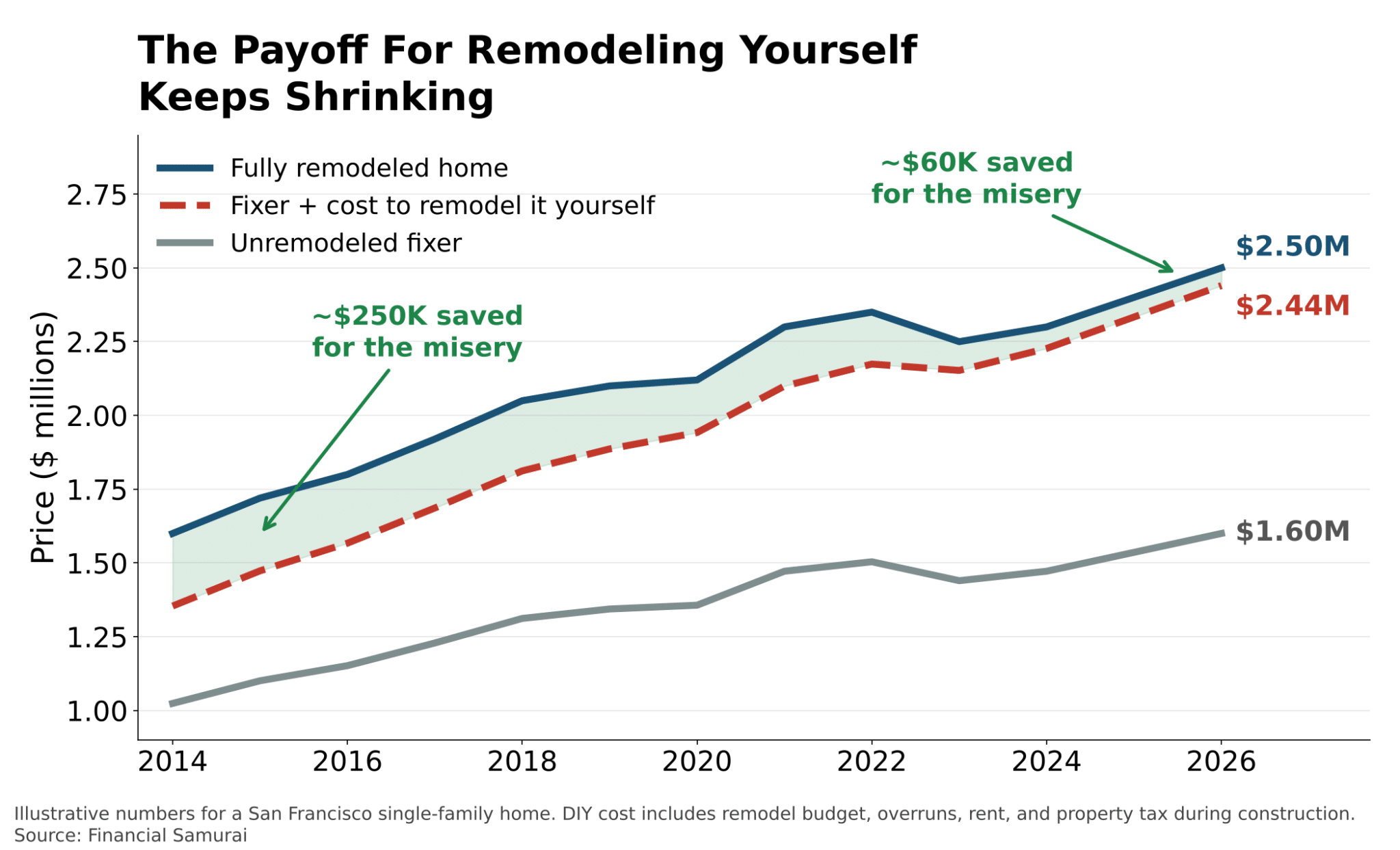
In this hypothetical example, ten years ago, buying a fixer and remodeling it yourself may have saved you roughly $250,000 compared to buying a finished home. That was real money for the pain.
Today, the savings have shrunk to about $60,000. Labor costs, material costs, and permitting delays keep eating away at the discount, while finished homes haven’t gotten much pricier relative to fixers.
Spread $60,000 over 2.5 years of construction and you’re earning about $2,000 a month to manage contractors, chase inspectors, and live in a rental. And that assumes nothing else goes wrong. One bad subcontractor or a three-month permit delay and the savings disappear entirely.
Why Do People Still Go Through With The Pain Of Remodeling?
There are two main reasons.
1) They think they’re smarter and more efficient than they really are
How hard could it be, they ask themselves? Get an architect, hire a reputable GC, pay them to pull permits, pick out the fixtures, and you’re good to go.
But unless you’ve gone through a full remodel or ground-up build, you have no idea how hard things are and how long they take.
Here are some examples of the frustration:
- One part for your bathroom is on backorder, delaying the entire project by a month.
- The custom cabinet that took three months to build arrives cracked, or a half inch too wide for the custom hole.
- The plumbing inspector wants one thing. You fix it. Then a totally different plumbing inspector shows up and wants something else.
- Your neighbors complain about the noise, which is out of your control, creating stress and awkward encounters at the mailbox.
- After installing the windows and hose-testing them for leaks, they still leak from the lower corners after a particularly violent rainstorm.
- The subcontractor forgot to install the shower membrane, or installed the tile crooked.
- Your general contractor disappears for months at a time, ghosting you for a more profitable job.
The list goes on. What can go wrong will go wrong, and all you can do is react.
The people working on your house will not operate under the same rules that you do. All it takes is one person or one part to mess the entire remodeling process up.
Do not underestimate how painful remodeling or building is. Your college degree or fancy job title means nothing.
2) They have eclectic taste
The second reason is more understandable, especially for quirky rich people. Most fully remodeled homes are designed to appeal to the most buyers possible. White oak floors. White quartz countertops. Gray accent walls. Matte black fixtures. Tasteful, safe, and about as exciting as plain oatmeal.
If you want a jade green kitchen, a speakeasy behind a bookshelf, or a Japanese soaking tub with a view of the fog rolling in, no developer is building that for you. You’ll have to do it yourself.
I get it. Your home should reflect who you are. But ask yourself how much you’re willing to pay to express yourself. Paint, lighting, furniture, art, and landscaping can get you 80% of the way to a unique home for a fraction of the cost and time. And the more personalized your remodel, the fewer buyers will want it when it’s time to sell.
Your dream home might be someone else’s gut job.
After all my remodeling experience, I’ll gladly pay a hefty premium for a fully remodeled home and live with someone else’s beige taste. Thankfully, the market hasn’t priced these homes at ridiculous premiums… yet.
Stop being so eclectic and picky. Buy the finished home and then make cosmetic changes if you want.
Karma Comes Back Around
The noise bullet point is worth a closer look, because it goes both ways.
When you remodel, you’re the villain. Your crew shows up at 8 am with saws and jackhammers, and the retiree next door who just wants a quiet afternoon nap starts plotting against you.
I know because I’m that retiree now. As I wrote in the one negative of living in a nicer neighborhood nobody talks about, five neighbors around me have been doing major remodels in less than a year.
Nicer neighborhoods attract buyers with the money and ambition to rip everything out. So even if you buy a remodeled home, you’re not fully escaping construction. You’re just escaping the bill.
I’ll take that trade any day. Here’s a podcast episode I did (Apple, Spotify) talking to my friend Harry on his new home building process.
If You Must Remodel Anyway
Some of you will ignore me. That’s fine. It took me two gut remodels to learn this lesson myself. If you’re going to do it, at least do it smart:
- Hire a GC with a recent track record in your city. Permitting expertise is local. Ask how many projects they’ve closed out with final sign-off in the past two years. Interview their previous clients.
- Pay for a permit expediter. In slow cities, it can save you a lot of headache, even if the concept itself is somewhat offensive.
- Order long-lead items before demolition. Windows, custom cabinets, and specialty fixtures should be sitting in a warehouse before the first wall comes down.
- Set aside a 50% contingency. If you don’t spend it, congratulations, you’re the first.
- Live somewhere else during the work. You can save a lot of money on rent living through a remodel, but prepare to suffer. If your GC can remodel one section at a time while you move around, it might be feasible. Otherwise, you have to bite the bullet and rent elsewhere.
You Should Be Happy Once It’s Over
The silver lining of any remodel is that when it’s finally done, you’ll feel relieved and maybe even thrilled to have survived the gauntlet.
It’s like hitting yourself in the head with a hammer. It feels amazing when you stop.
Even if your GC and subcontractors do everything right, they still have to get through the plumbing, electrical, and building inspectors, each of whom may inspect twice before the work can be covered up. Once you’re through it, you’ll marvel at all the hard work that went into making your home beautiful. Few things are more satisfying after a long journey.
And if you remodeled thoughtfully, by adding livable square footage or staying within a reasonable budget, you’ll likely get back at least 80% of your money. In cities with wealthier buyers or a booming economy, you may get back over 100% of the cost while enjoying the home in the process.
Just don’t forget to count the years it takes off your life.
Readers, where do you live, and what’s it like remodeling in your city? Have remodeling timelines gotten longer or shorter? How has the cost of remodeling changed? And would you pay a premium for a fully remodeled home to skip the process altogether?
Invest In Real Estate Without Ever Hiring A General Contractor
If you still want real estate exposure but never want to deal with permits, inspectors, or a GC who ghosts you, consider investing passively. One area I’m watching closely is the real estate behind AI. Every AI model needs physical data centers, and the biggest tech companies are spending hundreds of billions a year to build them.
Take a look at Fundrise, which manages over $3 billion for more than 350,000 investors and primarily invests in residential and industrial real estate in the Sunbelt, where valuations are lower and yields are higher. You can start with as little as $10, and the platform does all the work while you nap in peace. Fundrise is a long-time sponsor of Financial Samurai.
Subscribe To Financial Samurai
Join 60,000+ readers and sign up for the free Financial Samurai newsletter here. Every week, I share what I’m seeing and doing with my own money, written from firsthand experience since 2009.
To get new posts in your inbox as soon as they’re published, ad-free for the first few hours, sign up here.