
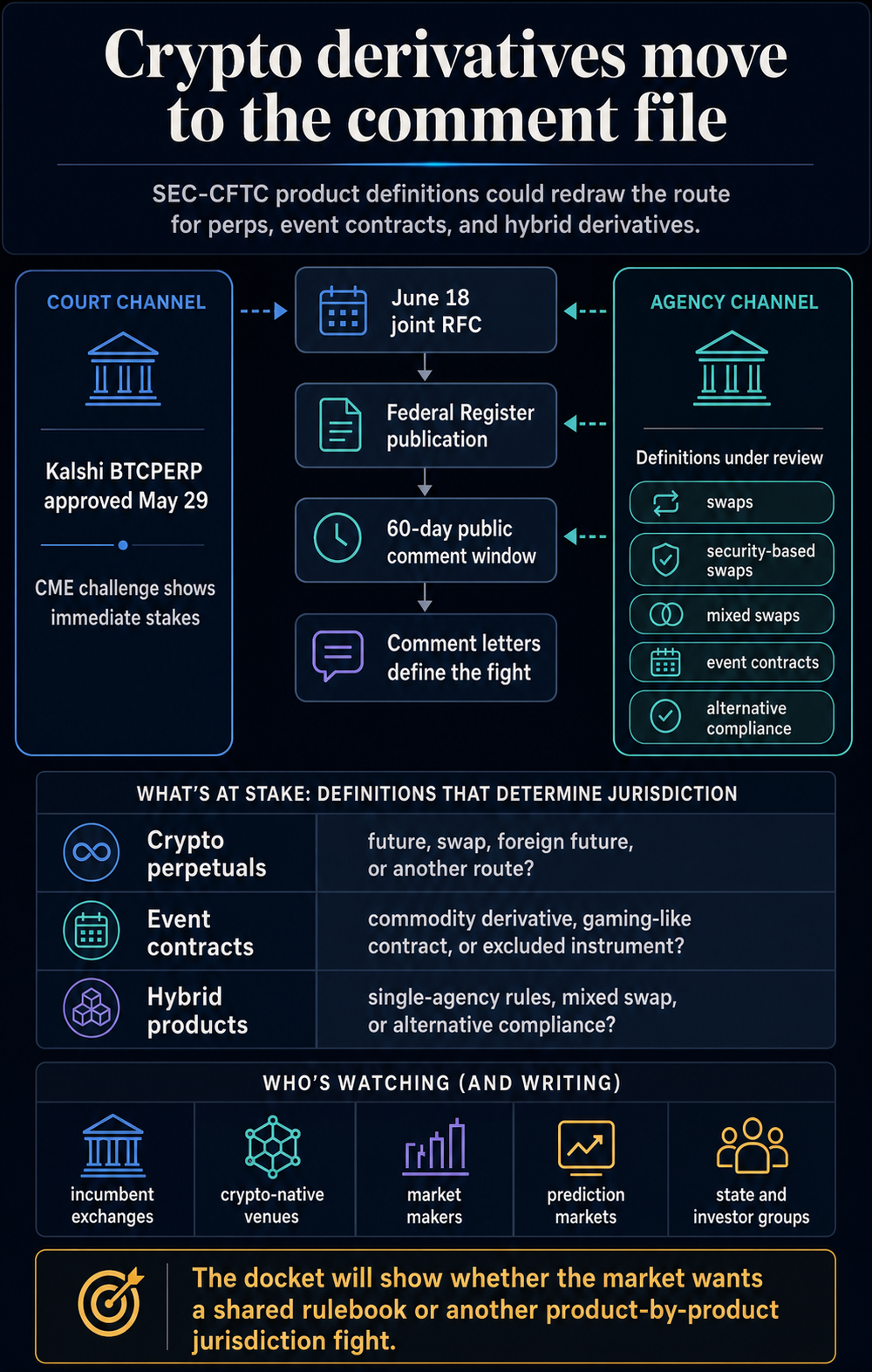
The next fight over crypto perpetual futures regulation is moving into the agency comment file: a place built for lawyers, incumbents, startups, and public-interest groups.
The Commodity Futures Trading Commission and Securities and Exchange Commission opened the process June 18, seeking public comment on how to further define swaps, security-based swaps, mixed swaps, novel products, event contracts, and possible alternative compliance approaches.
That now makes SEC-CFTC product definitions a market-structure issue that extends beyond a single listing.
The joint request for comment turns the fight over crypto perpetuals and prediction-market products into a formal venue before the next wave of approvals reaches the same point.
The stakes are practical: the current derivatives argument reaches beyond whether one exchange wins one approval. The product label often shapes how a contract launches, who can list it, which rulebook governs the trade, what reporting or oversight expectations apply, and whether a crypto-native venue can seek an alternative compliance path rather than fitting a model designed for a different market.
The public comment period will remain open for 60 days after the request is published in the Federal Register, according to the agencies.
Until then, the most important near-term signal may come from the first set of comment letters from exchanges, market makers, prediction-market operators, crypto platforms, and groups focused on gaming, state jurisdiction, market integrity, or investor protection.
Crypto perpetual futures regulation turns on product labels
The request asks for comment on product definitions under Title VII of Dodd-Frank, the post-crisis framework that divided swaps and security-based swaps between the CFTC and SEC.
That sounds technical, but in practice, the definitions determine which regulator oversees the product, which venue can list it, and which rulebook governs the trade.
For crypto, the practical question is how those legal categories handle products that trade continuously, settle in cash, reference crypto prices, resemble prediction-market exposure, or blend features that legacy markets treated separately.
The request asks for feedback and insights into event contracts, innovative product structures, exclusions from the swap definition, mixed swaps, futures treatment, and alternative compliance. It also asks whether a cash-settled perpetual contract referencing an equity security could be treated as a security future, and what effects such products could have on liquidity, price discovery, and hedging.
Equity-security concerns stocks rather than Bitcoin, yet it poses a live classification test for crypto perp markets: how should the agencies classify instruments that do not fit cleanly into older product lines?
| Product type | Regulatory question | Practical effect |
|---|---|---|
| Crypto perpetuals | Future, swap, foreign future, or another route? | The answer affects launch process, venue eligibility, margin, reporting, and retail access. |
| Event contracts | Commodity derivative, gaming-like contract, or excluded instrument? | The answer affects prediction markets, specified event products, and federal versus state control. |
| Hybrid products | Single-agency product, mixed swap, or candidate for alternative compliance? | The answer affects whether one regulator’s framework can satisfy another regulator’s concerns. |
The agencies have already set a policy backdrop. A March SEC-CFTC harmonization memorandum committed the regulators to coordinate on product definitions, crypto assets, emerging technologies, alternative compliance, data sharing, and cross-market oversight.
The same memorandum preserves each agency’s statutory authority. That caveat is central: comment letters can shape the agencies’ next move, but they cannot by themselves rewrite the law.

Kalshi turns Bitcoin perp classification into a live market fight
The immediate crypto connection is Kalshi. On May 29, the CFTC approved KalshiEX’s BTCPERP contract as a futures contract referencing the spot price of Bitcoin after a May 28 submission under Regulation 40.3.
The approval order described a cash-settled Bitcoin-referenced contract that trades in units of one ten-thousandth of one Bitcoin, has no fixed expiration, marks positions to market continuously, and uses funding payments to maintain convergence with the reference price.
That gets to the heart of the classification problem. A product can look to traders like familiar crypto perp exposure while asking regulators to treat it as a futures contract.
The practical question for Bitcoin perpetual futures is whether a crypto-style perp can sit within a regulated US futures framework without becoming a swap.
If that treatment becomes durable, regulated US venues may have a path to list products that offshore crypto exchanges helped popularize. If it changes, venues seeking similar exposure may need other regulatory routes.

The nearby CME/Kalshi dispute shows why the definitional fight has immediate market stakes. In the lawsuit, CME argues Kalshi’s Bitcoin perp was wrongly treated as a futures product, while the broader dispute tests whether a prediction-market venue can move toward a larger derivatives model.
The court fight is one channel, but the SEC-CFTC request now opens another.
In a lawsuit, parties argue over an approval that already happened. In a comment process, the industry can tell both agencies what future products should be called before the next wave reaches the same point.
The CFTC has also opened another path for crypto perps. On the same day as the Kalshi approval, CFTC staff confirmed a foreign-futures path for certain crypto-asset perpetuals tied to Coinbase Financial Markets’ Deribit affiliate and issued related no-action relief for customer-owned crypto and stablecoin margin transfers.
That shows the classification issue is not one-dimensional. US listing, foreign-board access, margin treatment, and agency coordination all shape where crypto derivatives liquidity can land.
Event contracts are part of the same perimeter fight
The request also arrives as event contracts face their own rule process. On June 10, the CFTC published a proposal concerning event contracts involving specified activities such as gaming, unlawful activity, war, terrorism, or assassination.
The proposal would create a structured review framework for those contracts and sits alongside a broader debate over prediction markets.
The overlap is structural. Event products and crypto perps differ, but they can converge inside venue strategies built around cash-settled products, continuous trading, retail-facing access, and federal derivatives rules.
A venue that can list Bitcoin exposure and specified event contracts in a single account presents a different kind of market-structure problem than a traditional futures exchange listing a single product family.

The comment file is where that convergence becomes more concrete. Incumbent exchanges can press for comparable rules when products create similar risk.
Crypto-native venues can argue that older categories block lawful products from moving onshore. Prediction-market operators can argue for federal treatment of event contracts.
Gaming interests, state officials, and investor-protection groups can press the agencies on jurisdiction, leverage, surveillance, retail suitability, and disclosure.
The Futures Industry Association and FIA Principal Traders Group had already made part of that case before the current lawsuit. In a 2025 response to a CFTC request for comment on perpetual contracts, the groups said that perpetual derivatives raise novel trading and clearing risk-management questions, urged clearer definitions, and called for a formal public process before broader rulemaking.
The June 18 request gives that kind of argument a cross-agency audience.
The next signal will be who writes first. The SEC’s comment form for S7-2026-21 says comments will be publicly available.
That turns the docket into a map of priorities. If incumbent exchanges focus on swap classification, process, and competitive injury, the filings may point toward pressure to slow product expansion.
If crypto-native venues focus on alternative compliance, foreign futures access, and onshore launch paths, the focus shifts to how the agencies might allow new products to reach US traders without duplicative regulation.
The most useful letters may not be the loudest ones. A market maker could explain how margin and liquidation rules would work across venues.
A clearing firm could focus on what happens when a perpetual contract trades through stress. A prediction-market operator could argue that event contracts can sit inside federal derivatives law without becoming sportsbooks.
A state official or gaming group could argue the opposite.
The agencies’ own language points to the tradeoff. They ask for clearer lines, but they also ask about alternative compliance.
The broader harmonization agenda points to data sharing and cross-market oversight, while the March memorandum preserves statutory mandates. The result is a public contest over which product designs deserve a workable US path and which ones should face the heavier obligations attached to swaps or securities-linked instruments.
For traders, the practical question is whether more of the crypto derivatives market can move onto regulated US venues with rules that fit the product.
For venues, it is whether the agencies draw product lines that make new launches predictable. For incumbents, it is whether the comment file gives them a way to insist on comparable compliance burdens before new platforms scale.
The next crypto perps dispute may still pass through court. After the June 18 request, it will also pass through comment letters.
Those filings will show whether the market wants a shared rulebook for hybrid derivatives, or whether every new product will keep turning into another fight over which regulator gets the trade.