
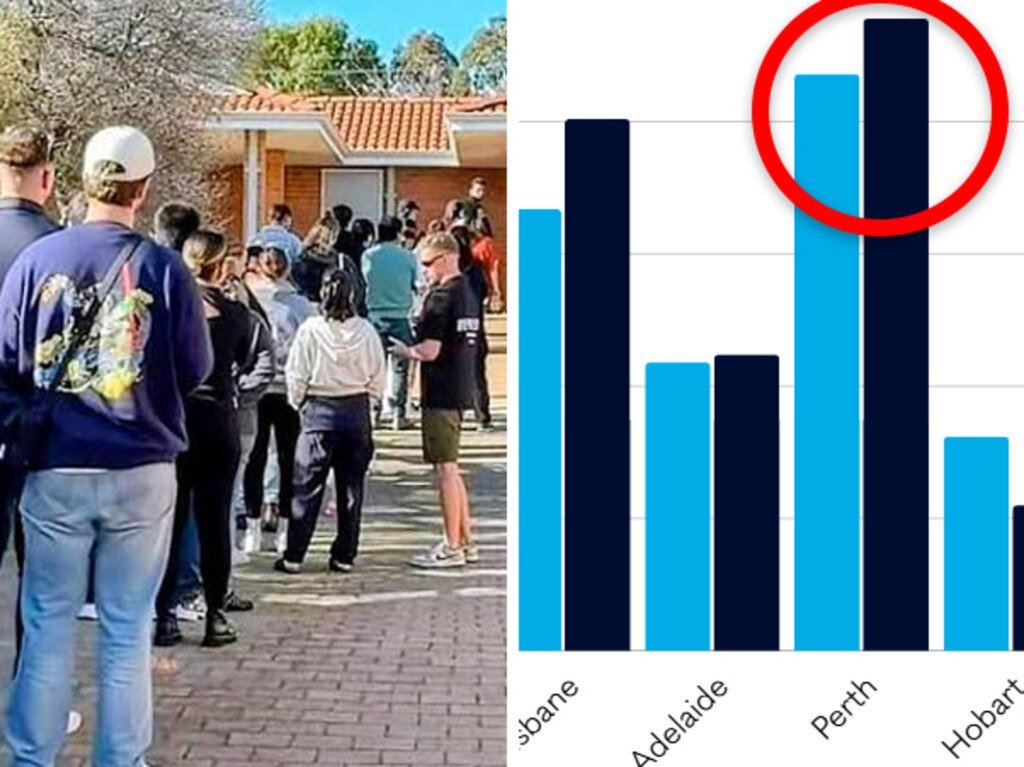
Australia has been named among the world’s top ‘forever renter’ nations, with new research revealing house prices have grown almost 22 per cent faster than incomes in just a decade.
The widening affordability gap places Australia 15th out of 39 OECD countries in the Forever Renter Global Index, which examined where long-term renting is becoming increasingly entrenched as homeownership slips further out of reach.
RELATED: Lazy tax: Shock move as Aus banks slash rates
A home leased in Geelong, Victoria.
The research by furniture retailer Luxo Living using the OECD Affordable Housing Index analyses the proportion of renters and homeowners alongside housing costs, overcrowding, and changes in house prices relative to incomes.
Australia recorded a score of 48.1 out of 100, narrowly ahead of the United States on 48, but it was the deterioration in housing affordability that stood out.
Australia’s house price-to-income index has climbed to 121 from a baseline of 100 in 2015, meaning property prices have risen almost 22 per cent faster than household incomes over the period.
That was the sixth-largest gap among the 31 countries for which comparable price-to-income data was available.

Australia ranks in the top 20 countries when it comes to renting, according to a new survey.
Only Portugal, Canada, the US, the Netherlands and Switzerland recorded a greater deterioration in affordability.
The figures highlight the challenge facing Australians trying to make the transition from renting to owning, with almost one-third of households now renting.
Renters account for 31.7 per cent of Australian households, while the homeownership rate sits at 62.7 per cent, according to the analysis.
Australian renters are spending a median 23.1 per cent of their disposable income on housing costs, including rent and utilities.
However, Australia performed comparatively well when it came to households experiencing the most severe housing stress.
About 6.5 per cent of households spend more than 40 per cent of their income on housing, compared with 22.7 per cent in Denmark and 20.1 per cent in Luxembourg.
A new ‘forever renter’ index has ranked Australia 15th in the world.
Australia’s trans-Tasman neighbour ranked even higher on the “forever renter” scale, with New Zealand coming in 10th.
More than four in 10 New Zealand households rent, while its homeownership rate has fallen to 57.5 per cent.
Colombia topped the global index with a score of 71, followed by Denmark on 67 and Chile on 64.
Luxo Living chief executive Winston Tu said the growth of long-term renting was also changing the way people approached their homes.
“‘Forever renters’ are no longer a niche group, they’re shaping how an entire generation lives, decorates and invests in their homes,” he said.
“As renting becomes the default rather than a stepping stone, furniture suppliers like us have had to evolve.”
Winston Tu, Founder & CEO of Luxo Living.
It comes as unions propose a new Australian tenancy standard of two years from one year, and for one in 10 new homes built to be for public housing.
Under the proposal taken to the federal government this week, landlords would be required to offer at least two years of housing security as the default standard, with renters still free to choose shorter leases.
ACTU president Michele O’Neil said housing had become a source of stress rather than security, with many workers not able to find secure, affordable housing near where they worked.
“We want to see strong rights for renters and a substantial increase in public housing,” she said.
ACTU President Michele O’Neil. Picture: Martin Ollman.
“Nurses, teachers and other workers are living with the yearly uncertainty that comes with constant rent hikes and one-year leases being the standard option.
“Our housing system should reflect the reality that millions of working people are renters. Workers deserve not only secure jobs, but also secure housing.
“Moving homes costs money, disrupts lives, and too often pushes workers further away from their jobs. Doubling the default rental standard from one to two years would still allow renters to choose shorter leases, but it would give workers more certainty and stability to plan their lives.”