
I would like to take this opportunity to share with you an income plan that can provide you with a monthly income from year 13 onward for the rest of your life.
If you put in an initial premium of $1,000,000 today, you will get an approximate income of $9,667 monthly (or $116k yearly). You will be able to achieve an ROI (return on investment)/yield of 12% p.a.
Would you be available to meet me to find out more about this income plan?
One of my friend put this advisory sales pitch that his relative got on my radar.
Man, I think this is a pretty good pitch and I am not sure if my readers have heard this before.
I am sure you have.
This layout of pitch comes from CPF.
For a number of years, we seen countless of articles (probably here on Investment Moats as well) that goes the same way.
Let me generate for you.

Suppose Kyith is 55 this year and born in 1971 and I reached CPF Full Retirement Sum of $220,400 in my CPF OA and SA.

If I have $220,400, I could estimate to have $1,750 monthly income 10 years later!
That is a ROI/yield of about 10%!
I also rounded up the yield just like the sales pitch from 9.53% to 10%. In the sales pitch above its actually 11.6% but round up to 12% so that its nicer.
But is such sales pitch wrong?
I don’t think it’s wrong.
These kinds of examples are meant to catch your interest, so the numbers are picked to feel close to you. Say the example uses $1 million, and you don’t have that much to put into a single-premium insurance policy. Then you might not be very interested, and I understand that.
But if the example is for an older person with around $500,000, that number feels much more real. The payout also needs to be something close to what you actually need. A lot of people feel that $4,000 to $6,000 a month is enough for retirement, so those are the numbers that get used.
If you work out the math using projections and all of that, the final presentation won’t be wrong. I hope that makes sense, and I’m open to hearing if you see it differently.
I think the bigger issue over the long run is the way these products play with the time period and the returns. Other investments can do the same thing too, and honestly, they could have done better than this.
The problem is that the advisor probably isn’t selling those kinds of things. That’s where the person listening to the sales pitch comes in.
Buyers could end up short-changed, and there’s an opportunity cost they might not see. Maybe it would be a better idea to set up an income strategy that’s more suitable and safer for them.
Here’s How the Actual Math Behind this Mental Advisory Mirage Work.
The following is an illustration of putting in a single lump-sum (can be investment or an insurance product wrapper, wrapping around an insurance product) of $1,000,000 at the start and 10 years later provide a pretty attractive income:

What the advisor is showing you is the starting capital today ($1M), and the income you’d get about 10 or 11 years later ($95,000 a year).
A lot of people don’t realise how much their money can grow over 10 years.
Here, we’re using a growth rate of 9.1% a year for the first 10 years. At that rate, $1 million grows to $2.38 million before we start taking any income from it.
How much income can you take out at the end of those ten years?
It really depends on the income strategy you’re using. If it’s an insurance product, the actuary can work out a steady income stream for you to take.
If you’re doing this yourself, you could use what we call a safe withdrawal rate (can read Why the Safe Withdrawal Rate (SWR) is Essential for Your Financial Independence). For people who lean more toward dividends, you could start with a conservative dividend rate instead.
Either way, it works out to be a percentage of the portfolio/plan value at the start of income paying. In this example the portfolio value is $2.38 mil.
We are using a 4% SWR here and so if we take $2.38 x 4% we get $95k.
The mental advisory mirage is getting you to relate this $95k to the $1 million instead of $2.38 million
A difference of 10% instead of 4%.
You ask yourself which number looks attractive to you? 10% or 4%?
Of course in sales we will use 10%.
There are Further Mental Mirage Tricks to Play on You
In this example, I use 9.1% growth which is the median return of MSCI World USD.
Now who uses a median return over a 56 year period to illustrate to prospects? You should use the more optimistic figures that your compliance team will not have a problem with.
We are so fortunate that equity returns in the past 15 years have been so good.
Now let me shift this from median to perhaps the 80th percentile of MSCI World USD 10-year return:

Instead of 9.1% p.a. returns, its 14% p.a. return.
Your $1 million today would grow to $3.7 million 10 years later. Based on 4%, you can get $149,000 yearly in income!
That is a 15% ROI/yield on $1 million!
Isn’t this even better than that 12% ROI/yield from the sales pitch?
Now since we are on 80th percentile 10-year return, maybe Kyith can spoil the sales pitch (like I often do), to show you the 20th percentile 10-year return:

The return rate is 5.9% a year instead of 9.1% a year. You will only get $71,000 yearly income.
I say only because some of you consider $5,920 monthly income to be pretty decent if returns are not so good.
You will also remember that I use a 4% percentage to figure out the starting income.
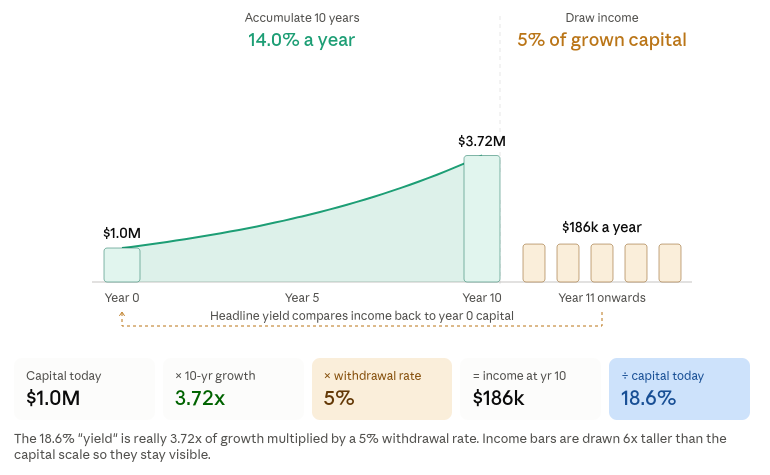
I can be more risk-seeking as a sales person and use… 5%, with an 80th percentile 10-year return:

Your $1 million grows to $3.7 mil… but you are able to extract $186,000 yearly or $15,500 monthly from this!
I think this is bordering on a poor sales pitch… purely because the number is so crazy that normal people will be thinking this is a scam.
Numbers have to be reasonable.
Now since I have the data let me present it in table:
| Percentile | 10-yr growth | CAGR | @2.5% | @3% | @4% | @5% |
|---|---|---|---|---|---|---|
| Worst | 0.77x | -2.5% | 1.9% | 2.3% | 3.1% | 3.9% |
| P10 | 1.50x | 4.1% | 3.7% | 4.5% | 6.0% | 7.5% |
| P20 | 1.77x | 5.9% | 4.4% | 5.3% | 7.1% | 8.9% |
| P30 | 1.97x | 7.0% | 4.9% | 5.9% | 7.9% | 9.8% |
| P40 | 2.09x | 7.7% | 5.2% | 6.3% | 8.4% | 10.5% |
| P50 | 2.38x | 9.1% | 5.9% | 7.1% | 9.5% | 11.9% |
| P60 | 2.60x | 10.0% | 6.5% | 7.8% | 10.4% | 13.0% |
| P70 | 2.95x | 11.4% | 7.4% | 8.9% | 11.8% | 14.7% |
| P80 | 3.72x | 14.0% | 9.3% | 11.2% | 14.9% | 18.6% |
| P90 | 4.52x | 16.3% | 11.3% | 13.5% | 18.1% | 22.6% |
| Best | 6.22x | 20.1% | 15.5% | 18.7% | 24.9% | 31.1% |
This breaks down the 56 year MSCI World USD return into worst to the best, and splitting the return into 9 more buckets. This allow you to see the range of 10-year return.
I put the yield, based on starting $1 mil, based on whether we are using 2.5% of the portfolio value right before income extraction, or 3%, 4% and 5%.
If you are an income person and think that the next 10 years can have the same return as the past 10 years then your CAGR can be at the 80th percentile or 14% p.a., and if you wish to be conservative, you can look at a 2.5% initial SWR and that would mean the income is 9.3% of that original $1 mil (93k a year)
Getting $7,750 monthly on $1 million in lump sum investment is not outrageous. But it requires the market to be doing that well… and you don’t get a 4.1% p.a. return (look at the 10th percentile)
I don’t think we can call the projection returns in insurance plans false, since it does have some real data behind it. The problem is that the period they picked is fairly recent and fairly short. If you zoom out and look at a bigger set of returns, you’ll see it was a pretty optimistic stretch.
It’s nice that you’d feel good about the future if returns are strong. I’m just not sure you’d feel the same way, or stay as calm, if returns came in much lower than expected.
Epilogue – Usually You Mentally Get Yourself into Products You Ultimately Realize are Mediocre.
I think salespeople will always find a way to work within what they are allowed to say, so that you become interested enough to come in for a meeting.
In a way, many sales persons are trained to explain the idea well, and they leave out most of the technical jargon. Good salespeople can do that. It’s a natural part of the job.
I’ve found that it’s more often our affinity to some securities, some investment ideas or strategy that quietly sneaks up on us.
The problem isn’t really the math.
The problem is that the salesperson is playing a mental trick on you. And to you all these mental trick make the product sounds more special than they really are.
I think we often see this, even with some of our clients, even after they have gotten to know our advisers. Our advisors keep seeing their clients buy the same things, even after we explain our thinking on these securities and investment strategies.
I could be wrong, but I think for some people, knowing more isn’t really what matters.
It’s more about how it gets explained. When it actually clicks in their mind, it can stop them from falling for these kinds of things.

Kyith is the Owner and Sole Writer behind Investment Moats. Readers tune in to Investment Moats to learn and build stronger, firmer wealth foundations, how to have a Passive investment strategy, know more about investing in REITs and the nuts and bolts of Active Investing.
Readers also follow Kyith to learn how to plan well for Financial Security and Financial Independence.
Kyith worked as an IT operations engineer from 2004 to 2019. Currently, he works as a Senior Solutions Specialist in Fee-only Wealth Advisory Firm Providend. All opinions on Investment Moats are his own and does not represent the views of Providend.
You can view Kyith’s current portfolio here, which uses his Free Google Stock Portfolio Tracker.
His investment broker of choice is Interactive Brokers, which allows him to invest in securities from different exchanges all over the world, at very low commission rates, without custodian fees, near spot currency rates.
You can read more about Kyith here.