The Commodity Futures Trading Commission (CFTC) has ordered Kalshi to keep operating after the prediction-market exchange declared a market emergency tied to New York’s enforcement campaign.
The move marks the strongest federal intervention yet in the widening fight over whether states can apply gambling laws to event contracts offered on CFTC-regulated exchanges.
It also comes as New York authorities broaden their scrutiny of prediction markets beyond Kalshi’s legal status, even as the company continues posting rapid growth and seeks a valuation of about $40 billion.
CFTC says New York action threatens national derivatives market
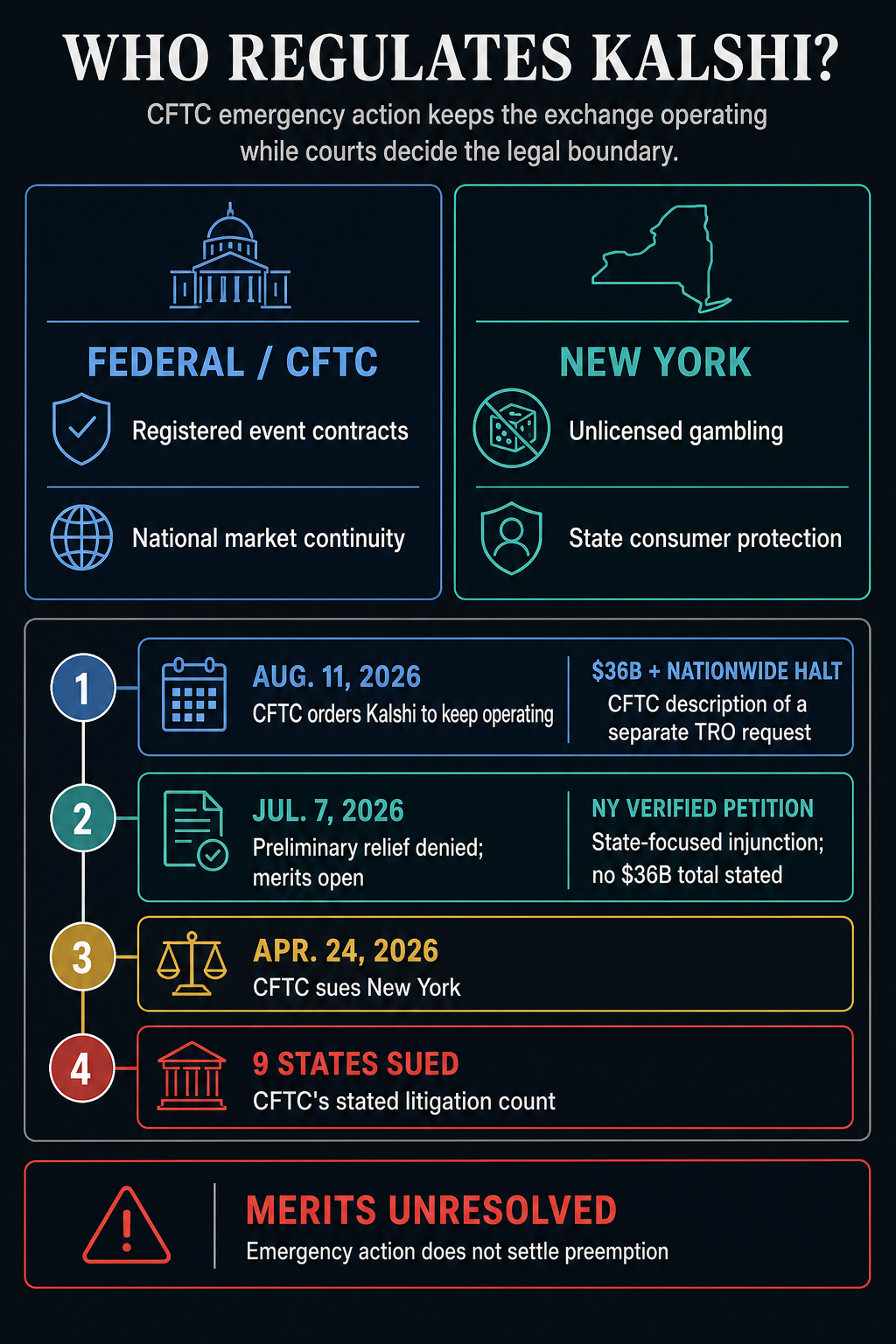
On Aug. 11, the CFTC directed KalshiEX LLC to continue operating under the Commodity Exchange Act’s Core Principles after the exchange told the regulator that New York’s enforcement effort had created a market emergency.
The agency said New York is seeking temporary relief that could prevent Kalshi from offering event contracts nationwide and expose the exchange to more than $36 billion in damages.
The dispute stems from Attorney General Letitia James’ July 31 lawsuit, which alleges that Kalshi offers sports prediction markets without a license from the New York State Gaming Commission.
Her office argues that Kalshi is effectively operating an unlicensed gambling business while avoiding obligations imposed on regulated casinos and sportsbooks, including taxes and consumer-protection requirements.
New York is asking the court to force Kalshi to surrender gains tied to the alleged violations, provide restitution to affected consumers, and pay penalties equal to three times those gains.
CFTC Chairman Michael Selig rejected that approach, accusing New York of trying to make event-contract derivatives “waste away under its iron curtain of state gaming laws” before courts can issue final rulings.
Selig argued that Congress did not intend federally regulated derivatives exchanges to be governed by a patchwork of state gambling laws. He said platforms such as Kalshi operate across state lines by matching bids and offers from users in different jurisdictions before sending trades to clearinghouses that back transactions nationwide.
“New York has no business regulating these interstate financial markets,” Selig said, adding that the CFTC is required by law to maintain order in them.
That position has already pushed the regulator into a broader fight with states over prediction markets. Over the past months, the CFTC has filed lawsuits against several US states, including Arizona, Connecticut, Illinois, New York, Rhode Island and Wisconsin, while also submitting amicus briefs in related cases before federal appeals courts and the Massachusetts Supreme Judicial Court.
The agency said keeping Kalshi operational is necessary to preserve market resilience, orderly trading and price discovery, arguing that disruption of a federally regulated exchange could undermine its mandate to maintain a uniform national derivatives market.
Still, the emergency order does not resolve the underlying question of whether federal derivatives law preempts state gambling rules.
New York widens pressure on Kalshi beyond the courtroom
New York’s push against prediction markets is expanding beyond the attorney general’s gambling case.
On Aug. 12, New York City Council Speaker Julie Menin said the Council had spent several months examining allegations of “false, deceptive, unconscionable, and objectionable marketing practices” across the prediction-market industry.
Menin sent letters to Kalshi, Polymarket, Coinbase, and Gemini Titan seeking information about how they promote contracts tied to sports, politics, culture, weather and other events.
The Council also plans to hold a hearing as it considers whether existing consumer-protection rules are sufficient or whether new legislation, enforcement measures, public education campaigns and other safeguards are needed.
The inquiry is particularly focused on whether prediction-market platforms are using marketing tactics that could mislead younger consumers. The Council cited allegations involving undisclosed influencer promotions, fabricated depictions of profitable trades and other advertising designed to encourage participation in event contracts.
Menin said the rapid growth of prediction markets has increased the urgency of that review, particularly because the platforms are not subject to some of the marketing restrictions that apply to casinos and online sportsbooks.
“Prediction markets aggressively entice consumers to bet and wager on sports, politics, culture, weather, and pretty much anything,” Menin said, adding that the Council intends to use its authority to address deceptive and predatory marketing.
The investigation creates a second pressure point for Kalshi in New York.
At the state level, officials are challenging whether some of its contracts can legally be offered without a gambling license.
At the city level, lawmakers are now examining how Kalshi and other prediction-market platforms attract and market those products to consumers.
Kalshi growth marches on despite mounting scrutiny
The growing regulatory pressure has so far done little to slow Kalshi’s commercial expansion.
The company is reportedly in advanced talks to raise a Series G round at a valuation of about $40 billion, nearly double the $22 billion valuation attached to its May funding round.
That prospective jump follows a sharp acceleration in revenue. Kalshi’s annualized revenue exceeded $4 billion in July, up from more than $2 billion two months earlier, with World Cup trading helping drive the increase.
Sports have become an increasingly important part of that growth. Kalshi processed about $27 billion in trading during the World Cup and attracted roughly 3 million users over the tournament. More recently, the platform handled around $11 billion in trading over the past 30 days, according to DefiLlama data.
That momentum sharpens the contrast with the regulatory fight surrounding the company.
New York is expanding its effort to bring prediction markets under gambling and consumer-protection rules, while the CFTC is using federal authority to prevent those efforts from disrupting a nationally regulated derivatives exchange.
Kalshi, meanwhile, continues to add users, increase revenue, and pursue a valuation that would place it among the most valuable private fintech companies.
The unresolved question is whether that trajectory can hold if courts ultimately determine that federal derivatives oversight does not fully shield Kalshi’s fastest-growing markets from state gambling laws.