
I am still on holiday now but I got to work on Gilgamesh, my personal project on and off while travelling around.
I used to have someone ask me if they would like to invest only in financials, or invest only in financial companies in their kid’s long term portfolio is a good idea.
With how well the local banks UOB, OCBC and DBS is doing, not to mention JPMorgan and Goldman Sachs, you can get the idea. Even local ETF providers hop on the bandwagon to launch financials-themed ETFs.
Gilgamesh allows me to crunch some market returns data to show enlightening view of portfolios easier.
Perhaps the most all encompassing financials portfolio is the MSCI All Country World Financials Index. This is an index that includes the financial firms in developed as well as emerging markets.
If you Google “MSCI ACWI Financials Index”, you would be able to get the factsheet.
The MSCI All Country World Financials index did an annualized return of 11.9% p.a. compare to 12.3% p.a. of the MSCI All Country World index. Not too shabby of a return.
You would understand why folks are so enamored in a sector.
It also helps if you look at the top holdings:


But what if you have $1 million, a significant part of your net wealth and you would invest in a MSCI All Country World Financials at ANY point in the past 20 years?
I have the index market return data from Oct 2004 to Dec 2025, which is 20.9 years of market return data. This allows us to see if you invest that $1 million at any month, how would your 5-year, 10-year, 15-year, 20-year return be like.
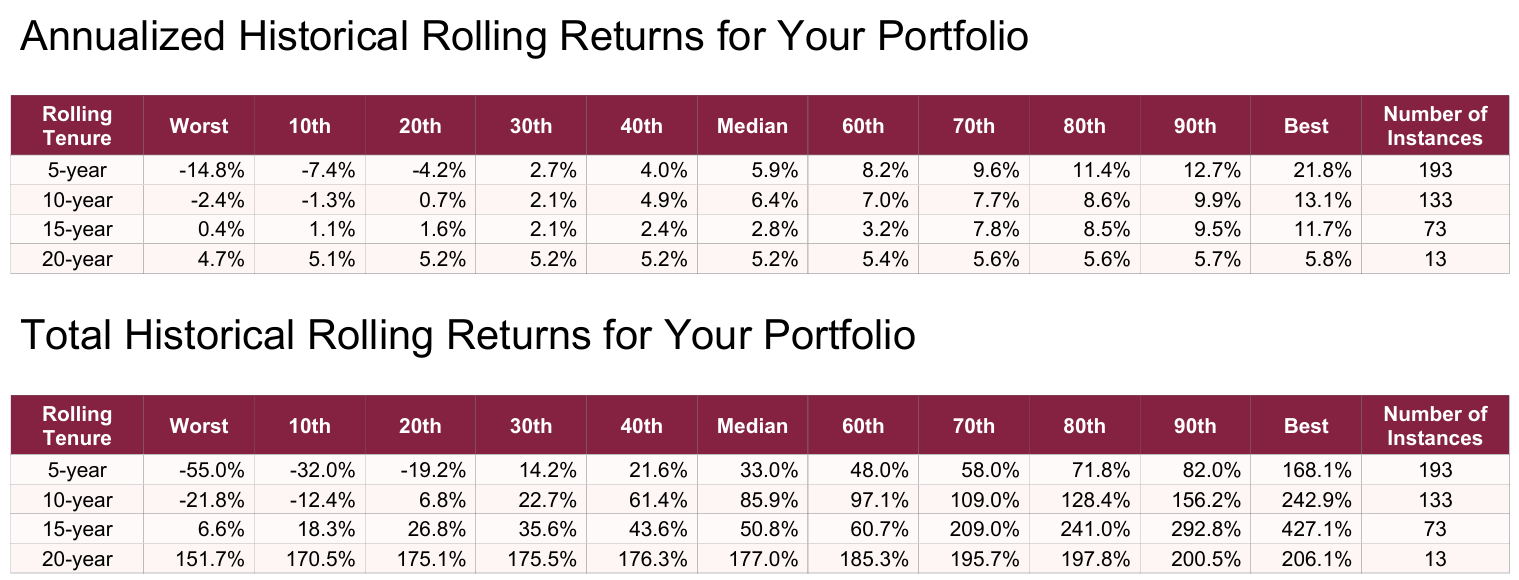
The annualized return is as follows:

If we roll the return tenure month by month, we can get a range of annualized return and we can slice and put them into 9 buckets, from the worst annualized return to the best annualized return.
Number of instance show how many x-year periods we are able to simulate. For example, 193 instance of 5-year rolling tenure, means there are 193 5-year annualized returns from Oct 2004 to Dec 2025.
You can get -13.4% p.a. after investing for 5 years.
This should be the worst of the great financial crisis that the absolute top.
As you invest longer, the worst or 10th, 20th percentile returns get better.
But you may be surprised that the median return even 15-years is 2.8% p.a.
The 80th, 90th percentile and best shows you that you can invest for 15-years and get 8% or 10% p.a. returns. But that is if you are lucky.
Gilgamesh can also show us the unannualized cumulative return or what we call total return:

So you can invest for 5 years and a $1 mil portfolio is left with $490k.
Looking at unannualized returns sometimes can be pretty startling but shows closer to reality.
But Kyith, what if you take out emerging markets?
That is a good question.
You got to consider, Singapore at one point, is an emerging markets, and you would want to invest in the Singapore banks when they were financing the growth during the growth phase of our country.
Would it be wise to take out emerging markets? It is like taking out Singapore or are you saying Singapore banks are so unique that if we present a rolling return profile like the above, they would look absolutely different?
Let me be more obliging and provide the rolling returns of the MSCI World Financials index, an index without emerging markets:

The returns look actually worse than with emerging markets.
At some point you got to acknowledge your investment experience can be less certain than you imagined.
The advise is to not be too concentrated in a sector. There is no best or worse sector. Every sector would have their day where they do better. It is whether you are more aware or less.
If you want to trade these stocks I mentioned, you can open an account with Interactive Brokers. Interactive Brokers is the leading low-cost and efficient broker I use and trust to invest & trade my holdings in Singapore, the United States, London Stock Exchange and Hong Kong Stock Exchange. They allow you to trade stocks, ETFs, options, futures, forex, bonds and funds worldwide from a single integrated account.
You can read more about my thoughts about Interactive Brokers in this Interactive Brokers Deep Dive Series, starting with how to create & fund your Interactive Brokers account easily.

Kyith is the Owner and Sole Writer behind Investment Moats. Readers tune in to Investment Moats to learn and build stronger, firmer wealth foundations, how to have a Passive investment strategy, know more about investing in REITs and the nuts and bolts of Active Investing.
Readers also follow Kyith to learn how to plan well for Financial Security and Financial Independence.
Kyith worked as an IT operations engineer from 2004 to 2019. Currently, he works as a Senior Solutions Specialist in Insurance Start-up Havend. All opinions on Investment Moats are his own and does not represent the views of Providend.
You can view Kyith’s current portfolio here, which uses his Free Google Stock Portfolio Tracker.
His investment broker of choice is Interactive Brokers, which allows him to invest in securities from different exchanges all over the world, at very low commission rates, without custodian fees, near spot currency rates.
You can read more about Kyith here.