
A couple of days ago, I made some re-allocation of the global equity allocation of my Daedalus Income portfolio [The latest portfolio update here]
Some have commented my portfolio is rather complicated but generally the following funds are systematic-active funds based around the developed world region:
| Fund | Value |
| iShares Edge MSCI World Multifactor UCITS ETF (IFSW) | $83,729 |
| JPM Global Equity Multi-Factor UCITS ETF (JPGL) | $233,431 |
| WisdomTree Global Quality Dividend Growth UCITS ETF (GGRA) | $201,155 |
| Avantis Global Equity UCITS ETF (AVGC) | $161,589 |
| Dimensional World Equity Acc SGD | $94,978 |
| VanEck Morningstar US Wide Moat UCITS ETF (MOTU) | $10,281 |
| Total | $785,163 (48% of portfolio) |
If you wish to keep your developed world allocation simple, you could use one of these funds. You could even use an MSCI World index fund if you don’t understand or don’t shared the same systematic active philosophy. There is no harm there since MSCI World have done pretty well against these funds for the past few years. You may only be looking deeper into these systematic funds only in the case when MSCI World don’t do as well for a few years (which is usually not a good time to look into it).
Dimensional World Equity technically is a developed + emerging market fund. This is where 60% of my SRS money resides (with the other 40% in Dimensional Global Targeted Value). MOTU is actually US based but constitute a rather small portion of the portfolio. I keep it around to track its performance.
I reallocated about S$90,000 and the final allocation is roughly this (20th Dec 2025):
| Fund | Value |
| iShares STOXX World Equity Multifactor UCITS ETF (IFSW) | $145,145 (increase) |
| JPM Global Equity Multi-Factor UCITS ETF (JPGL) | $183,304 (reduce) |
| WisdomTree Global Quality Dividend Growth UCITS ETF (GGRA) | $161,351 (reduce) |
| Avantis Global Equity UCITS ETF (AVGC) | $194,392 (increase) |
| Dimensional World Equity Acc SGD | $94,978 |
| VanEck Morningstar US Wide Moat UCITS ETF (MOTU) | $10,281 |
| Total | $789,451 (48% of portfolio) |
This S$90,000 is sold out from JPGL and GGRA and S$30,000 reallocated to AVGC and S$60,000 reallocated to IFSW.
You may also notice that the name of IFSW… is slightly different from the previous table. This is part of the update of this article and why it warrants some reallocation capital.
This is a small tweak to the portfolio in the grand scheme of things because the majority of the long term returns (> 10 years) are going to be driven by:
- The region: In this case how well the developed world will do.
- The asset class: Equities
If both of these don’t do well in the next year, 3 years, all these tweaks may only make the performance slightly better. They cannot overturn a -30% drawdown.
The premiums, or the additional returns that we can earn by systematically trying to harvest our risk taking in cheaper, more profitable and higher momentum companies can only be observe over time and not in 1 or 2 years. Avantis Small Cap value shows meaningful performance difference of 50% over 5 years, and so is iShares Emerging Market Value Factor over Emerging Market.
The longer term goal is to identify just a couple of main systematic active funds out of all these funds that I understand better, have enough time to assess their implementation, and just stick with them.
- I like JPGL’s neutral over each sector and it will do well versus the others during correction but JPMorgan really didn’t say much about their methodology. I divert money due to the lack of transparency.
- GGRA is in the portfolio because I wanted a portfolio that is more profitability/quality based. Back then, there were not a lot of clear option. The methodology to rank high quality dividend growth, in a way pick security with higher return on asset, growth in earnings for the past few years (you can read the methodology here). But in a way, now we have more option that gives us exposure to fundamental profitability factors in AVGC and IFSW that I might not need GGRA. I divert money due to this reason. I suspect GGRA will be the first to make way, leaving me with IFSW, AVGC and JPGL.
- I understand AVGC to a certain degree due to my experience with what I learn at work with Dimensional. Avantis also have enough public resources to help enlighten us on their methodology and their attribution. They also show that they are open to questions. I gave them 1 year since they started to assess their implementation and they have done alright. This is why I increase my allocation.
The part that I want to spend a little more time to discuss is IFSW.
iShares Decides to Switch their Multifactor Strategy by Adopting STOXX’s Equity Factor Screened Strategy
One fine day, for some reason, I decide to take a look at IFSW (the ETF’s ticker) webpage. I notice for some reason, the name of the ETF appeared to be different and I wonder if I landed on the right page. When I check the factsheet, to my horror, I saw that this is really the fund that I have invested in.
Even without looking at the news, I got that sick feeling that iShares decide for some reason to change its methodology how they implement their multifactor strategy.
The official news release can be seen here on ETF Stream: BlackRock drops MSCI indices from three multifactor ETFs
I was disappointed with the whole process in that this is quite a big deal and I didn’t get any updates from my broker (IBKR) or something that was initiated by iShares.
Let this be a lesson that it is very possible that an ETF provider would change its strategy. I think whether it is for the better or worse is subjective. Firms such as Dimensional and Avantis live and die by their methodology, and they are usually on a look out for implementable edges that can improve your expected returns. I am less sure about the motivation of large asset managers such as BlackRock and JPMorgan when they list an ETF because the motivation is just to have a name multifactor option so that they can complete their product range.
They may have less motivation how well the fund does.
In the case of moving from MSCI strategy to STOXX, I suspect that this is a cost thing. In a short report on MSCI, one of the argument against MSCI is that they are starting to look costly to an asset manager and some have started to look for lower cost alternative.
STOXX, which is a subsidiary of Deutsche Börse Group, may be a cheaper implementation, which may allow BlackRock to earn more.
Why I decided to stick with IFSW despite the strategy change
There are 4 reasons for this:
- My allocation to IFSW was not the most significant among the developed world equity allocation.
- You would only see the results not one year or two year but over a longer period. While there is always a chance that IFSW would do worse, continue its mediocre performance, I need to give it enough time before I can assess it.
- Again, the large part of the return is likely to come from the asset class and region exposure. Even with underperformance, IFSW should deliver equity like returns if the region and asset class do well.
- I took a look at STOXX’s strategy (which I will share more later), and they look… promising based on what I understand about equities fundamentally.
So I stuck with my existing IFSW allocation.
The New STOXX Equity Factor Screened Strategy did Pretty Well in 2025.
BlackRock switched 3 multifactor UCITS strategies over and here are their performance:
| ETF | Factor ETF YTD Performance | MSCI ETF YTD Performance |
| iShares STOXX World Equity Multifactor UCITS ETF (IFSW) | 24.62% | 19.82% | SWDA |
| iShares STOXX Europe Equity Multifactor UCITS ETF (IFSU) | 19.06% | 18.27% | CEBZ |
| iShares STOXX US Equity Multifactor UCITS ETF (FSEU) | 16.77% | 16.34% | CSPX |
It is one thing to put out something that look right, but it is another thing that the implementation turn out well.
I am aware that one year, is basically a coin clip in out or underperformance, which is a challenge to decide what to stick with over the longer term.
What will make me switch over entirely would be some criteria.
The first one (not the most critical) is the execution and implementation. Many people can find a lot of other factors that work, but implementable and can work in real life is another thing and this is a consideration.
I will go through a few others
I Find Myself Drawn to The Methodology Behind IFSW
As a person who used to pick my own stocks, and who are aware to a certain degree about factor research, I was able to push past my initial disappointment and stuck with IFSW because when I read the methodology behind the strategy… I find that you can’t find that it does a lot of the thing that I agree with but also some that I wish it goes.
Here is a summary:
- It’s valuation is a composite metric instead of only one.
- The valuation in a way would compare against its own historical. No UCITS factor strategies said they compare time-series valuation.
- It does both price and fundamental momentum. No UCITS factor strategies said they rank based on fundamental momentum. In a way, when I invest in individual stocks in the past, I would ask if a stock has catalyst for earnings to surprise in the future, and while the strategy doesn’t do what I do, it does check if prices did show strength due to near-term historical earnings announcement and earnings drift.
- Its quality is focus more on trying to penalize operating assets growth, rank stocks with gross profitability higher, penalize accrual growth, penalizes share dilution. There are existing empirical research that validates most of these, which Avantis would also adjust in their own way.
These factor funds cannot do exactly as what I want them to do, but I find IFSW’s new methodology to be one of the closest that it could.
I will try my best to provide some info on the methodology below.
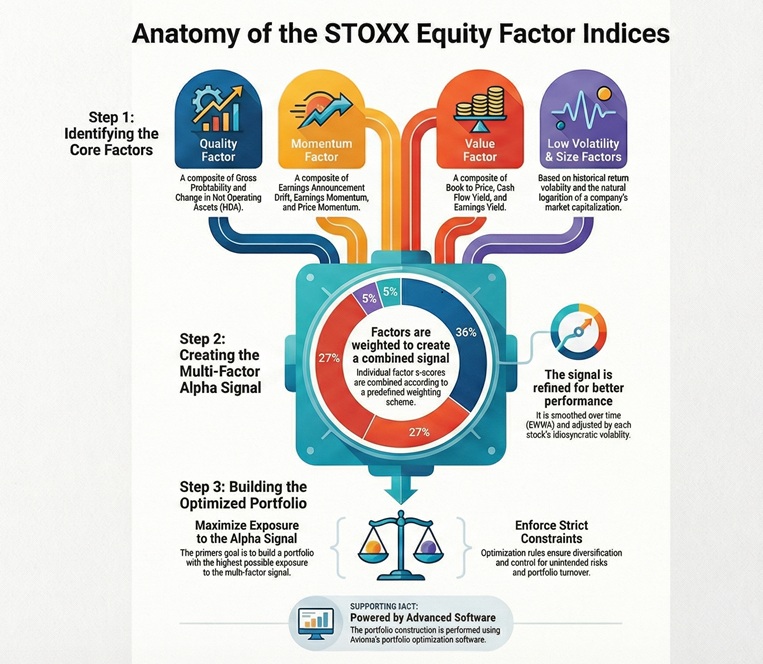
IFSW currently based its securities selection with a new STOXX Equity Factor Screened methodology.
You can read more about the methodology by turning to page 574 (out of 607 pages) of the STOXX Index Methodology Guide.
The strategy is trying to pick a portfolio of stocks that collectively will generate higher returns.
- The stocks selected is based on a parent index which is the STOXX Developed World (more information about STOXX Developed World can be found here). This is an index similar to the MSCI World, which covers large and mid-cap global companies.
- From the parent, certain stocks were removed that failed some basic rules such as
- Too small or illiquid.
- Fail the ESG criteria
- For every stocks that is left, 16 different scores or signals in STOXX terms are generated based around several well-known independent ideas:
- Value
- Momentum
- Quality
- Low volatility
- Size
- The stocks are then selected to make sure that the portfolio of securities are not too concentrated in a single country, sector or company.
We then end up with a pretty diversified basket of 300 or so stocks.
These 5 different factors are weighted in the following manner:
| Factor | Weight |
| Momentum | 27% |
| Quality | 36% |
| Value | 27% |
| Low Volatility | 5% |
| Size | 5% |
I will list down here how they score the stocks based on the 5 different factors:
The Value Composite
| Metric | Detail | Weight |
| Book-to-Price | Latest book value / Total market cap | 20% |
| Cash Flow Yield | Last 12-month Cash Flow / Total market capData is smoothed such that data 3 months ago holds less weight. | 20% |
| Time Series Normalized Cash Flow Yield | Taking the cash flow yield, not smoothed and compare to itself. Basically, trying to see whether it is cheap relative to itself 3 years ago. 3 years avoids being too short term. | 20% |
| Dividend Yield | Last 12-month trailing dividend / Total market cap | 20% |
| Earnings Yield | Last 12-month net income / Total market cap. | 20% |
The Momentum Composite
Momentum is made up of 3:
| Metric | Weight |
| a. Earnings Drift | 25% |
| b. Earnings Momentum | 50% |
| c. Price Momentum | 35% |
a. Earnings Drift
Earnings drift basically look at the stock-specific reaction around earnings, strip out all market/sector influences, and smooth the result into a stable score that reflects how the stock tends to behave after its earnings announcement.
Here is roughly what it does:
1. Look at the stock’s return on earnings day + the next business day
- Take the two days most affected by the earnings announcement.
- Example: Earnings day return = +4%, Next day return = +2%
2. Remove the parts of the return caused by broad market forces
Axioma’s risk model breaks every stock’s return into:
- Market (e.g. S&P 500)
- Sector (e.g. tech)
- Style factors (value, momentum, size, volatility)
- Idiosyncratic (stock-specific)
They subtract everything explained by these broad factors, leaving only the “pure stock-specific move.”
What they want is to get the moves that is purely based on the stock’s own news, such as earnings and not because the whole market moves.
3. Add the idiosyncratic return from earnings day + next day
Combine the number in 2 with 1.
You get either:
- A strongly positive number: stock had a good earnings reaction.
- A strongly negative number: stock had a bad earnings reaction.
4. Smooth it using EWMA with 6-month half-life
Instead of using just the most recent value, they blend past values to make the measure more stable.
- EWMA = recent events get more weight; older events fade gradually.
- Half-life 6 months = every 6 months, the weight of older data is cut in half.
This avoids a noisy, jumpy signal.
b. Earnings Momentum
The sum of the number of EPS upgrades for the current (FY1) and following (FY2) fiscal years minus the sum of the FY1 and FY2 EPS downgrades for the current and following fiscal years, all divided by the sum of the total number of FY1 and FY2 EPS estimates.
The signal is smoothed using an EWMA process with a half-life of 6 months. (Recent events get more weight; older events fade gradually.)
Stocks with resulting ratio greater than 1.0 are treated as missing values in the calculation of the score.
c. Price Momentum
The sum of monthly local currency returns over the 12 complete months prior to the review cut-off date, excluding the latest month.
The signal is smoothed using an EWMA process with a half-life of 1 month.
Review Frequency
The strategy reviews its holdings based on the methodology on a quarterly basis in March, June, September and December.
- Since the review of the strategy requires to know the weighting and fundamental data (from their Axioma data), the data used is snapshot on the 2nd Friday of the month in review.
- The implementation of the index is conducted after the 2nd Friday of the month in review.
The Quality Composite
The quality part is made up of the following:
| Metric | Weight |
| a. Penalizing Accruals | 20% |
| b. Penalizing Share Dilutions | 20% |
| c. Rank Gross Profitability Higher | 20% |
| d. Penalizing Growth in Net Operating Assets | 20% |
| e. Penalizing Carbon Emissions Intensity | 13% |
| f. Check if its SBTi (Science Based Targets initiative) is aligned with climate science | 7% |
I will focus more on the first 4 and not so much on the ESG one. If there are some empirical research for them I will also provide.
a. Accruals
Companies with high accruals relative to cash flows tend to have lower future returns, lower earnings quality, and more earnings manipulation.
Key fundamental drivers:
- Earnings Quality: High accruals = earnings not backed by cash.
- Persistence: Cash-based earnings persist more than accrual-based earnings.
- Mispricing: Investors mistakenly extrapolate accrual earnings, causing reversals.
Researches linked to accruals:
- Sloan (1996), “Do Stock Prices Fully Reflect Information in Accruals and Cash Flows?” -> High-accrual firms underperform low-accrual firms.
- Richardson, Sloan, Soliman, Tuna (2005–2006) -> Broad evidence that asset growth and accruals predict returns and identify low-quality firms.
The strategy calculates the monthly change in operating assets minus the monthly change in total liabilities, all divided by the 36-month rolling average of total assets and multiplied by -1.0.
Values are truncated at -12% and 20%. (If the calculated accrual value is too extreme (too high or too low), they cut it off at a maximum or minimum level.)
The signal is smoothed using an EWMA with a half-life of 24 months, which means they lower the weight of the signal if it is older than 2 years.
b. Dilution
An increase in shares outstanding signals that the company is financing growth through equity rather than internal cash flows — often a red flag.
Key fundamental drivers:
- Information Asymmetry: Management issues shares when they think the stock is overpriced.
- Weak Internal Financing: Firms unable to fund growth internally may dilute existing shareholders.
- Future Return Predictor: Equity issuance negatively predicts future returns.
Researches linked to dilution:
- Loughran & Ritter (1995) – SEO (secondary equity offerings) long-run underperformance.
- Pontiff & Woodgate (2008) – Share issuance is one of the strongest predictors of low future returns.
- Daniel & Titman / Baker & Wurgler – Market timing hypothesis: firms issue equity when valuations are high.
The strategy calculates the negative of the relative monthly change in total shares outstanding, adjusted for any corporate actions. Values are truncated at +/- 50%. The signal is smoothed using an EWMA with a half-life of 24 months.
c. Gross Profitability
Gross profitability is a powerful predictor of firm quality and future returns, often more informative than net income.
Key fundamental drivers:
- Economic Moat: High gross profits indicate pricing power and strong competitive advantage.
- Efficiency: High gross profit per asset suggests strong business model profitability.
- Persistence: Gross profitability is more persistent than bottom-line earnings (which are noisy).
Researches linked to gross profitability:
- Novy-Marx (2013), “The Other Side of Value” → Gross profitability is a strong, independent predictor of future returns.
- Fairfield, Whisenant & Yohn (2003) → Profit margin changes predict future earnings growth.
The strategy calculates revenues minus the cost of goods sold, all divided by total assets, where all 3 quantities are all greater than 0. Values are truncated at the 2nd and 98th percentiles. No EWMA smoothing is applied.
d. Change in Net Operating Assets (NOA)
Increases in operating assets relative to liabilities are tied to lower subsequent returns and lower quality of earnings.
Key fundamental drivers:
- Investment vs. Returns: Firms that aggressively expand operating assets often earn disappointing returns (asset growth effect).
- Overinvestment: High NOA growth may indicate empire building, low managerial discipline, or poor capital allocation.
- Earnings Inflation: Rising NOA often comes with earnings boosted by accounting rather than core business.
Researches linked to change in NOA:
- Fairfield, Whisenant & Yohn (2003) – NOA growth predicts earnings declines.
- Richardson, Sloan, Soliman, Tuna (2005–2006) – Broad evidence linking asset growth to poor returns.
- Hirshleifer, Hou, Teoh & Zhang (2004) – Overinvestment hypothesis and the investment factor.
The Low Volatility Composite
The strategy will also factor in a score where stocks with lower last 12 month total returns be ranked higher. Volatilities that are 1-month and 2-month out is given less weight which makes the strategy weigh nearer term volatility with more importance.
- The standard deviation of monthly total returns in local currency, calculated over the 12 complete months prior to the review cut-off date.
- Stock level volatilities are exponentially smoothed twice using an EWMA with half-lives of 1-month and then 2-months.
- Values are then multiplied by -1 and are converted to percentage ranks within the eligible universe and truncated at the 1st and 99th percentiles.
- The percentage ranks are then transformed into scores using the inverse of cumulative normal distribution and are truncated at +/- 3 standard deviations.
The Fund Reviews/Reconstitute Quarterly
Different factors have different decay. Decay means that the potential premium tends to disappear over time. Some factors such as quality and value tends to be slower and so if you wish to review and rank the stocks in the universe, it is okay to do that annually.
However, some factors like momentum has a faster decay.
In Alpha Architect’s work on momentum, they find the sweet spot closer to 3 months to 6 months if I remember.
Thus, it will be good that a strategy with some momentum factor to review and reconstitute more frequently. The downside is that potentially more costly due to stocks turnover.
IFSW rebalances every quarter.
STOXX’s Strategy Results in High Active Share but the Performance is Similar or Better.
Active Share in factor investing measures the percentage of a portfolio’s holdings that differ from its benchmark index, quantifying how “active” a strategy is in pursuing specific factors (e.g., Value, Momentum) rather than just tracking the market. It ranges from 0% (pure index) to 100% (no overlap), indicating the conviction and divergence of the factor-based strategy from the index.
If you buy an index strategy, you would want the Active Share to be a rather low percentage (< 5%) because the performance should not differ much from the index.
If you run a systematic active strategy, you may not want your strategy to hold the same composition as the index.
I asked both Gemini and Qwen, which are the two AI platforms to compare the holdings between IFSW and SWDA and Gemini gave me 68%, Qwen gave me 79.5%.
Gemini gave me the following table to compare notes:
| Active Share Range | Description |
| 80% to 100% | These funds have holdings that significantly diverge from the benchmark, giving the manager the greatest opportunity (and risk) to outperform. |
| 60% to 80% | Funds that are considered actively managed, with a noticeable difference from the index. |
| 20% to 60% | Funds in this range are often referred to as “closet-trackers.” They charge fees for active management but hold a portfolio that is very similar to the index, which historically makes it difficult to outperform after fees. |
| 0% to 20% | These funds closely resemble a passive index fund. |
I think I might need to code something to do my comparison if I wish to be rather sure.
If I look at the holdings visually aside, from the top holdings, much of the holdings does look different
In a way, a high Active Share and similar if not better performance show that despite holding relatively different securities, the strategy is delivering.
Which is what you want in a strategy because otherwise why would you invest in a systematic active fund?
Epilogue
These are some of the main reasons for me to switch some of the allocations over.
It is not always an easy thing to do because one of the learning lessons over the past 5 years is about patience. We feel the pain in ideas not working out, only for the performance to show up the very momentum we gave up on them.
We think there is a group of stocks that forever will do better than another group of stocks that will forever suck.
I got to recognize that each of AVGC, IFSW, GGRA and JPGL are systematic strategies which means that they are regularly going to be reconstituted.
While IFSW has performed well, in the last reconstitution, they would review sell the stocks with waning fundamental momentum, that are perhaps more expensive for something cheaper but showing more momentum.
If your feel edgy after the markets have ran up a fair bit, in the past you would be thinking about selling to reallocate to “other ideas”, whatever that means.
A systematic strategy is a delegated and discipline strategy to do that.
I think JPGL is the one that I feel more edgy about reducing because by its more equal sector weight nature it is most susceptible if there is mean reversion of some of the weaker sectors due to the broadening out.
But in a way if broadening out is due to AI productivity, which improves earnings, its a good testing ground to see if IFSW’s new implementation works.
I would likely not make more major moves aside from reducing GGRA and spreading out among AVGC, IFSW further.
If you want to trade these stocks I mentioned, you can open an account with Interactive Brokers. Interactive Brokers is the leading low-cost and efficient broker I use and trust to invest & trade my holdings in Singapore, the United States, London Stock Exchange and Hong Kong Stock Exchange. They allow you to trade stocks, ETFs, options, futures, forex, bonds and funds worldwide from a single integrated account.
You can read more about my thoughts about Interactive Brokers in this Interactive Brokers Deep Dive Series, starting with how to create & fund your Interactive Brokers account easily.

Kyith is the Owner and Sole Writer behind Investment Moats. Readers tune in to Investment Moats to learn and build stronger, firmer wealth foundations, how to have a Passive investment strategy, know more about investing in REITs and the nuts and bolts of Active Investing.
Readers also follow Kyith to learn how to plan well for Financial Security and Financial Independence.
Kyith worked as an IT operations engineer from 2004 to 2019. Currently, he works as a Senior Solutions Specialist in Insurance Start-up Havend. All opinions on Investment Moats are his own and does not represent the views of Providend.
You can view Kyith’s current portfolio here, which uses his Free Google Stock Portfolio Tracker.
His investment broker of choice is Interactive Brokers, which allows him to invest in securities from different exchanges all over the world, at very low commission rates, without custodian fees, near spot currency rates.
You can read more about Kyith here.