
Most people felt that they should do something at the turn of the year to “make things right”. Making wiser financial choices might be a very common one especially when they got the bonus in early part of the year.
I was sharing with a friend that trying to put money in at the end of the year (e.g. 2025 now) or start of the year might not be the best time.
I want readers to note that whenever I discuss this kind of stuff, it is with a lens that we are thinking about implementing larger sums of money. The sum that you will most likely feel pain about if you felt that you have made a wrong decision. If we are talking about small sums of money, I care less. Also, if you are dollar cost averaging, these stuff really matter less as well.
There are seasonal flows where funds sell off what may have worked well last year to invest in what may not have worked well last year. In a way, there is some profit taking with the net result observed to be some dip in the early part of the year.
Seasonally, the mid of February, after the third week of the month, where the options expired is potentially a weak part of the year. You would see some dips.
You see it this year (before Liberation day), you see it in 2023, you see it slightly in 2022, you definitely see it in 2020, because the COVID crash is EXACTLY between the options expiry of Feb (Friday of the third week of the month) to March.

There are these seasonality charts like the one you see above of the S&P 500. They aggregate the price data of many years (in this case the past 20 years) and you are able to see what is the seasonal pattern. You can see how strong the end Oct, Nov, Dec period is.
If there is a window to get in, that will be the dip in mid Sep to mid Oct.
Usually, there will be more reset at the end of the quarter due to a lot of options expiring. If the last quarter has been good, the reset will make it lose some strong force and if the last quarter is weak, this will make it lose some weak force.
You kind of will have three windows of investment which is End Mar, End Jun an End Sep.
Plenty of opportunities if you felt like you wish to get in the best time in a more empirical manner.
Since the topic to my friend was implementing money for the new year, we are more focus on the better time to put in the whole chunk of your money at the start of the year.
And based on this, I told my friend it is better to do it at the end of March, given what I know.
But I wonder if that is right….
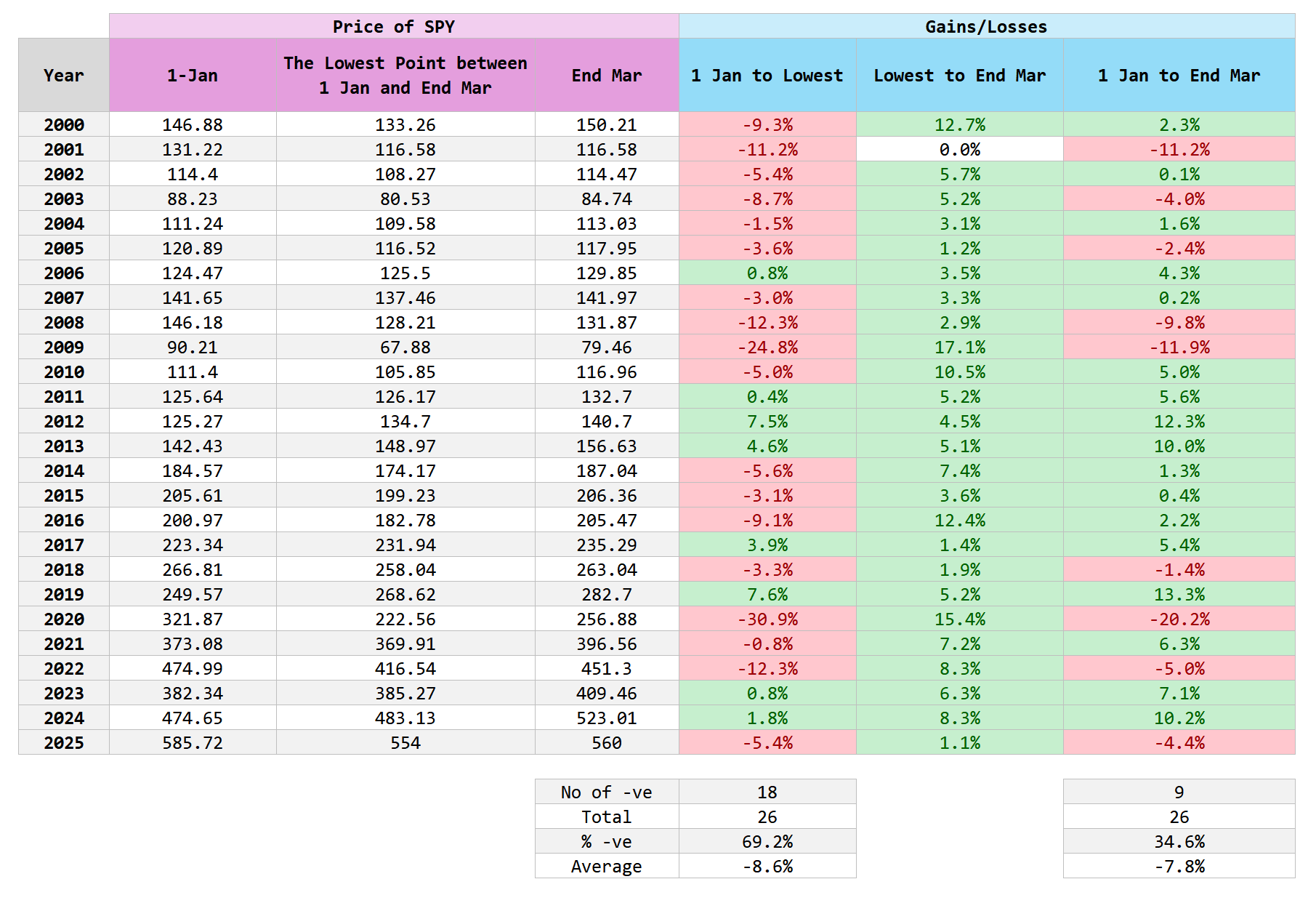
I help tabulated the price of SPY, the longest running ETF for the S&P 500 for the past 26 years, year by year below:

In a way, not all our markets are correlated to the US market but since most of the investing conversation today revolves around the US, finding out the opportune time to deploy relative to the US may be relevant.
The purple part shows the prices at three points of the year:
- One day before 1st-Jan
- End of March
- The lowest point between 1st Jan and End of March.
This coincide with my idea that:
- If you want to deploy your money, you don’t want to wait too long. Many people end up waiting and waiting and waiting, and before you know it one year has past.
- Emotionally or mentally you wish to be invested, it is just that you are one of those who want to find the nice nice spot.
- And you have money be it your bonus that you got end of last year (is that normal?) or at the start of the year.
On the right, in the blue color section measures some price difference to show the gains and losses:
- 1 Jan to Lowest: The price difference between the start of the year and the lowest point. If you see a negative number, it means after Jan and before end of March there is a lower point. If it is positive then 1 Jan is the lowest.
- Lowest to End Mar: The difference between End Mar and Lowest point. This number usually is positive. Not quite useful.
- 1 Jan to End Mar: The difference between 1st Jan and End Mar. If it is negative, that means end Mar is lower than 1st Jan. If positive, that means end Mar is higher.
If we look at 1st Jan to End Mar, only 35% of the time end Mar is negative which means that if you wait until what Kyith said which is end Mar to deploy, then you might end up paying up for your investments.
From 1st Jan to Lowest, almost 70% of the time there is a lower point.
The average is -8.6% for those years that are down.
A better rule might be:
- It is likely in the first quarter there is a lower point so wait for a lower point to invest.
- If it comes, maybe 4-6%, just deploy.
- By the end of March, if there is no opportunity, accept that you are unlucky and invest at higher.
This may be more sensible.
The Problem with Deploying Lump sums Based no these Seasonality Timing
To some with $2 million, which may be 95% of their net wealth to deploy, finding an opportune time to invest in the most ideal investment, is mentally a critical thing for them.
I cannot say I don’t understand that. There was a phase that this is critical for me as well.
Until experience tells me to fxxk it, it really doesn’t matter that much because:
- You can think of don’t know how many considerations.
- If you are investing in a globally diversified portfolio of equities, and are investing for 10-50 years, you will eventually realize you are deliberating over less consequential things.
- Many people fail to deploy 100% of what they want to deploy during the opportune period if it comes along because:
- Mentally, there is always a lower low. They should conserve their capital so that they buy at the “best” price.
- Everything leading up to this point tells them they have a low risk capacity, lower than they are willing to admit most of the time.
As a working person, it is so easy to miss that opportune period even though it seems important to you. The worse thing is if you missed it, mentally it becomes more difficult to allocate your money!
My rules are basically to have a small window to find a drawdown to see if you get a better price.
If you can, put all in. If cannot, hard luck. Just deploy.
The more the market goes up, the terrible you will feel. Yes losing money will feel terrible. Both will make you feel terrible.
I shared with my friend that I understand why they are doing this and its not easy especially when the markets looked treacherous. We can only learn some lesson by dealing with the uncomfortableness to be able to say it so easily.
The Mid-Term Election Years
Having said that if you look at the mid-term years:

Mid-term years have seasonally have higher intra-year volatility.
All but one year, there is some sort off a lower point.
I do question even if there is, would someone dare to put in all their money on the drop?
I always felt that “there is going to be more” is always gonna prevent people from putting in more.
What about the rest of the money?
You either hold or you got to put at higher prices. Net-net was it worth it emotionally?
You decide.
If you want to trade these stocks I mentioned, you can open an account with Interactive Brokers. Interactive Brokers is the leading low-cost and efficient broker I use and trust to invest & trade my holdings in Singapore, the United States, London Stock Exchange and Hong Kong Stock Exchange. They allow you to trade stocks, ETFs, options, futures, forex, bonds and funds worldwide from a single integrated account.
You can read more about my thoughts about Interactive Brokers in this Interactive Brokers Deep Dive Series, starting with how to create & fund your Interactive Brokers account easily.

Kyith is the Owner and Sole Writer behind Investment Moats. Readers tune in to Investment Moats to learn and build stronger, firmer wealth foundations, how to have a Passive investment strategy, know more about investing in REITs and the nuts and bolts of Active Investing.
Readers also follow Kyith to learn how to plan well for Financial Security and Financial Independence.
Kyith worked as an IT operations engineer from 2004 to 2019. Currently, he works as a Senior Solutions Specialist in Insurance Start-up Havend. All opinions on Investment Moats are his own and does not represent the views of Providend.
You can view Kyith’s current portfolio here, which uses his Free Google Stock Portfolio Tracker.
His investment broker of choice is Interactive Brokers, which allows him to invest in securities from different exchanges all over the world, at very low commission rates, without custodian fees, near spot currency rates.
You can read more about Kyith here.