
I am concern about this concept call debasement of the currency.
Debasement simply means making something worth less and less in value, and these set of actions is less apparent to some people. In the past you can have a gold coin, but the government can add more and more impurities to the gold coin and while it still looks and feels like a gold coin, some of those who know would realize the gold coin is actually worth less.
So a debasement of a currency is taking meaningful actions to make a currency worth lesser and lesser.
Is it related to inflation? I think so.
If your currency is worth lesser and lesser, it buys less things, and you got to pay more of that currency for it.
The worry is that all fiat currency is going to be debased more, its whose worse. Perhaps a country like Singapore, which requires their currency to be stronger and have more pristine fiscal health may not engage in such deliberate action.
Swiss Franc and Singapore dollar are damn strong.
I wonder how many people realize that it is by a stroke of luck that they were born in this tiny island that manage to do so well.
And how much of their financial mental model is based on a currency that is so strong. I feel this is important. I once asked an adviser for a person who is retiring, should the default advise be to invest or hedged to the currency they will retire in?
What happens if you wish to retire in Turkey?
That advise will still apply, but your prospect or client may find it so challenging to do, compare to keeping their money in a stronger currency. Years and years of weakening in their currency would make them apprehensive and search out something stronger.
But when you are an adviser living in a country with so stable and strong of a currency, would you empathize enough with the client? More so, is that still the technically correct advise?
I ended that conversation with more question mark than answers mentally.
This word debasement may not be too popular (from what I can tell) currently, but this will be one of the concerns, among so many concerns that my readers, friends and our prospective clients will have.
I want to emphasize one of the concerns because if you have less years in the markets, or more years but failed to build good mental lattices/frameworks, you be thinking the answer is binary.
Buy gold or put in cash.
A couple of years ago maybe it is buy bitcoin or put in cash.
But now cryptos are not doing well, people have the impression is no good. Now their impression of gold is better.
I tend to think the right answer is:
- Put in assets that have some good long term economic drivers of return.
- You don’t have to just put in one single bloody thing, just be diversified.
The first one is a tenant of Providend’s pillars when considering whether to put something in our portfolios. A pillar should be viewed more as a qualifying consideration, and not the main reason it ends up inside our portfolios.
A currency is just a medium of exchange.
What we should ultimately be concerned with is viewed over 20 years, does our overall net asset base (your assets minus your liabilities) grow over time, in whichever currencies.
There is real growth la. Your purchasing power is preserved.
The issue with many I find is that they spend so much time deliberating over that one, or two thing that they have to put their whole $4 million out of $6 million into.
But is there really one thing? or two thing?
There are more right?

This is a chart of Western Digital.
You might have their hard disk in your computer. Almost 300% in the last 1 year. This is in USD, but if I deduct 6% of depreciation on it, your asset value should preserve right?

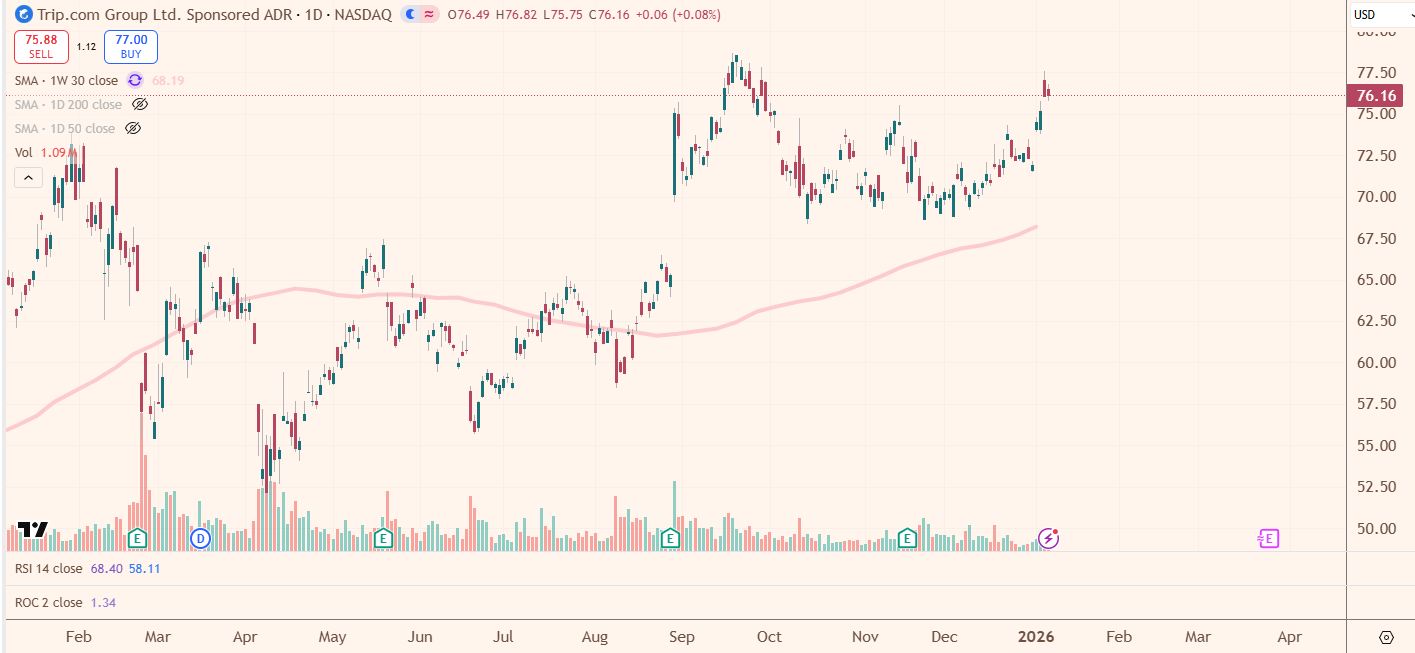
This is a chart of TCOM or Trip.com.
You might have booked some hotel or flight tickets from them.
16% in the last one year. After 6% depreciation of the USD only 10%. Not very good right?
But it still kind of preserve the value right?
I just anyhow think of companies and pulling them out to show you.
Each of these companies are engaging in some real businesses, earning real earnings per share and most likely the revenue sources is very diversified. One year of earnings may be rough, two years maybe still rough, but over longer time, if the EPS goes up, price should follow accordingly, especially if the companies exhibit good shareholder returns (dividends and share buybacks).
For the past 15-20 years, the USD has gone up and down, up and down, relative to the SGD. This is not debasement just currency fluctuation. But from 2002 to 2011, the USD is just a one way depreciation.
- 2002: $1 USD convert to $1.80 SGD
- 2011: $1 USD convert to $1.22 SGD
Whenever there is a ONE year weakening of USD relative to SGD like last year, so many people think that it is going to be a 30 year one way weakening. The correct answer is more not sure because you imagine the people who lived through 2002 to 2011, and they hedge all their USD, how much cost that will eat up when the next 15 years the currency relationship just meanders around?
The investor in 2011 is damn sure USD is going to be $1 USD change $0.70 SGD in 2025.
That is why I call these… one of the uncertainties you will face as a retail wealth manager.
I tallied the 10-year annualized return of the MSCI World from 1 Jan 2002 to Dec 2011 in different currencies:
| Currency | Annualized Return over the 10 years |
| USD | 3.6% p.a. |
| AUD | -3.3% p.a. |
| CAD | -0.9% p.a. |
| EUR | -0.2% p.a. |
| JPY | -1.8% p.a. |
| GBP | 2.9% p.a. |
| SGD | 0 p.a. |
Damn shit right?
Bet those of you who followed some of my recommendations will feel horrendous about what you are looking at it. When convert back to Singapore dollar its practically no return over 10 years.
Instead of just the MSCI World, I am going to throw out a bunch of indexes during that same 10 year period.
They are all in terms of SGD:
| Index | Annualized Return over the 10 years (SGD) |
| MSCI World | 0% p.a. |
| MSCI World Small Value | 5% p.a. |
| MSCI World Small SMID | 4% p.a. |
| MSCI World Value | 0% p.a. |
| MSCI Emerging Markets Small Value | 14.8% p.a. |
| MSCI Emerging Markets | 9.9% p.a. |
| MSCI Japan | -0.6% p.a. |
| MSCI Europe | 0.7% p.a. |
If we aggregate into different portfolios, there will be stuff that does well, even after a 3% p.a. depreciation of the USD. And if you look at some of these stuff, your portfolio today is probably not positioned into them currently.
It is so easy to ask the question do we really need emerging markets small value ETF now.
The answer is we don’t even know the next 15 years will be like the past 15 years, or the prior 15 years. There will be the ones who would give me a very spirited argument “Kyith, now is different liao. You look at XXX, or YYY, it is never going to happen again. ZZZ will surely do this when AAA happen.”
Each of us will have different degree of understand as to whether these things will happen, but eventually all of these will boil down to… different degree of uncertainty.
We won’t know the degree and pace of changes or even how the changes will look like, all these are uncertainties.
In a way, what I find is the most corrosive may be the thinking of concentrated positioning, what they should mainly put into. The ebbs and flows of the market will make you keep revisiting that allocation question again and again and again and again.
If you have maintain just adequate liquidity, but keep your assets diversified in different assets that have good long term economic drivers of returns, you should do okay. In the short run, there will be ebbs and flows. I cannot tell you how these assets will perform well during a 10 year currency depreciation (as an example). Even if I tell you, I might be very wrong!
Same as any adviser that tell you that you should position this way or that.
Allocation into risk assets and keep diversify. When you diversify it also make uncertainty, and insecurity easier to live with because you reduce the weight of each ‘bets’.
You end up probably better than fearing volatility and keeping all in cash.
Lastly, those same index returns, in SGD but extending them to today:
| Index | Annualized Return over 26 years (SGD) |
| MSCI World | 6.7% p.a. |
| MSCI World Small Value | 7.6% p.a. |
| MSCI World Small SMID | 7.1% p.a. |
| MSCI World Value | 5.4% p.a. |
| MSCI Emerging Markets Small Value | 10.4% p.a. |
| MSCI Emerging Markets | 7.3% p.a. |
| MSCI Japan | 4.4% p.a. |
| MSCI Europe | 5.1% p.a. |
If you want to trade these stocks I mentioned, you can open an account with Interactive Brokers. Interactive Brokers is the leading low-cost and efficient broker I use and trust to invest & trade my holdings in Singapore, the United States, London Stock Exchange and Hong Kong Stock Exchange. They allow you to trade stocks, ETFs, options, futures, forex, bonds and funds worldwide from a single integrated account.
You can read more about my thoughts about Interactive Brokers in this Interactive Brokers Deep Dive Series, starting with how to create & fund your Interactive Brokers account easily.

Kyith is the Owner and Sole Writer behind Investment Moats. Readers tune in to Investment Moats to learn and build stronger, firmer wealth foundations, how to have a Passive investment strategy, know more about investing in REITs and the nuts and bolts of Active Investing.
Readers also follow Kyith to learn how to plan well for Financial Security and Financial Independence.
Kyith worked as an IT operations engineer from 2004 to 2019. Currently, he works as a Senior Solutions Specialist in Insurance Start-up Havend. All opinions on Investment Moats are his own and does not represent the views of Providend.
You can view Kyith’s current portfolio here, which uses his Free Google Stock Portfolio Tracker.
His investment broker of choice is Interactive Brokers, which allows him to invest in securities from different exchanges all over the world, at very low commission rates, without custodian fees, near spot currency rates.
You can read more about Kyith here.