
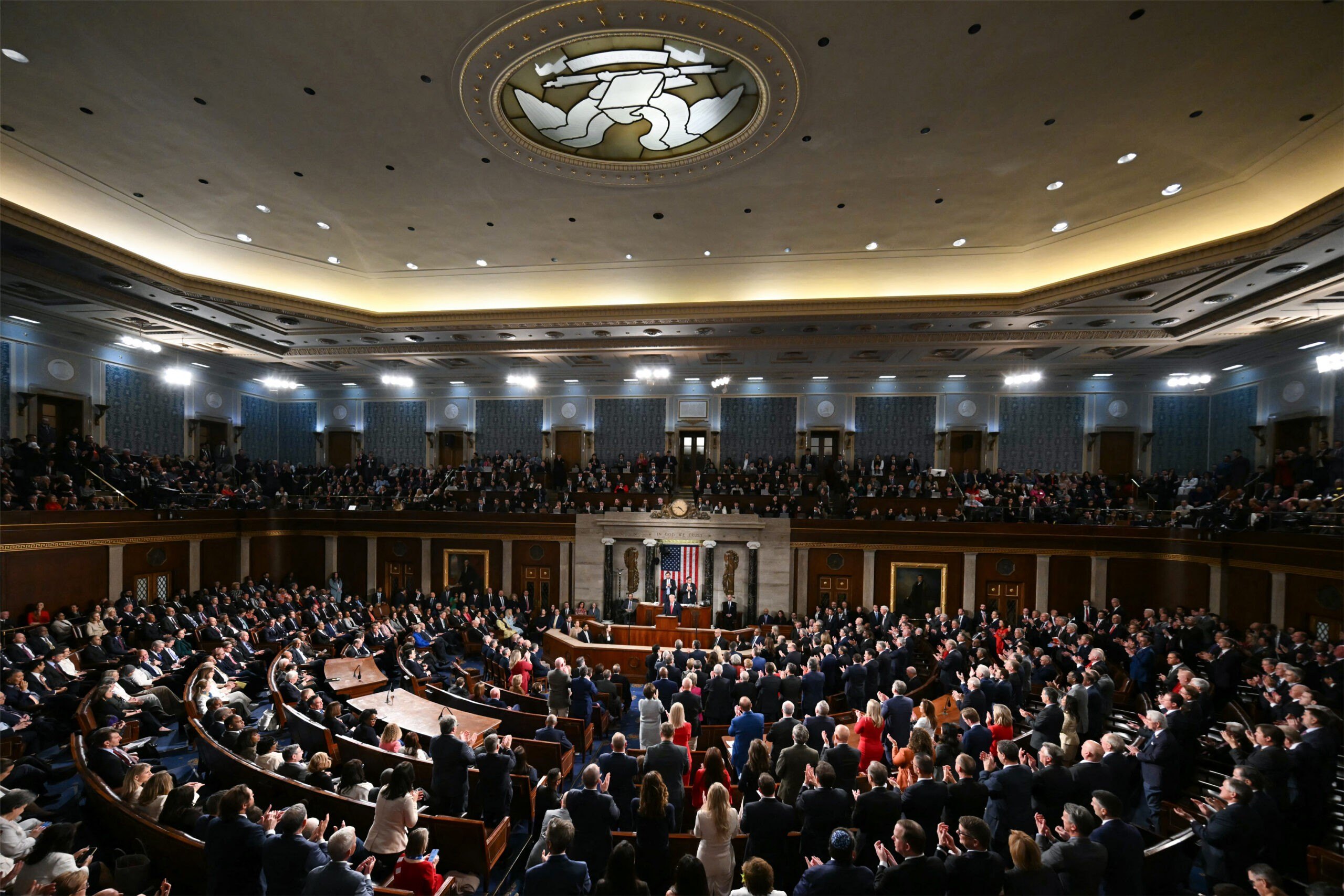
President Donald Trump reiterated his aim of making the housing market affordable without lowering home values during the State of the Union speech, his annual address to Congress.
Trump’s speech on Tuesday night, which lasted an hour and 47 minutes, took aim at economic issues as the president moves to reassure voters he has curtailed rising costs that he campaigned to fix.
Low interest rates will help reduce the “Biden-created” housing affordability crunch, Trump said, while protecting the high home values of those “who feel rich for the first time in their lives.”
“We want to keep those values up, we’re going to do both,” Trump said.
Trump said mortgage rates are “falling fast and payments are down almost $5,000 since I took office.” The average mortgage rate was 7.04% in January 2025, when Trump took office, compared to 6.01% now, according to Freddie Mac.
What did Trump say about the ban on institutional investors?
Trump’s solution to the housing crisis includes a range of proposals to make it more attainable. He has signed an executive order to discourage institutional investors from buying up single-family homes. He’s also pushed for lower interest rates and directed Fannie Mae and Freddie Mac to purchase an additional $200 billion in mortgage bonds to lower mortgage rates.
In the speech, Trump asked Congress to pass legislation to make the ban permanent. That investor ban hasn’t yet appeared in the bipartisan housing package, the Housing for the 21st Century Act, which is now in the Senate.
Trump added that “another pillar of the American dream that has been under attack is homeownership.”
He said a mother of two in the public gallery from Houston had placed bids on 20 homes, only to lose to “gigantic investment firms that bypassed inspection, paid all cash, and turned those houses into rentals, stealing away her American dream.
“Now, I’m asking Congress to make that ban permanent because homes are for people, really. That’s what we want, not homes for corporations,” he said.
At least 85% of Americans still believe that homeownership is “essential to the American dream” because it represents stability, upward mobility, and the opportunity to build generational wealth, according to Shannon McGahn, executive vice president and chief advocacy officer of the National Association of Realtors®, who cited a recent poll.
“The National Association of Realtors is grateful that the administration and members of Congress are focused on addressing the nation’s housing affordability and supply challenges. We share the goal of increasing housing inventory at all price points and advancing policies that strengthen communities, grow local economies, and create opportunities rather than limit it,” she says.
When it comes to the institutional investor ban, the questions now are ones of scale, enforceability, and spillover effects, says Jake Krimmel, Realtor.com® senior economist.
“In particular, large institutional investors represent a relatively small share of the national housing stock, and because their activity is often highly localized, it remains an open question whether banning new purchases would meaningfully shift metro-level markets,” he explains.
Trump delivers economic message aimed at costs
The speech also comes days after the U.S. Supreme Court struck down most of the sweeping tariffs Trump has made a centerpiece of his foreign and economic policy. Those have had a major impact on a wide range of building materials.
Trump said he was not deterred by the “very unfortunate ruling.” He said the tariffs would “remain in place under fully approved and tested alternate legal statuses.” These tariffs, Trump said he hoped, would replace income tax.
After Trump’s address, the Associated Builders and Contractors President and CEO Michael Bellaman said in a statement that the organization “appreciates the president’s continued focus on the economy, expanding opportunity for American workers and addressing affordability.”
He added that the construction industry employs more than 8.3 million people and contributes more than $2 trillion annually to the economy.
Trump indicated in his address that there was momentum in the new-construction industry.
“A short time ago, we were a dead country; now, we are the hottest country anywhere in the world, the hottest,” Trump said.
“As thousands of new businesses are forming and factories, plants, and laboratories are being built, we have added 70,000 new construction jobs in just a very short period of time.”
Bellaman said in his statement that “while resilient, the construction industry faces ongoing headwinds from high costs, tariff uncertainty and a chronic workforce shortage.
“As these concerns mount, the president should note that this industry is key to achieving his promises to lower the cost of housing, infrastructure and energy for American families. ABC urges the president to create the conditions for contractors to thrive with pro-growth policies so that he can deliver on his affordability promise for the American people.”
In his State of the Union address, Trump also announced a “ratepayer protection pledge” that would require data center developers to provide their own power. Trump also said it would mean data center developers could build power plants on their sites. Trump said this would offset home energy costs.
In the Democratic rebuttal to Trump’s address, Virginia Gov. Abigail Spanberger said Democrats were “working to lower costs,” but did not expand on the affordability issues Americans are currently grappling with.
However, Senate Democrats have unveiled several housing bills of their own aimed at cutting tax breaks and increasing home construction.
Housing affordability is a key issue for lawmakers
McGahn, from the NAR, says that “unlocking existing inventory, streamlining regulatory barriers, incentivizing new construction, and supporting responsible development are all essential components of addressing housing affordability.
“That includes reforming outdated capital gains thresholds that have not been updated in decades and now discourage longtime homeowners from selling, reducing mobility and limiting the number of homes available for new buyers,” she says.
She adds that the NAR encourages the Senate to consider the Housing for the 21st Century Act.
Krimmel, the economist, says that four years of high mortgage rates layered on top of a longstanding housing shortage have made the housing affordability crisis a central focus for national policymakers.
But the issue was featured only briefly within the broader affordability discussion, with Trump citing falling rents, lower mortgage payments from falling rates, and job growth in the construction industry.
“Rents are down 1.5% year over year and are roughly 4.8% below their August 2022 peak, according to Realtor.com data,” says Krimmel.
“And government data show CPI shelter has been disinflating since April 2023. Mortgage payments are also down over the past year, though our estimates suggest the typical annual savings on the median-priced home is closer to $3,000 than the $5,000 figure cited.
“On construction employment, overall construction jobs are up about 44,000 over the past year, not 70,000 as referenced. Looking more narrowly at the housing sector, residential building construction employment is down roughly 12,000 jobs since January 2025, consistent with slower new-home construction activity.”
Krimmel adds that, although housing affordability has entered the national conversation, policies that address its root cause still await a clearer legislative road map.
“Lasting affordability relief will require not only getting the housing market moving again, but also taking meaningful steps to boost supply in the short run and expand it sustainably over the long run.”