
Out of the 164 UCITS iShares funds that I profiled a few days ago, the iShares EM Dividend UCITS ETF (SEDY) caught my attention.
This is an emerging markets fund that was incepted in November 2011. It is a distributing fund which means that it pays out a distribution.

SEDY basically invest in emerging markets companies with the highest dividend yields.
It is traded on the LSE which means that you can buy it off using Interactive Brokers.
The current indicative yield seem to be 6.6% for the portfolio (but may not be the actual fund distribution).
When you invest in SEDY, you basically delegate the job of finding the stocks that fit a certain criteria.
Out of all the stocks in emerging markets, stocks that meet the following criteria is curated.
- Non-negative trailing 12-month EPS
- Indicative annual dividend yield > 0%
- Must have paid dividends in each of the previous 3 years.
- Float-adjusted market capitalization of at least US$250 million.
For all the stocks that fit the above criteria:
- Rank the stocks based on indicative annual dividend yield from highest to lowest. This does not include any special dividend.
- The top 100 stocks are selected as index constituents.
- Each country cannot have more than 30 stocks.
The rebalancing frequency is annual which means every year you get the highest dividend stocks that paid for the past 3 years.
They happen to be pretty cheap currently.
Return Performance of SEDY
You seen the 5-year annualized return to be 5.9% p.a. and 10-year return to be 6.7% p.a.
Given how challenging emerging market was I thought it is ok.
One thing I like about TradingView, which I recently discovered was that I chart with… or without dividends.
So this is how SEDY looked like without dividends:

Current price still 20% below where it started in 2011.
I am not sure why folks have the impression dividend stocks are low volatility. Okay the 3-year standard deviation of 12.7% is much lower than the traditional emerging market volatility (> 20%) but it still moves quite a lot relative to fixed income.
Here is how SEDY look if we factor in the distributions:

Whoa, now it looks different. If we factor in the dividends the investment have gain 56% or 3.25% since then.
Not that good of a performance. But if the charts can factor in dividends it means I can compare against SEMA, or the MSCI Emerging Markets index ETF:

Focusing on highest dividend companies might not have been the most rewarding in the last 14 years.
But that is not what dividend investors were looking for.
SEDY’s Income Experience
Where i find unique about a distributing class of ETF like SEDY is that we can study the income experience.
Imagine you identify with a high dividend income strategy for your retirement. You also like the idea that:
- You delegate the job of picking and rebalancing high dividend stocks to an ETF
- The fund does this for you every year.
- You are satisfied with the income provided in Nov 2011 because it is adequate for your income needs.
So you put say all your money into SEDY when it first listed.
How will your experience be like?
SEDY’s first year distribution is almost 5.3%. If you have a $2 million portfolio that will provide $106,000 the coming year or $8,833 monthly.
The following chart shows SEDY’s annual aggregated distribution:

What you realize is that it goes down, then up, then down, then up, then down again.
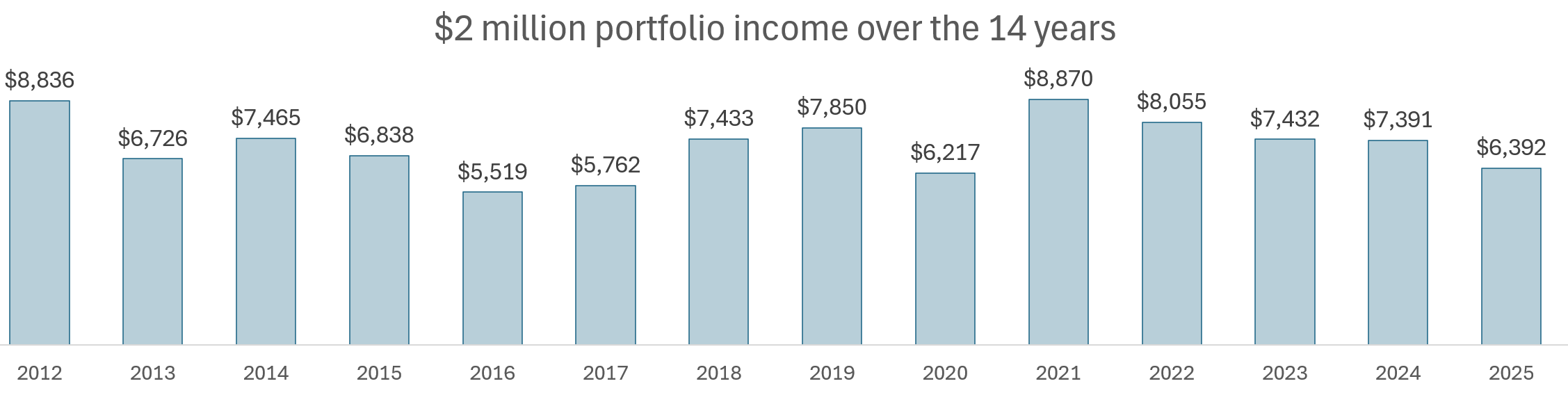
Now assume you put in $2 million, here is the monthly income experience:

If your plan is only to spend the income and not touch the capital, then you will have less and less to spend upon instead of seeing it adjust for inflation.
That is… if you need $8,800 monthly and not a single cent less.
Now I am not sure if your planner plans for you this way “Assume the yield is this and you can get $8,800 monthly. You will continue to receive $8,800 monthly throughout your life, which can pay for your needs, which is $8,800 monthly.”
Because you see this experience, can you tighten your belt, especially for the years that the income fell to $5,500 monthly?
Why dividend investing is popular is income investors believe that:
- They can get consistent dividend payout that goes up with inflation over time.
- Your capital is intact and you will have a perpetual income machine.
The $2 million capital after 14 years is left with $1.6 million.
Not sure how folks will feel about that.
I tried to tally up the distribution yield if you invest in any year in the past 14 years:

The dividend yield has increased recently not sure if it is because as an aggregate the value of the securities are lower than before. If you have $2 million today, your income would be $138,000 or $11,500 monthly today.
SEDY Might Not that Tough of a Sell in 2011
Some of you might comment: Kyith it is stupid to based a dividend strategy on countries like Brazil, China, Indonesia, Poland, Taiwan, India, South Africa, Malaysia, Hong Kong.
Well I am not sure what is stupid.
You realize that many dividend investors prefer to do dividend investing in their home ground of Singapore… which is not too far away from some of these countries.
So what makes dividend investing in Singapore soooooooooooo different from a strategy like SEDY?
Some would think if you don’t want a Singapore-based dividend strategy, a global one would make more sense.
I don’t know.
You need to feel the thing in 2011.
We just came out from a GFC. And you know what was performing well for the past 11 years?
I show you the performance difference:

Here is a growth of $1 million from 1999 to Nov 2011 between the MSCI Emerging market and MSCI World.
You touch your heart, wipe what you seen in the last 14 years (try your best), and you tell me if you were presented with two dividend strategies, one global one emerging market, would you feel that the emerging market is…. worse?
What is difficult to do is to craft a strategy that is not so tainted by recent good performance, and also consider things that may be due to luck.
This is what I find so difficult to explain or help people see.
Epilogue – You Can’t Have the Income Stream You Desired by Product Alone
I came into studying SEDY hopeful that the income experience to be decent, but knowing about the emerging market history, I wasn’t that surprised.
I actually thought overall 14 years in, if someone needed income from SEDY, it was hanging in there while delivering $1.2 million over 14 years with $1.6 million capital left.
Based on what I seen, you can’t really have the income stream you desire for your needs by finding a product/solution that is off the shelf (e.g. SEDY) because:
- The income is not consistent.
- The income usually don’t adjust for inflation.
- The manager has their own mandate and its not your mandate.
There are some of these which are more ideal or suitable than others.
But you get the consistent income, and perhaps also inflation adjustment by your own income strategy or income wrapper.
For example, most people would not immediately retire (I hope) if they realize their product gives them exactly the income they need. Usually, they would have some income buffer.
If we use 30% as an income buffer, a person with that same $2 million portfolio would actually need $6,160 monthly in income. You will realize the eventual income covers this person except for two years (2016, 2017).
That stability is not created because it is a dividend income strategy but because you create that stability.
And that is my underlying message. The product(s) is crucial but not as crucial as the income strategy you craft around them.
Beyond that, I think high dividend as a strategy for income is a struggle.
SEDY’s strategy is very simple and you might find fault in that, but a lot of people came into this realm finding affinity towards such a simple strategy.
The wiser ones learn over time you might need more criteria.
I think if you want a more sustainable income for retirement, a dividend quality growth strategy is better. You need more capital (which is what people don’t like), but it keeps up with inflation better.
I think I still have a few case study in the locker.
If you want to trade these stocks I mentioned, you can open an account with Interactive Brokers. Interactive Brokers is the leading low-cost and efficient broker I use and trust to invest & trade my holdings in Singapore, the United States, London Stock Exchange and Hong Kong Stock Exchange. They allow you to trade stocks, ETFs, options, futures, forex, bonds and funds worldwide from a single integrated account.
You can read more about my thoughts about Interactive Brokers in this Interactive Brokers Deep Dive Series, starting with how to create & fund your Interactive Brokers account easily.

Kyith is the Owner and Sole Writer behind Investment Moats. Readers tune in to Investment Moats to learn and build stronger, firmer wealth foundations, how to have a Passive investment strategy, know more about investing in REITs and the nuts and bolts of Active Investing.
Readers also follow Kyith to learn how to plan well for Financial Security and Financial Independence.
Kyith worked as an IT operations engineer from 2004 to 2019. Currently, he works as a Senior Solutions Specialist in Insurance Start-up Havend. All opinions on Investment Moats are his own and does not represent the views of Providend.
You can view Kyith’s current portfolio here, which uses his Free Google Stock Portfolio Tracker.
His investment broker of choice is Interactive Brokers, which allows him to invest in securities from different exchanges all over the world, at very low commission rates, without custodian fees, near spot currency rates.
You can read more about Kyith here.