
So after yesterday, which is April 1, Singlife like many insurer published the revised premiums when we renew our Shield and Rider on our next birthday.
If you read this post, you would know that my Shield plan rider, call Health Plus Lite, the premiums went up from $201 in 2023 to $373 in 2024 and then to $564 to 2025.
It is going to go up to $1100 this year.
That is a fxxking 53% per annum.
And you heard about the riders that in the future that don’t includes the deductibles that only reimburse the co-insurance? Well the Health Plus Lite from Singlife is that kind of plan.
Since my Plan 1 covers private hospital, the Lite rider covers the co-insurance of the private hospital.
You kind of know where is the problem.
Private coverage.
I am going to show you some of the premiums comparison since on and off, I kept the premium tables for Aviva/Singlife since 2006. Insurers will remove the old premium tables so once they are updated you cannot find them anymore.
There are some takeaways:
- You need to ponder hard whether a rider is worth it when the premiums of what covers the 10% part of your medical bill is equal if not more than the premiums that covers the 90% part of your medial bill.
- Shield and riders for Government hospitals don’t have a problem! Still rather affordable.
Okay lets take a look at the data.
Premiums for the Base/Main Private Hospital Shield Plan Showed Increases
The table below shows the premium difference for the main plan for Plan 1, Plan 2 and Plan 3. They coincide with the grade of medical care that you would go for in Private, Restructured A ward, and Restructured B1 ward.


What you would notice is that aside from Plan 1 there isn’t much changes.
In fact, there isn’t much premium change for the Restructured A and B1 ward plans for a while!
For some reason, the premiums for age 46 to 50 did not change, which is the age group that I am in currently.
The Annual Premiums for Government A and B1 Wards and Below are Rather Stable
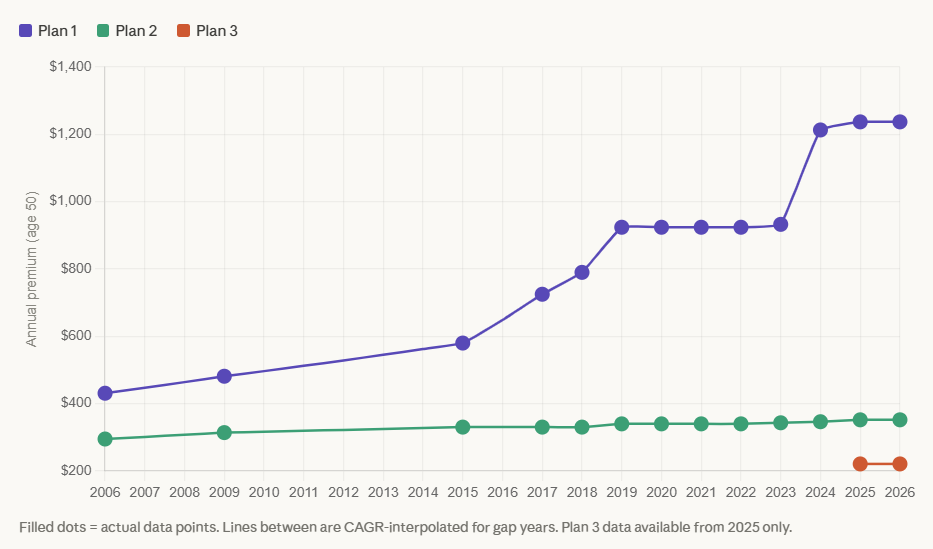
This is the chart of the annual premiums from 2006 to 2026 for Singlife/Aviva’s Plan 1 and 2:

Plan 1 covers the private and Plan 2 covers restructured A ward.
If the price indicates demand and stress, then people are flocking to private and still see it as remaining relevant.
Plan 2’s premiums were essentially flat or slightly declining for over a decade, then jumped in 2026. This pattern is classic for a book of business that was profitable for years (restructured wards are government-controlled in cost, reducing insurer exposure), followed by a repricing event possibly triggered by regulatory changes, increased claims volume post-COVID, or the insurer reassessing its loss ratios after years of suppressed pricing.
But every time you see complains about the premium cost, perhaps it is those who are most sensitive to needing private treatments making the noises.
The Annual Premiums for Rider without Covering Deductible (Health Plus Lite) has Increased Significantly from Last Year
This is the rider that I am on.
So there are two or three different Singlife Rider:
- Prime – Covers both deductible and co-insurance
- Lite – Covers only the co-insurance
- Deductible cover – Covers only the deductible (cannot buy in already)
From April 2026, existing riders like Singlife Health Plus (Private & Public Lite), Singlife Health Plus (Private & Public Prime), Singlife Health Plus Deductible Cover, and Singlife Health Plus (Private Cover & Public Prime) are now only available for renewal policies — meaning they can no longer be purchased as new plans.
So since my base plan is a private cover and I have a Lite Rider that only covers co-insurance, this is the difference in premiums versus 2025:

Si Mi Lan Jiao.
The difference between this grandfathered plan, with the potential new one that Singlife will released is that the co-insurance cap will be at $6,000 instead of $3,000.
So they jack up our premiums by 50-100%.
On top of the increase in the last 2 years.
The Annual Premiums for the Co-Insurance Cover Rider for Restructured A Ward Hospital Shows Increase but Less Significant.
Here are the premium difference for the Lite Rider if your base is a Restructured A Ward:

The plan for Restructured A ward tells a different story:
- Ages 1–30: ~35–44% increases, the heaviest hikes in this plan
- Ages 31–55: More modest ~19–30% range
- Ages 56–64: Nearly frozen (0–2%)
- Ages 65–90: A consistent ~10–12% increase
- Ages 91–99: Fully frozen
But the most important thing is the difference.
While a 20.89% rise for a 50-year old from $158 to $191 looks hefty, that is still way cheaper than $1,122 if you are under private.
The Rider that Covers Both Deductible and Co-insurance Show Increases but Less Drastic than the Co-insurance only.
Here are the premium tables for the Private grade if you have chosen the rider that covers the deductible and co-insurance:

- Ages 1–20: ~15–17% increases
- Ages 21–40: Jump to ~20% across the board
- Ages 41–50: Slight step down to ~15%
- Ages 51–55: The biggest spike — 30–33%, with age 55 being the peak at +33.01%
- Ages 56–60: Mixed band, ranging from ~18% to 25%
- Ages 61–70: Back to a consistent ~15%
- Ages 71–93: A very uniform 20% increase
- Ages 94–99: Tapering off from ~13% down to ~10%
Here is the one for Government Restructured A ward:

- Ages 1–11: ~15% increases uniformly
- Ages 12–13: Slight dip to ~13.5% — a small kink in the data
- Ages 21–25: Drop to ~10%, the lowest increases in this plan
- Ages 41–45: Minimal increases of only ~5%
- Ages 56–60: Jump to ~22%, among the highest
- Ages 64–80: A consistent 20% band
- Ages 81–90: Tapering down from ~10% to ~7.6%
- Ages 91–99: Completely frozen — no change at all
We are seeing a 20% increase.
I cannot believe I would say this is more controlled.
The Difference Between Covering Deductible and not Covering
The main difference between Lite and Prime is whether they cover the deductible so by comparing the difference in premium, you might get a sense of the “savings”.
Here is the difference in 2026:

Your premiums is cheaper definitely.
But its like telling someone who cannot buy HDB that if you choose to buy a condo nearer to city center to outskirts, you can enjoy massive savings.
It is just more expensive in absolute terms.
Here is the difference if we discuss last year:

The difference was more significant, and so Singlife narrowed the gap by increasing the premiums for the Lite more.
Private versus Government A Ward Plan if Including Rider
I think over time, policy holders need to make a decision about
- Their grade of care.
- How much premiums they wish to pay.
- How much out of pocket expenses that they need to pay.

You are going to enjoy about pretty significant savings.
If You Buy a Rider, you Are Signaling Your Pain Threshold for Out-of-Pocket Expenses Planning is Weak that You Are Willing to Pay Recurring for it.
Okay before you criticizing me, the rider in this time and age does a pretty pivotal role in increasing the Medishield Health Limits (MSHL) for Cancer drug treatments.
So we cannot say it is solely determined by your willingness to plan for out-of-pocket costs.
My reader (who knows much more about insurance than me) made a thought provoking comment:
- We know that the main plan covers like 90% of your hospitalizations, less the annual deductible.
- The rider covers the deductible and the co-insurance.
If the premiums are the same price, then why are you so willing to pay so much for the rider if it covers less?
Unless the Cancer limits are important and out of pocket is painful for you.
So this is something to think about.
If you want to trade these stocks I mentioned, you can open an account with Interactive Brokers. Interactive Brokers is the leading low-cost and efficient broker I use and trust to invest & trade my holdings in Singapore, the United States, London Stock Exchange and Hong Kong Stock Exchange. They allow you to trade stocks, ETFs, options, futures, forex, bonds and funds worldwide from a single integrated account.
You can read more about my thoughts about Interactive Brokers in this Interactive Brokers Deep Dive Series, starting with how to create & fund your Interactive Brokers account easily.

Kyith is the Owner and Sole Writer behind Investment Moats. Readers tune in to Investment Moats to learn and build stronger, firmer wealth foundations, how to have a Passive investment strategy, know more about investing in REITs and the nuts and bolts of Active Investing.
Readers also follow Kyith to learn how to plan well for Financial Security and Financial Independence.
Kyith worked as an IT operations engineer from 2004 to 2019. Currently, he works as a Senior Solutions Specialist in Fee-only Wealth Advisory Firm Providend. All opinions on Investment Moats are his own and does not represent the views of Providend.
You can view Kyith’s current portfolio here, which uses his Free Google Stock Portfolio Tracker.
His investment broker of choice is Interactive Brokers, which allows him to invest in securities from different exchanges all over the world, at very low commission rates, without custodian fees, near spot currency rates.
You can read more about Kyith here.