
As people talk about how AI is going to kill these data-related companies, I saw this chart pop-up in one of our internal discussions:

This is a chart of the Straits Times index from 2000 to 2026 (Green), overlay with the weighted average of earnings per share (EPS) – 12 months forward (Orange) and taking one divide by the other (Cyan).
If you look at the green line, you can see the Singapore equity market starts going through that pretty challenging 1999 to 2003, where we have a US recession, Asian Financial Crisis, Dot Com bust, SARS all stacked together. That to me still feels like the most challenging phase and whenever people say “I don’t think you can have many shitty stuff stacked together all at once after another..” I would think of this LOL.
Then we have a pretty good period aided by how well China have been doing.
Since 2008, Singapore market have not gone any where and only made back to its high in 2025.
That is 17 years.
I like to caution that the Straits Times Index is not total return, which means it did not factor in dividends but I think even if you add that, it still takes a long time to come back.
I just find that different people have different frames when discussing a particular area such as Singapore. Those who invested mainly in 2018 may have a better experience than those who have a lot invested in 2008. This is no different than talking about the property market.
I would hear different kinds of morale when talking to people that bought their properties in 2013 verus 2018 somewhere in 2020.
Your experience is different.
Fundamentals explain why the performance of a region is like that. It is not without region.
Straits Times Earnings Per Share Growth Versus Price.
The orange line shows the 12 month forward earnings per share estimate.

If we take the earnings per share forecast for the next 12 months of each of the index components and you aggregate them, you get a chart like this.
While you may wonder how accurate are consensus forward estimates there are positive to it.
- If your business was not doing well but likely doing better due to what you said in the quarter, forward EPS will look better. This should show everyone you will make more profits.
- The current price of something is an aggregate of FUTURE cash flows, discounted with a hurdle rate. You are always trying to see how expensive or cheap something is not about what it did in the PAST but the FUTURE.
- While we can say analysts and bosses can be overly optimistic, viewing it in such a chart adjust over time.
You can go out there and see how easy it is to find this data. We just got access to this not too long ago. If you are a client of Providend and eventually like this post after reading this, do email or message me and I can see if our Investment Team can do more content like this.
Okay, the pink box highlights a period where the earnings per share struggled. You realize that the orange EPS line moves in a similar manner as the green line.
I would say if price is down, it indicates that the EPS is going to turn down.
If price is up, it indicates the EPS is going to turn up.
Not always but when viewed over a 17-year period you can see it.
The price is an aggregate of future cash flows and in hindsight future cash flows of the Straits Times was volatile, and went nowhere.
I think you know the MSCI World did pretty well during this 2010 to 2020 period of EPS struggle so here is the EPS of the MSCI World and MSCI Emerging Market:

This chart shows the EPS for MSCI World and Emerging markets over a long time frame. We have more data if it is this. This is trailing earnings per share instead of forward, but you can see that when viewed over a time series, it kind of matters less.
The MSCI Worlds trailing EPS went through the same rise and dips but earnings per share end up higher. In contrast, the trailing EPS of the MSCI Emerging markets also went through the same grind as the Straits times, and you also know the performance of Emerging Markets was less than stellar over that period.
So where is the EPS of Straits Times, MSCI World, Emerging Markets going to go Kyith?
Beats me.
My job is to tell you that there is fundamental grounding to the performance of these stuff so that you can focus more on the question: So does earnings per share, when viewed over longer term really goes up?
Price Leads EPS
I used to say I will wait for the fundamentals to show me convincingly that the earnings are showing up.
But that usually doesn’t work that well.
I get confusion why the price is running for no reason.
Then I realize that price… is the best indicator of future performance. Not always, but the market consistently tries to price in how it is.

I highlighted a few pink boxes and you can look at the green and the orange lines. Generally the green lines lead the orange lines, which indicates that price leads fundamentals.
For example the price starts going up in 2008 before the EPS turns up. Its easier to see on such a chart but in a day by day basis without such EPS chart, you be even more confused why the price is rising!
There will be a lot of whipsaws though, and this is because the market consistency tries to value stuff.
The most weird one is the last pink box. You see a huge run up of EPS, but the price (green line) like didn’t go anywhere. But in a sense, the price might indicate that EPS growth is going to take some breather.
What we are seeing the EPS is it seems to be heading higher.
Or is it going to go into a dump again?
That is a topic for another day but at least now you might wonder more about the fundamentals.
It also kind of tell you that if EPS is generally higher in the long term, I don’t think price can be surpress for too long.
What About Valuation?
The Cyan line takes the price dividend by the forward EPS and it shows the valuation of the index at that point:

I drew lines to show the historical valuation range that the Straits Times index that trades at, which is around 11 to 14 times the past 17 years.
If we invert PE of 11 and 14 we get 9% and 7%.
We can look at this as the earnings yield of the Straits Times if we invest long enough (perhaps 15-25 years).
In a way without much EPS growth it doesn’t mean that you don’t have returns. If we have a long time horizon, we can earn a certain yield. it s a question of if the majority of the companies return the money well to shareholders in the form of share buyback or dividends.
If most of the stocks are not shareholder friendly (perhaps like the last 10 years) then having a good earnings yield also doesn’t help.
In general, markets go through their ebbs and flows and the market gets more cheap or expensive. But there are sometimes reasons for it.
We haven’t see the earnings per share jump to a higher plateau for a while.
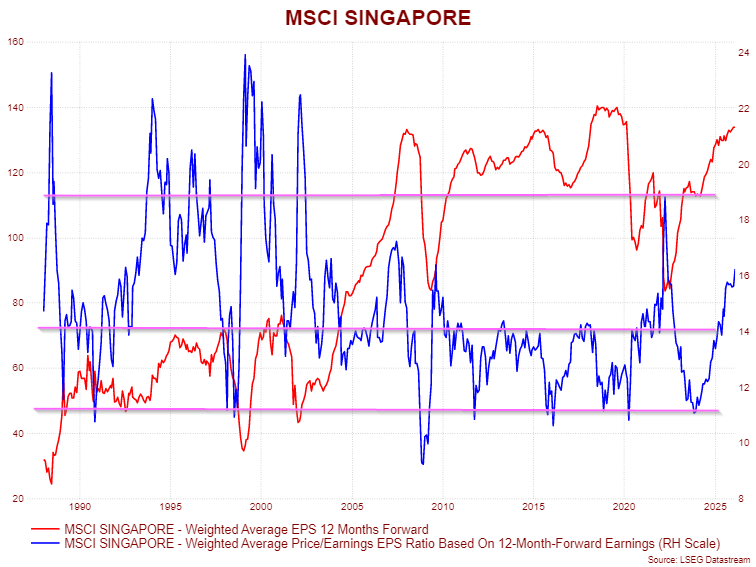
I have a longer chart using the MSCI Singapore index, which is a more concentrated index:

This is also forward EPS, and you can see that aside two different things:
- Where EPS was in the early 1990s and how bonkers the EPS growth was from 2003 to 2008 relative to history.
- That the MSCI World actually can trade at a higher valuation.
In a way should we worry if the valuation based on PE is not cheap?
It kind of means:
- The market have priced in good earnings.
- If earnings surprises even higher than what is priced in, the Straits Times Index can move up.
- If earnings disappoints more, prices would struggle.
The price of a basket of securities over the long term, is driven by fundamentals and hopefully I showed you in today’s short exercise.
If you like this stuff and wanna tap into my money brain, do join my Telegram channel.
I share what I come across in:
- individual stock investing
- wealth-building strategies
- portfolio management
- personal finance, financial independence.
I would also share some of the thoughts of wealth advisory, financial planning and the industry that I don’t wanna put out on the blog.
Would probably share some life planning case studies based on the things I hear or came across as well.

Kyith is the Owner and Sole Writer behind Investment Moats. Readers tune in to Investment Moats to learn and build stronger, firmer wealth foundations, how to have a Passive investment strategy, know more about investing in REITs and the nuts and bolts of Active Investing.
Readers also follow Kyith to learn how to plan well for Financial Security and Financial Independence.
Kyith worked as an IT operations engineer from 2004 to 2019. Currently, he works as a Senior Solutions Specialist in Fee-only Wealth Advisory Firm Providend. All opinions on Investment Moats are his own and does not represent the views of Providend.
You can view Kyith’s current portfolio here, which uses his Free Google Stock Portfolio Tracker.
His investment broker of choice is Interactive Brokers, which allows him to invest in securities from different exchanges all over the world, at very low commission rates, without custodian fees, near spot currency rates.
You can read more about Kyith here.