
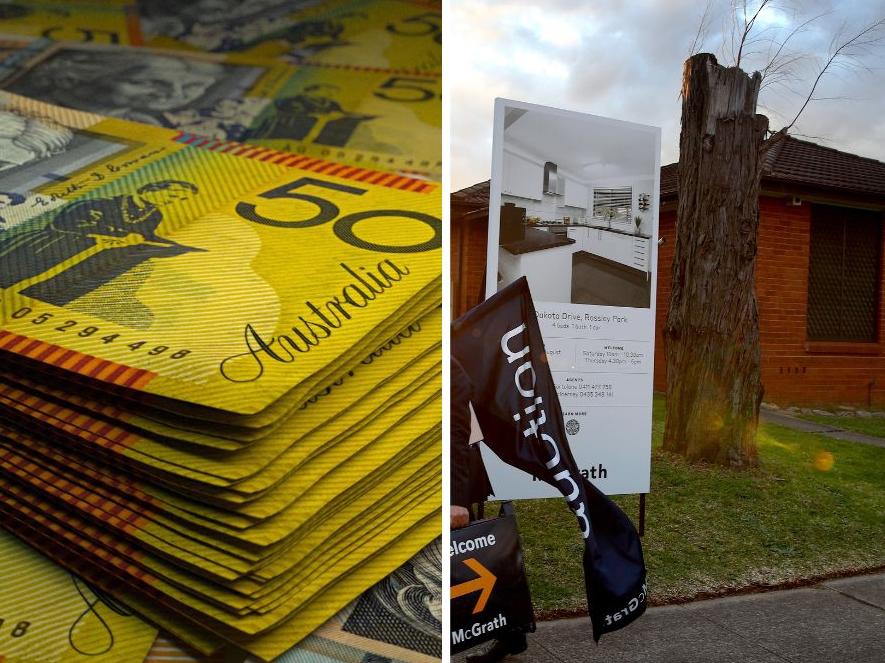
Competition at auction began to moderate late last year, but demand is expected to remain strong over 2026. Picture: Jeremy Piper
Sydney households will need to earn nearly $305,000 by the end of 2026 to afford an average city house and $165,000 a year for a unit if expected interest rates and price rises eventuate, new data shows.
The analysis of PropTrack price modelling and rate predictions from two of the country’s big four banks showed a window of better housing affordability may soon be closing.
Both ANZ and Westpac are now forecasting no further interest rate cuts in 2026 due to stubborn high inflation, with both banks expecting the cash rate to remain on hold until the end of the year.
This sustained rates climate would coincide with continued rises in prices over the year that, although slower than in 2025, would mean buyers needing much larger budgets to be able to keep up.
PropTrack modelling has forecast continued rises in prices over 2026, with Sydney values tipped to rise about 5 per cent over the year, down from nearly 7 per cent in 2025.
The research group noted these rises would be driven by migration-fuelled population growth, housing shortages and government buyer support such as the First Home Guarantee Scheme.

This Castle Hill home recently sold for $2.68m.
MORE: Usman Khawaja’s $9m plan for retirement
These forces would be a “tailwind” that would mitigate some of the market impact of a changing interest rate environment, PropTrack economist Angus Moore told The Daily Telegraph in December.
Continued price rises would also be driven by strong demand for the most affordable properties – rather than demand for properties across the top end of the market.
A home buyer wanting to purchase a median priced Sydney house ($1.62m) with a 20 per cent deposit currently needs an income of about $291,000 to afford it and not go into mortgage stress.
Avoiding mortgage stress meant the buyer would be spending no more than a third of their income on housing costs.
Apartment buyers currently need an income of $157,000 a year to be able to afford a median priced unit with a 20 per cent deposit and an average mortgage rate.
MORE: Iconic Hollywood actor faces eviction over $90k rent debt
Real Estate Buyers Agent Assocation president Melinda Jennison said interest rates would play a decisive role in the market.
Another 5 per cent rise in prices would change this requirement.
With a median house now costing nearly $1.7m, a house buyer would need about $305,000 to afford the purchase.
Unit buyers would need to earn $165,000 by the end of 2026 to still be able to afford a median priced apartment.
Real Estate Buyers Agents Association of Australia president Melinda Jennison said housing shortages would force prices up over 2026.
“We are well behind Housing Accord targets and, without a material easing in immigration, demand to both buy and rent will continue to outpace supply in many cities,” she said.
“ I expect continued depth in the more affordable house and townhouse markets, as higher-income households are pushed out of premium suburbs and into the middle-ring and outer locations.”
MORE: Aus’ worst major suburb to live in revealed
Hotspotting founder and property analyst Terry Ryder.
Terry Ryder, director of research group Hotspotting, said in a note to investors that most markets across Australia would perform reasonably well in 2026.
“Demand is being fuelled by an unprecedented high level of infrastructure investment (and) high population growth,” he said.
“At the same time … we continue to build far too few new dwellings, listings of properties for sale are extremely low everywhere and vacancies continue to hover around historically low levels.”
Mr Ryder added that $900 billion in major infrastructure projects would make it more challenging for new construction to catch up with demand.
“It’s creating heightened economic activity and jobs – and therefore demand for real estate,” he said.
“And it is exacerbating the shortage of new dwellings because tradespeople are working on the big-ticket government projects rather than building new houses and units.”
This Greystanes home recently sold for $1.625m.
MORE: Sydney landlord’s stunning $210k demand
Intuitive Finance director Andrew Mirams said first-home buyers would be a key driver for the 2026 market because of government support allowing them to buy with 5 per cent deposits.
“The government incentives and 5 per cent deposit scheme, while also raising the buying limits and removing the income tests, mean this market will potentially boom into 2026 and beyond,” he said.
A potential wrecking ball to current forecasts for further price growth over 2026 would be interest rate hikes – the expectation of CBA and NAB.
CBA predicts a single cash rate hike for 2026 to come in February. NAB has forecast two 2026 rate hikes, one in February and another in May. Most other forecasters are ruling out rate hikes at this stage.
Mr Mirams said rate hikes could impact market sentiment and make buyers more hesitant, but sluggish construction at a time of strong population growth may mitigate much of the impact.
“We still have a chronic building undersupply, so if the government doesn’t address migration, then we are going to continually have a lack of supply to meet demand.”