
Last year, my private shield plan rider’s premiums went up from $201 to $373. Singlife Health Plus Private Lite premium went up by 85%. You can read Singlife Shield and Health Plus in 2024. (And my 85% Health Plus Premium Increase)
When I reviewed my premiums this year last night, Health Plus Private Lite’s premiums went up from $373 to $564. That is a 51% increase over 2024.
KNN Singlife WTF.
I was pretty sure I have not crossed over from 45 to 46 because your premiums will go up significantly at 5 or 10 year mark.
My main shield plan, which is a private plan that covers private medical treatment went up from $805 last year to $832 this year.
WHAT KIND OF BULLSHIT IS THIS 180% rise in premium in 2 years.
Some of you may have heard of this new requirements for integrated shield plan riders to address healthcare costs. Read this MOH announcement here.
- From 1st April 2026, new riders sold will no longer cover the minimum IP deductibles set by MOH. This means that you would have to pay the deductible.
- They will also raised the cap on what the policyholder have to pay from the co-payment (excluding deductibles) to $6,000. This was originally $3,000.
By doing this, they hope that this will create better signaling so that people consider their grade of healthcare more and this will manage future premiums better.
Singaporeans can expect the new riders to be much more affordable compared to existing riders on the market today. On average, the premiums of new IP riders are expected to be about 30% lower than existing riders with maximum coverage. This translates to annual premiums savings of around $600 for private hospital IP rider policyholders and around $200 for public hospital rider policyholders, on average, with older policyholders enjoying greater premium savings. -MOH
Well news flash: my fxxking private Singlife rider IS a rider that only covers co-insurance and NOT the deductible.
SO WHY ARE MY PREMIUMS STILL RISING LIKE THIS????
If the premiums are rising like that then where is the fxxking savings?
I will tell you where is the fxxking savings that MOH is talking about. If you pay for a Singlife Health Plus Private Prime rider, which currently covers both the deductible and co-insurance, would cost $1,531 instead of the $564 that I paid this year. So I “saved” 66% of that if I opted for a non-deductible rider.
Well fxxk.
MOH you should fxxking tell people that the real advise is if you wish for private healthcare optionality there is no arbitrage opportunity. 2 years of your annual premiums on a full rider currently will be equivalent to the deductible you offset.
But I suspect that they have an inconvenient problem.
If they said this, there will be so much influx to the public healthcare system that Ong Ye Kung and gang have not good immediate solutions for.
Majority of the Costs n the System Accrual with Private Medical Treatment.
Now that I fxxking calm down a bit I find that unless you can afford these premiums uncertain, more and more, the insurers are really pushing you to really consider the grade of healthcare.
To give you some perspective, the same rider for a 45 year old like myself would cost:
- Health Plus Prime for Plan 2 (which is the shield plan for restructured A treatment): $419
- Health Plus Lite for Plan 2: $147
Both numbers are much more manageable.
Shield plans that allows a policyholder to attend private healthcare have the more significant price adjustments compare to other grade of shield plans that are more for Restructured A and B1 wards.
I happen to keep about 12 Singlife/Aviva policy renewal statement since I got my first private shield plan from Aviva in 2006 so I can kind of collate the data.
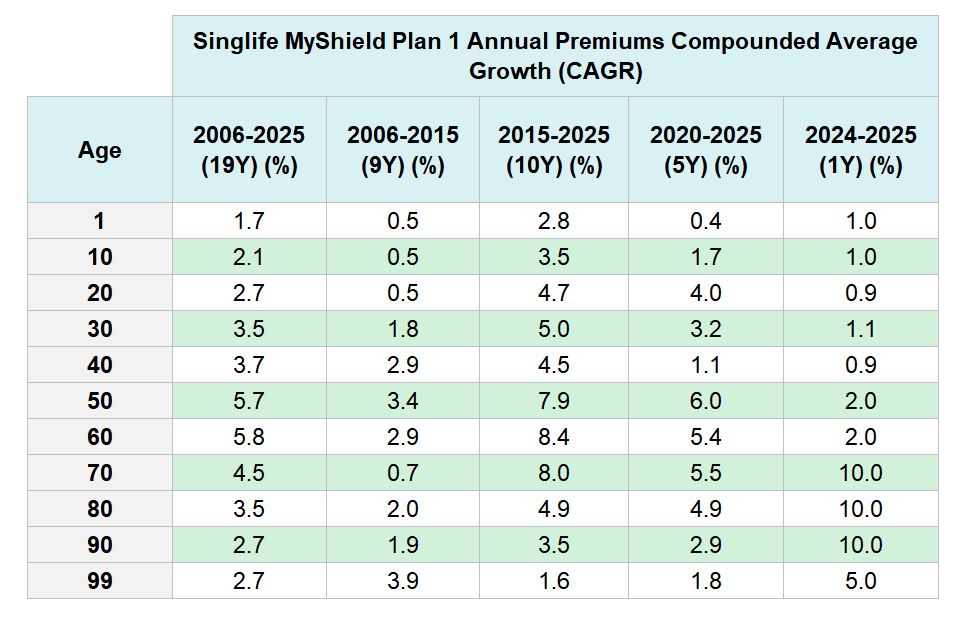
The table below shows the compounded average growth (CAGR) for the annual premiums since 2006 (19 years ago):

I break down the CAGR based on the age of the policyholder so as everyone can see if there are certain unique patterns. Each column is of different time period:
- The full 19 years CAGR
- The first half CAGR
- The second half CAGR
- Last 5 years CAGR
- Last year to this year.
Some may be surprised that the highest CAGR over 19 years is about 5.8%. That is very high already but more so, the age between 40 to 70 show the highest CAGR. The growth in the first 9 years is pretty low, perhaps showing that the problem has not set in yet. The 50-80 years range for the last 10 years is the main problem.
The table below shows almost the same table but more for Plan 2, which is the lower grade plan that allows you to go to a Class A restructured hospital:

The 19-year CAGR shows…. almost no growth!
There are even some periods where premiums for those age 1 to 10 are cheaper today than 19 years ago!
You would notice that this year, Singlife actually reduce the premiums for those 80 years and older compared to the premiums in 2024.
But we are also observing the great CAGR below 30 years old.
I suspect Singlife’s problems for their Plan 2 has to do with how they used to provide free Plan 2 coverage for kids up to 21 years old.
Generally, you may not gripe so much if you have opt for a plan without private care option.
The Lifetime Premiums for a Government Restructure A Ward Shield Plan is Actually lower than 2006
Our impression is that how much we will pay in premiums today would be more significant than 19 years ago but that is not always the case.
We can compare the 50-year old that is in 2006, 2009, 2015.. to 2025, and see if he or she survive till 99, how much total lifetime premiums would the policyholder have to pay.
The chart below shows how much the 50-year of each year-cohort have to pay if we talk about MyShield Plan 1, which is the highest grade of care:

The 50-year old in the past two years would have to pay $20k and $40k more respectively. We see a bump at 2019 as well.
This is not too surprising because most are aware of healthcare inflation.
But the chart below is somewhat similar but for Plan 2:

I was damn surprised that the amount they have to pay… is not too different. The cohort in 2025 may pay less than the one 19 years ago!
I rechecked the numbers a fair bit because this was partly processed by code, and partly because… how can this be possible?
I tabulated the premiums for 50-year old on Plan 2 from 2006 till today below:

I think you would agree that the premiums didn’t rose much.
Sometimes, our lens is so focused on something without realizing the data could be rather different for things we are less aware about.
To manage your recurring and critical healthcare insurance inflation, I might have show you a way. But cost is just one aspect you need to think about. Everyone has their own philosophy with healthcare and for some, private may be a non-negotiable.
But I suspect for many of you, the anxiety with whether to right-size is because you have no opinion and once you right-size, you might not easily be able to go back to a higher grade plan.
The vital knowledge that would help you make your decision better has got less to do with financial planning, or wealth management but your understanding about your preference, and the healthcare experience.
This is something that perhaps an adviser may not always be the domain expert and why you might need to actively listen to your friends discussion about their healthcare experiences.
If you want to trade these stocks I mentioned, you can open an account with Interactive Brokers. Interactive Brokers is the leading low-cost and efficient broker I use and trust to invest & trade my holdings in Singapore, the United States, London Stock Exchange and Hong Kong Stock Exchange. They allow you to trade stocks, ETFs, options, futures, forex, bonds and funds worldwide from a single integrated account.
You can read more about my thoughts about Interactive Brokers in this Interactive Brokers Deep Dive Series, starting with how to create & fund your Interactive Brokers account easily.

Kyith is the Owner and Sole Writer behind Investment Moats. Readers tune in to Investment Moats to learn and build stronger, firmer wealth foundations, how to have a Passive investment strategy, know more about investing in REITs and the nuts and bolts of Active Investing.
Readers also follow Kyith to learn how to plan well for Financial Security and Financial Independence.
Kyith worked as an IT operations engineer from 2004 to 2019. Currently, he works as a Senior Solutions Specialist in Insurance Start-up Havend. All opinions on Investment Moats are his own and does not represent the views of Providend.
You can view Kyith’s current portfolio here, which uses his Free Google Stock Portfolio Tracker.
His investment broker of choice is Interactive Brokers, which allows him to invest in securities from different exchanges all over the world, at very low commission rates, without custodian fees, near spot currency rates.
You can read more about Kyith here.