
Q. I am a recently divorced 48-year-old woman with one son, aged 10. I earn $145,000 annually and was given the house — my principal residence — in the divorce settlement, which is a fully paid off three-bedroom townhouse in Montreal. My ex-husband also pays $550 monthly in child support that ends when my son reaches age 18. I have no other savings or investments except for a $20,000 emergency fund. I can likely save $3,000 monthly after all expenses and was wondering how I should save and invest this money. Retirement savings and education savings for my son are key priorities for me. —Stefania B. in Montreal
Answer: Hi Stefania. My suggestion for your son’s education is to contribute $5,000 a year to a registered education savings plan (RESP) so you maximize the grant. The annual contribution to get the maximum grant is $2,500. However, you can go back one year at a time to pick up missed grants and the grant stops becoming available once your son turns 17. You are likely going to help your son with his schooling, so why not contribute to the RESP and get the government grant?
It’s not as clear-cut an answer when it comes to saving for retirement. The standard strategy is to maximize your registered retirement savings plan (RRSP) first, then your tax-free savings account (TFSA), followed by non-registered investments. That is the best or the worst advice you can follow . It’s all dependent on how you manage your money.
I will show you the textbook approach, as well as how people more commonly behave, then you can decide which is right for you.
To set this up I assumed inflation at two per cent and investment returns of five per cent, made up of a combination of interest, dividends and capital gains. Your living expenses are about $71,000 annually, after tax and investment contributions. I also assumed you will want the same $71,000-a-year after-tax income in retirement, which would start in January of the year you turn 65. Canada Pension Plan (CPP) and Old Age Security (OAS) payments start at age 65 as well.
I calculated the results of investing $30,000 a year, plus any tax savings, other year-end savings after spending $71,000 a year after tax, plus the $5,000 once you stop adding to the RESP. This illustrates the impact of investing the RRSP tax refund. I looked at what happens if the money is invested into one of three scenarios: 1. all of it goes into a non-registered account; 2. the TFSA maximum plus the remaining amount to a non-registered account and 3. $30,000 to an RRSP and the surplus to a TFSA and then to a non-registered account.
This is an example of the textbook RRSP strategy working. The calculations indicate that under scenario 1, putting your money into a non-registered account, your savings at age 65 are $800,400 and savings are spent by age 83. With scenario 2, contributing to a TFSA first, you will have $902,000 at age 65 and you will spend it all by age 87. With scenario 3, contributing to an RRSP first, you will have $1,264,200 by age 65 and it will be spent by age 91.
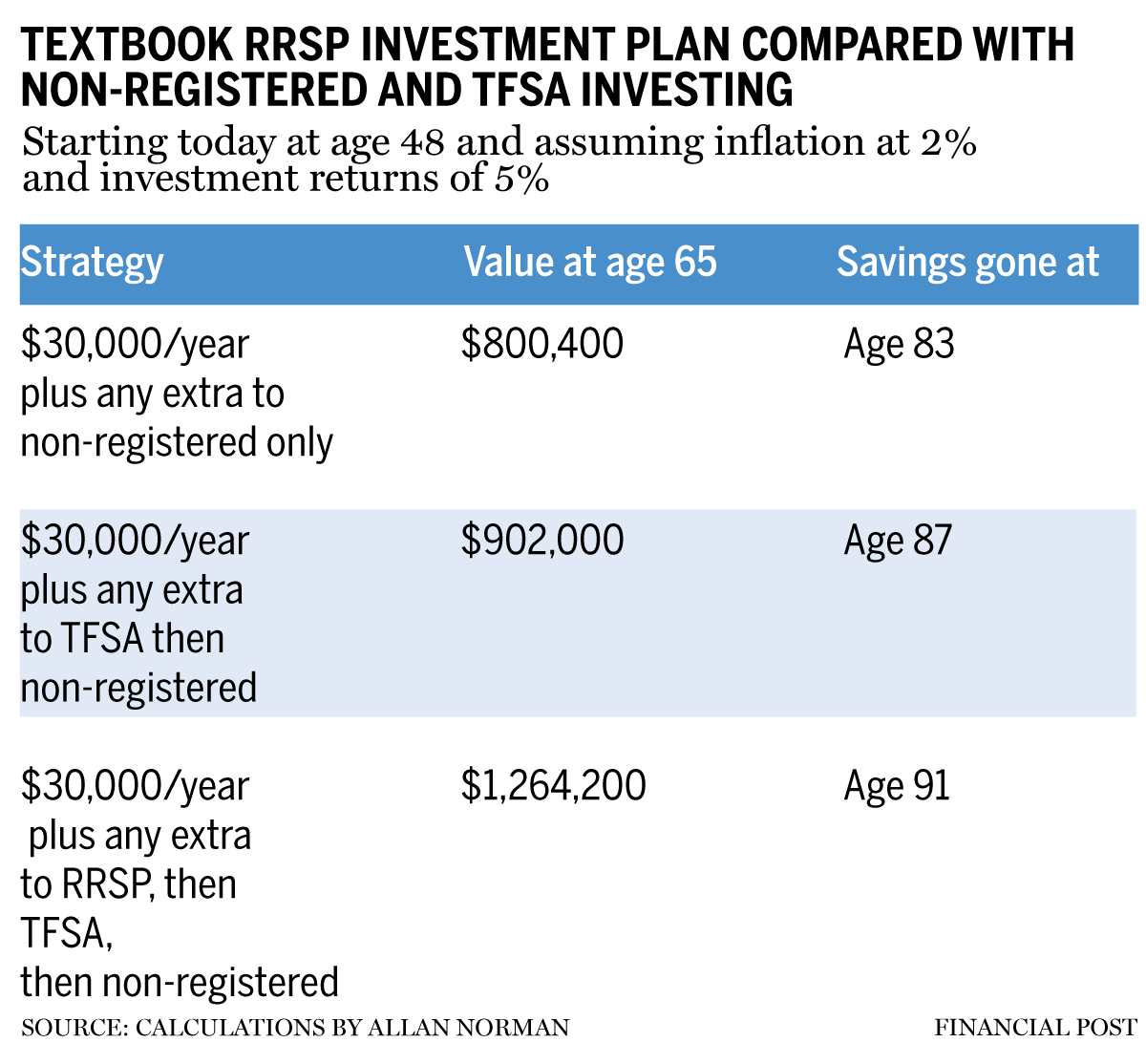
The RRSP results in this scenario are, I feel, representative of what most planners and writers present.
However, I also calculated scenarios more reflective of how I think most people actually invest, which is not to reinvest annual RRSP contribution tax refunds or year-end savings, if any. Also, once the $5,000 RESP contributions stop, I didn’t add that to your retirement savings calculations.
In each Scenario, only $30,000 is invested each year. In scenario 1, all contributions go to a non-registered account. In scenario 2, you contribute up to your TFSA limit, then to a non-registered account. In scenario 3, you contribute up to your RRSP limit, then to a TFSA, then to a non-registered account. The rest is spent.
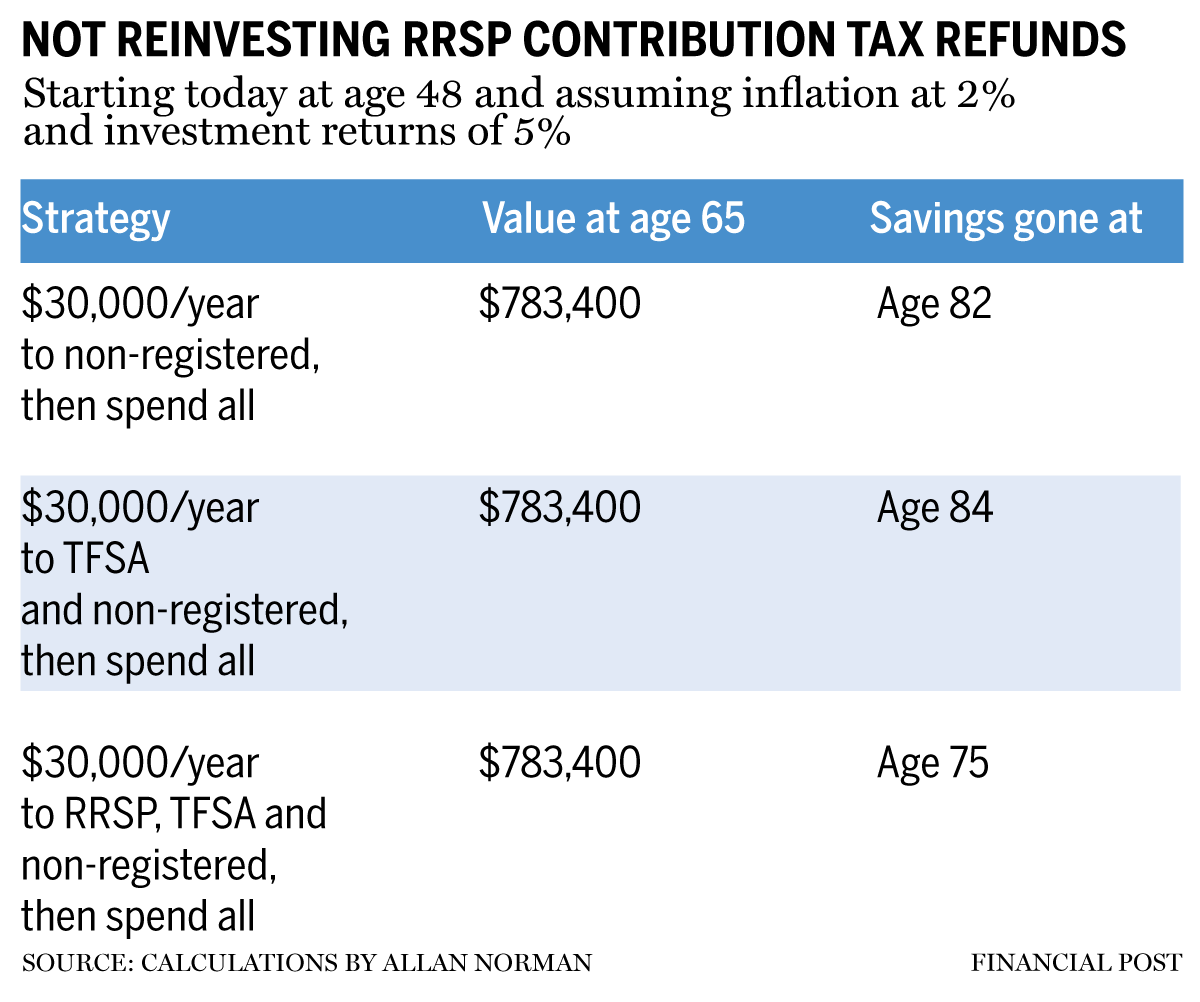
The calculations indicate that under scenario 1, the savings are gone by age 82. With scenario 2, the money is gone by age 84. With scenario 3, the money is gone by age 75. (This is because all of the money in the registered retirement income fund is 100 per cent taxable when withdrawn. You have to draw a larger amount to cover the tax if you want the same after-tax income.)
The big take-away from these scenarios is that if you invest the same fixed amount in any of the strategies you will have the same value at age 65: $783,400. Each account type is taxed differently, which explains why your money is running out at different ages. Money invested in a TFSA accumulates tax free and comes out tax free. Money invested in a non-registered account has annual distributions taxed and its growth is taxed when traded or withdrawn. Everything drawn from an RRSP or registered retirement income fund is 100 per cent taxable.
What is missing from the table are the tax implications during the accumulation phase. When you are accumulating in a non-registered account there will likely be tax owing each year and if you don’t pay the tax from your investment account, which most people don’t, it will come from your free cash flow.
The RRSP looks to be a particularly bad strategy if you don’t reinvest the RRSP contribution tax savings, although the tax savings are significant. If your average marginal tax rate is 40 per cent, a $30,000 RRSP contribution creates a tax savings of $12,000. That is $12,000 extra to reinvest or spend and do things with, which may be more important to you at this stage of your life.
Stefania, now that you know this, do you think you would reinvest the tax savings if you contribute to an RRSP? If so, then the textbook RRSP strategy may be best for you. If not, you may be better maximizing your TFSA first. A conversation with a financial planner becomes useful so you can design a plan to suit you and your future .
Allan Norman, M.Sc., CFP, CIM, provides fee-only certified financial planning services and insurance products through Atlantis Financial Inc. and provides investment advisory services through Aligned Capital Partners Inc., which is regulated by the Canadian Investment Regulatory Organization. He can be reached at alnorman@atlantisfinancial.ca.
Do you have a question for FP Answers? Email wealth@postmedia.com.