
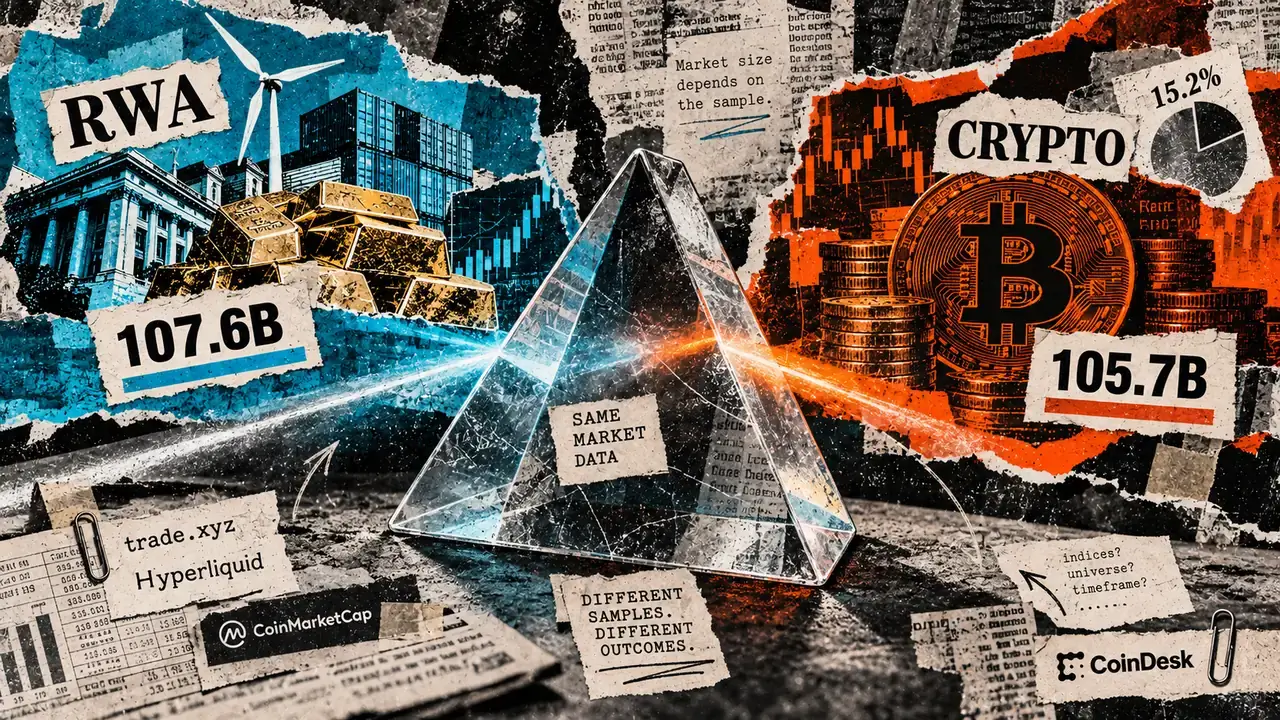
A new report from OKX and Token Terminal says real-world-asset (RWA) futures on trade.xyz edged past crypto futures on Hyperliquid in July. The headline numbers were $107.6 billion of RWA-contract volume against $105.7 billion of crypto-contract volume.
That was a selected-venue crossover, not an industry-wide change in market leadership. The underlying report treats trade.xyz and Hyperliquid as category-leading onchain venues. Broader datasets confirm that RWA perpetuals are growing quickly, but they do not show a comparable takeover of crypto derivatives as a whole.
RWA futures crossed crypto inside the report’s sample
The report tracked July 1 through July 30 and found that RWA volume on trade.xyz reached $107.6 billion, slightly above $105.7 billion of crypto-perpetual volume on Hyperliquid. Its selected RWA series had climbed from $760 million in October 2025.
That is a significant change inside the measured sample. It is also narrower than the OKX summary suggests when it says RWA futures surpassed crypto futures by volume.
A category-leading venue is a proxy, not the whole market. Its data can show what is happening on that platform, but it cannot establish the size of every competing venue and contract outside the sample.
The report’s open-interest figures reinforce the growth signal without resolving that scope problem. Its selected RWA series rose from $16.1 million to $1.72 billion over nine months. The page contains conflicting fold-change labels, so the endpoints are more reliable than any one multiplier.
Broader July measurements show how much the picture changes with the market universe:
| Dataset | RWA measure | Comparison universe | Defensible takeaway |
|---|---|---|---|
| OKX and Token Terminal | $107.6B | trade.xyz RWA versus $105.7B of Hyperliquid crypto volume | RWA edged crypto inside a selected onchain venue comparison |
| CoinDesk Research | $460B | $3.03T of total centralized-exchange derivatives volume | RWA perps were about 15.2% of this CEX denominator |
| CoinMarketCap Research | $792.2B | 19 centralized and decentralized venues | RWA activity was larger across a wider venue set, but no equivalent all-crypto denominator was supplied |
CoinDesk Research reported $460 billion of July RWA perpetual volume on centralized exchanges and $3.03 trillion of total CEX derivatives. Dividing those figures puts RWA perpetuals at approximately 15.2% of CoinDesk’s CEX denominator.
That calculated share is not a consolidated global estimate. Still, it shows why the trade.xyz-versus-Hyperliquid crossover cannot prove that traditional-asset contracts displaced crypto derivatives across the industry.
CoinMarketCap Research measured $792.2 billion of July RWA-perpetual volume across 19 centralized and decentralized venues. That total confirms the category’s scale. It does not establish RWA’s share of all derivatives because the report does not pair it with an equivalent all-crypto denominator.
One denominator can reverse the result
CoinMarketCap’s DEX analysis demonstrates the effect directly. Across nine fully collected decentralized exchanges, RWA contracts remained below 20% of volume. When the HIP-3 venue group was added as a tenth venue, the measured RWA share crossed 50% on July 8.
The reason was structural. HIP-3 activity in that dataset was more than 99% RWA, while Hyperliquid’s much larger main crypto book was excluded from the calculation. Adding an RWA-heavy venue without adding the related crypto venue changed the denominator enough to reverse the result.
That does not make the trading activity unreal. It means “overtook” describes a chosen sample, not a settled fact about the entire derivatives market.
Within the report’s selected series, RWA trading grew from $760 million to $107.6 billion and open interest reached $1.72 billion. Separate CoinDesk and CoinMarketCap datasets found hundreds of billions of dollars in monthly RWA-perpetual activity across broader venue sets.
Those measurements establish that crypto exchanges are becoming substantial markets for derivatives linked to offchain assets. They do not establish market-wide displacement. Until researchers use like-for-like venue coverage, contract definitions, time windows and crypto denominators, any crossover claim should state the sample that produced it.