
The surging costs of renting in Australia is adding to the nation’s domestic inflation problem and could be backing the Reserve Bank into a corner that will result in more rate rises.
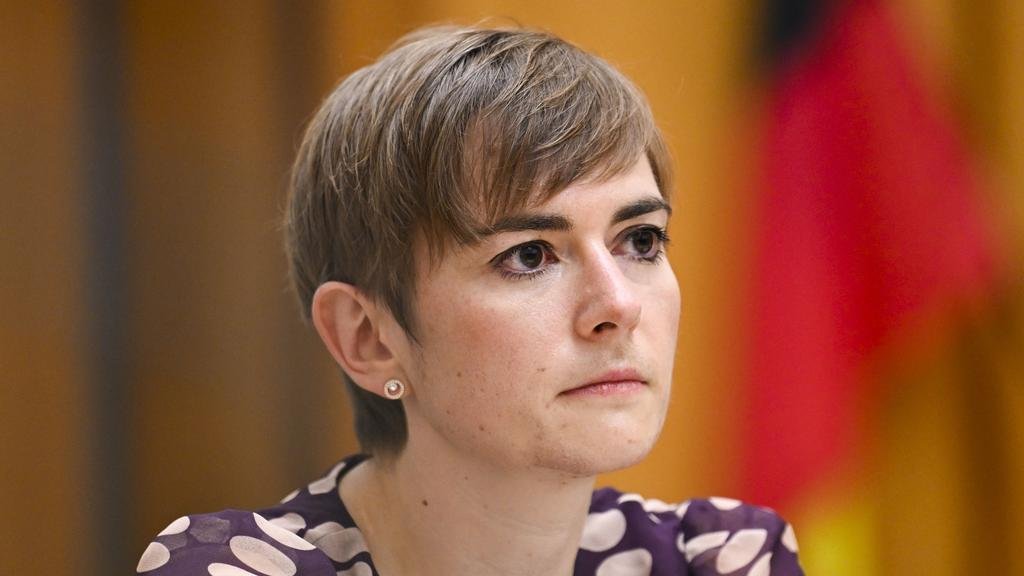
Assistant governor Sarah Hunter faced the Senate Select Committee on Intergenerational Housing Inequity on Thursday, pushed to answer questions on the RBA’s thinking around Australia’s struggling property market.
RBA assistant governor, Sarah Hunter. Picture: NewsWire / Martin Ollman
Asked about rent costs, Dr Hunter acknowledged that record high prices were a significant driver of inflation.
“Rent is part of our inflation challenge,” she said.
Australia’s median rent hit a record high in June of $670 per week, realestate.com.au data shows. This is led by capital cities where the median rent is $690, while rent in the regions is sitting at $600.
While rent has increased 6.4% over the past year – rising almost twice as fast as the increase in the value of the housing market – Dr Hunter confirmed the RBA would not provide a formal view on rent capping.
All states and territories in Australia with the exception of the Northern Territory only allow investors to increase tenants’ rent once a year. Various rules and parameters exist in every different state around specific amounts.
“We haven’t looked in detail at the particular lever,” Dr Hunter said of the RBA’s work. “Even so, we would not be the ones doing that, it would be local or state governments.”
Dr Hunter said the RBA’s focus remained firmly on its dual mandate of low inflation and full employment, warning more rate hikes could be necessary in the coming months.
Commonwealth Bank, ANZ and National Australia Bank all switched their cash rate forecasts from a hold to hike on the back of new data from the Australian Bureau of Statistics (ABS) last week, which revealed underlying inflation has yet to soften after three months despite the bank’s tightening earlier in the year.

Both headline and underlying inflation have been of concern to the RBA in recent months. Picture: Getty
“We understand that at that point in time, it’s very challenging. The tricky thing is, we have a job to do to bring inflation down. We’ve got to do that,” Dr Hunter said.
“Inflation impacts everybody, from the people who are renting, through to the mortgage holders but the board is committed to bringing inflation down and the tool to do that is interest rates.”
Dr Hunter was pushed to answer whether Aussies would be able to withstand another rate hike – a major turning point for the country which would push the cash rate to its highest level in 15 years.
“If we look at borrowers overall, we don’t see any systemic signs of financial stress or risk of a financial stability event,” she said.
“The amount of households in negative equity is at historically low standards.”
The comments echo similar comments from Dr Hunter at the end of July, when she said households with a mortgage did not appear systemically struggling to manage.
Dr Hunter told the Senate that RBA modeling showed around 40% of mortgage holders have two years’ worth of mortgage repayments in offset accounts or similar.
The assistant governor’s appearance in Canberra comes with just over three weeks to go until Reserve Bank’s monetary policy board makes its next decision on interest rates.
The latest National Accounts figures, published this week, are also adding fuel to the fire.
The next interest rates decision will be on 29 September. Picture: Hu Jingchen/Xinhua
Australia’s economy grew 0.4% in the June quarter ahead of expectations, adding to the likelihood of a rate hike on 29 September.
The latest ABS accounts confirm the economy grew at 2.1% over the year to 30 June in seasonally adjusted terms.
“There is a complex mix of headwinds and tailwinds at work including interest rate rises, tax policy changes, a wind-down in public infrastructure work and a major ramp-up in data centre investment,” Westpac’s economist team said.
“Activity is likely to be choppy going forward and underlying pulse harder to find.”