
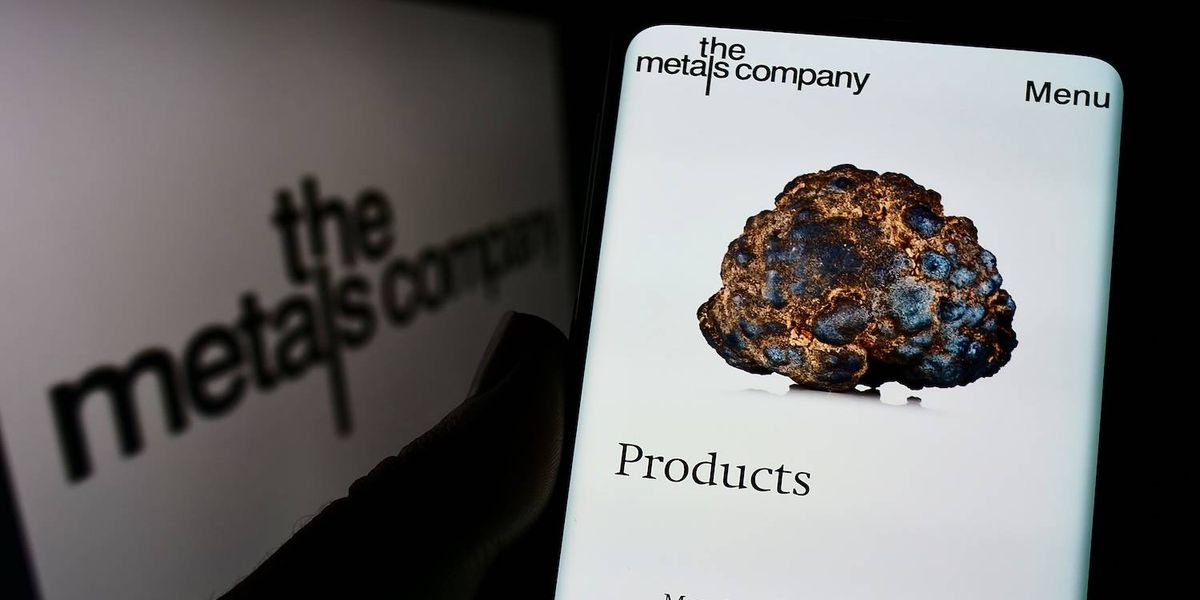
The US National Oceanic and Atmospheric Administration (NOAA) has formally certified a second deep-sea exploration license application from The Metals Company (NASDAQ:TMC) (TMC), accelerating the explorer’s strategy to secure seafloor mining rights under American domestic law.
The certification of the “USA B” application area clears the federal agency to begin drafting a site-specific Environmental Impact Statement (EIS) for the proposed exploration zone.
Spanning approximately 122,000 square kilometers of international seafloor, the tract holds an estimated 1.02 billion tons of polymetallic nodules containing high grades of nickel, cobalt, copper, manganese, and rare earth elements, according to the company’s August 2025 Initial Assessment.
The decision follows NOAA’s determination on April 28, 2026, that the company’s consolidated application for the separate “USA A” tract was fully compliant under the Deep Seabed Hard Mineral Resources Act (DSHMRA) of 1980.
The Nasdaq-listed company shifted its permitting focus toward the US statutory framework in early 2025, bypassing stalled negotiations at the International Seabed Authority (ISA), which has yet to finalize its global exploitation code.
“Today’s certification of our USA B exploration license application marks another important milestone in NOAA’s transparent, rules-based process and we look forward to the development and publication of an EIS. Exploration is a critical step to unlocking the transformative potential of the untapped nodule resource for the United States,” CEO and Chairman Gerard Barron said in a statement.
Under the Cold War-era DSHMRA framework, the US government asserts the right to license its citizens to conduct deep-sea mining activities in international waters as a freedom of the high seas.
NOAA will next publish a Notice of Intent to Prepare an EIS, followed by a public comment period for both the draft environmental review and the proposed Terms, Conditions, and Restrictions (TCRs) governing the license.
A final determination on the issuance of the USA B exploration license will occur after the EIS is finalized.
The advancement of deep-sea mining projects faces ongoing resistance from environmental organizations, which argue that deploying industrial collection machinery on the ocean floor could cause irreversible biodiversity loss and permanently disrupt benthic ecosystems.
In response to ecological concerns, the company has emphasized its ongoing collection of baseline scientific data. Last month, it submitted a decade of biological and geochemical samples gathered from the eastern Clarion Clipperton Zone (CCZ) between 2013 and 2022 to DeepData, an open-access repository managed by the ISA.
The exploration activities within the USA B area are expected to yield further technical and environmental data as the regulatory process advances toward a final licensing decision.
Don’t forget to follow us @INN_Resource for real-time news updates!
Securities Disclosure: I, Giann Liguid, hold no direct investment interest in any company mentioned in this article.
From Your Site Articles
Related Articles Around the Web