
At the start of the year, I would usually report how much I spent in the past year. In this post, I will share my spending in the year of 2025.
I learned from somewhere that we would usually allocate our income with this framing:
- My Spending for today – These are our current expenses.
- My Spending in the past – These are the repayments on the debts we owe.
- My Spending in the future – These will be our savings and investments. They are meant to fulfil a life goal in the future, which will require some money.
You can decide how much to spend for today, the past and the future.
There is a tradeoff to saving up money to spend in the future, and we should all recognize that. Unfortunately, some fail to recognize the tradeoff, and they struggle with living life with money.
Reviewing our spending is a way for us to be more conscious about our spending.
My Past Annual Income Spending Reports
Updating my spending has become a customary update on an annual basis. Not everyone may be interested. However, you might be interest in how my spending has evolved over the years:
- 2014: $23,798/yr – A review of my past year’s expenses
- 2015: $22,150/yr – How our family’s $22,150 annual expenses mean for our financial security and financial independence
- 2016: $26,238/yr – My Annual Expense Report – $26,238/yr and its link to Financial Security and Independence
- 2017: $21,723/yr – Annual Expense Report 2017 – $21,723
- 2018: $19,655/yr – Annual Expenses and Financial Security Musings
- 2019: $23,186/yr – Spending Report for the Year
- 2020: $22,464/yr – How I spent $22,464 in 2020
- 2021: $27,680/yr – Annual Expenses Report 2021
- 2022: $39,187/yr – Annual Spending in 2022
- 2023: $29,554/yr – Annual Spending in 2023 – Reflection of Spending Consciousness
- 2024: $41,923/yr – Annual Spending in 2024
In the first 3.5 years, the expenses comprised three adults’ spending. The expenses were spent on two adults for the next 4.5 years. The current spend (not included in the list above) is the spending of one person (me).
How I Classify My Spending
There have been a few changes over the years in how I classify my spending.
I think if you are on this path of figuring out how to track, budget and reflect upon your spending, you are going to look at things differently. The more you learn, the more you will calibrate how you look at your spending in a way that fits your needs the most.
I revamped my spending last year after my dad passed away in 2023. The current system fits more for a person monitoring their path to Financial Independence.
I have written extensively about how I think about my personal money situation in My Personal Notes section.
Generally, they are grouped so that I can review specifically the following areas:
- My most essential spending (You can read about them in each article). Most inflexible and needs to be most conservative.
- My basic spending. Often inflexible but the timing of spending can be flexible. Mostly conservative.
- Spending if I work.
- Spending that would come from portfolio sources.
- Flexible spending. Can be adjusted, scale up or down depending on market conditions.
The difference between each spending group is based on critical planning characteristics:
- How flexible or inflexible is the income/spending needs.
- Does the spending requires inflation-adjustment.
- Whether the spending is gong to last forever or it ends after certain years.
These critical characteristics affect your income strategy in the following way:
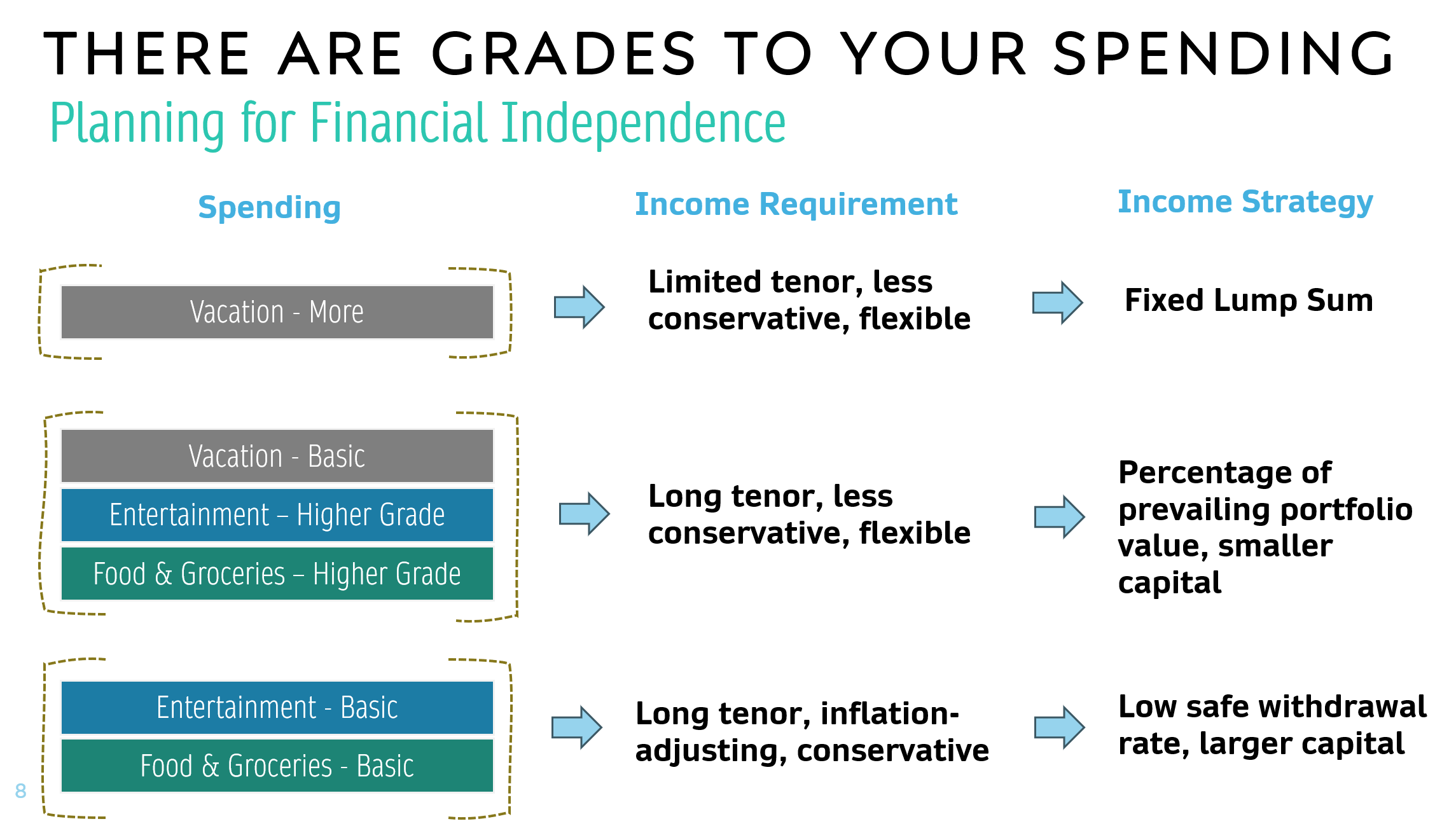
The above is more like an example, not how I want to plan out.
The more inflexible, inflation-adjusting or long the spending needs to be, the more conservative your income strategy needs to be.
Thus, how you look at your spending matters.
Ok let us take a look at 2025’s annual spending.
2025 Spending – $30,768 in the Year
Here is how my spending looks:

My total spending for 2025 comes up to be $30,768. This is lower than the $41k last year and the main reason was I donated less money in 2025.
You can see the monthly spending as well as the total and average at the bottom.
I will spend the next few sections to explain each group in detail.
Essential Inflexible Spend – $3,255 in the Year
The essential inflation spend is a category that I have my eye on the most. This is the inflexible spending that is most essential to life and if this goes up based on inflation, then I have to spend this in a way.
I reflected upon this category and came up with the following budget for income planning:

Updated 5 Jan 25. Click to view a larger table.
The spending is to be provided by the Daedalus portfolio that I frequently wrote about, with the most recent one here. You can read about why I list these items and the corresponding amount in this post.
Reviewing the spending in this category is to see if this template still make sense.

My spending in 2024 is about $1000 higher than in 2023. This time the spending dropped back to closer to 2023 level. The biggest difference is due to the spending in Utilities, Conservancy & Essential Replacements, which saw a reduction from $2,239 to $1,117.
For clarity the common items that goes into here are:
- Property Tax – not paid this year but likely paid this month. My property tax in FY2026 is $212 [last year is $172 so that is a 23% increase!]
- Broadband – $7 monthly this year
- Personal Mobile Subscription – $15 monthly this year
- Town Council Charges – $89 monthly this year (without subsidy) [this is higher. Last year was $78]
- Utilities (Water, Gas, Electricity) – $0 monthly average [100% offset by U-save
- Laptop Replacement
- Mobile Phone Replacement
- Refrigerator Replacement
- Toiletries
I probably provision a budget of $3,364 annually for this and so spending $1,117 is still within the limit.
This year I did not replace the fridge, mobile phone or laptop/computer so this explains the lower spending. I do suspect I might replace the computer and mobile phone so the spending is higher.
I saved up $200-$240 annually for each of these replacement, whether I spend in the year or not. This is a discipline way of provisioning for spending that would eventually happen.
My food spending of a total of $1,063 is low compare to about $4,320 because of a few reasons:
- CDC Voucher subsidizing grocery and food spend.
- Meal prepping. You can read about my meal prep here.
- I would usually eat 2 meals a day.
There are those who say the cost and time is not worth it but with the basic food cost approaching $5-6 per meal, food prepping becomes more worth it. Still I do set my budget as $6 per meal for 2 meals a day. With meal prep, I do average $6 in food cost a day. But as you can see the food cost is even lower.
As a worker, the transport cost averages $90 a month but if I am not working, I do think this will go down dramatically.
I did not pay any utilities this year due to U-Save vouchers.
Lastly, I have 2.5 months of Town Council fee rebate in the year.
My essential inflexible spend of $3,255 is lower than the $10,244 plan for in 2023.
Basic Inflexible Spend – $1,952 for the Year
The Essential Inflexible Spend are the spending that allows a person to run for a long time at the minimum.
However, the reality is that you would have to provide for more in the house. Things break down in the home and you want to improve things over time. You also want to provide for more medical needs. You will have to spend on basic inflexible spend but if market conditions are not so good, you can shift when you spend it. But you would ultimately have to spend and cannot cut down much.
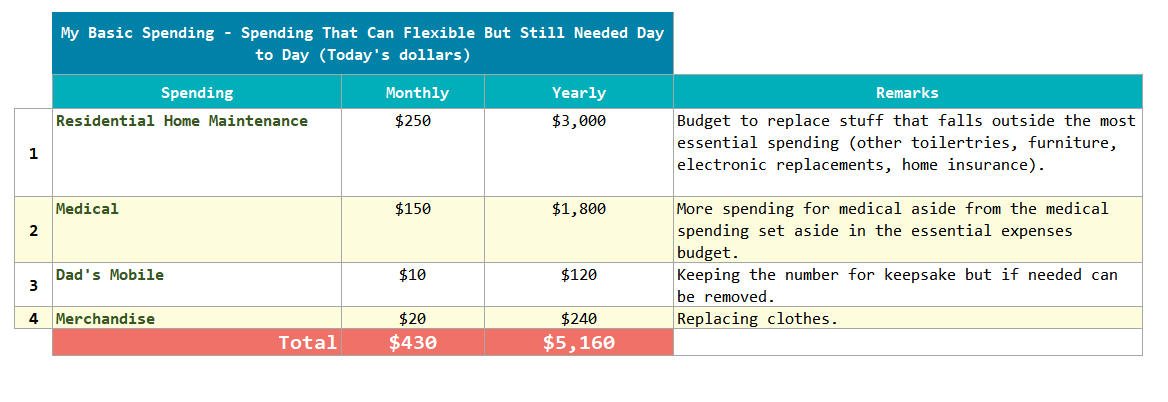
I wrote about provisioning $5,160 a year for things like this:
You can read more about this in this post here. This spending will come from Daedalus income portfolio as well.

I spent $1,952 in 2025 and this is not too different than the $2,266 spend in 2024. This is still lower than the $5,160 provision in the year.
Whatever is not spent here (about $3,000 here) is accumulated annually. This is especially so for the excess $1000 in residential home maintenance which will eventually be needed to replace something pretty necessary such as washing machine, painting, 10-15-yearly renovations.
You might also notice that the spending is pretty lumpy and if you are less seasoned with budgeting, you might struggle to make sense of it.
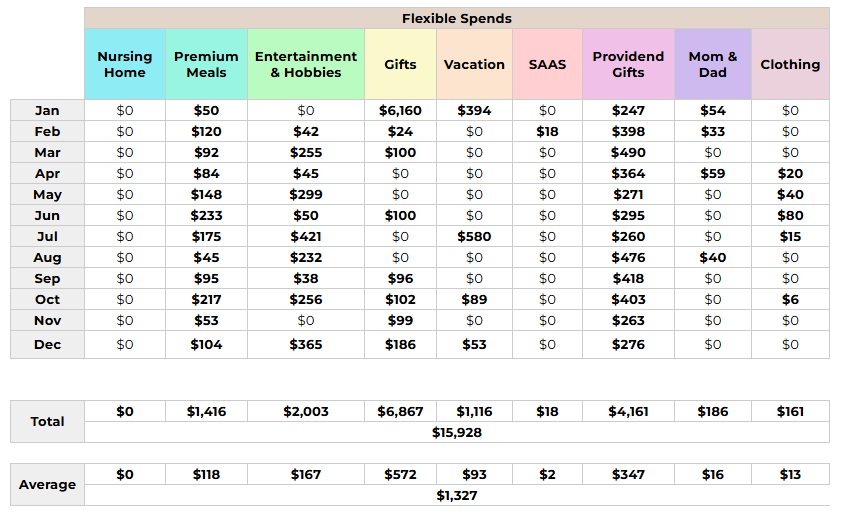
Flexible Spend – $15,928 in the Year
Flexible spend is what you would call your Discretionary spending. The kind of spending that makes life meaningful. This is also the spending that you think you can be flexible about.
Why does this matter in your income planning?
If you are really flexible with this, then if the portfolio is not doing well, then you can cut your spending. You have to deeply reflect if you can cut this.
Aside from income tax, flexible spending is where I spend 50% of my annual spend.

Last year, I spend $25,734 so this is also a reversion back to my 2023 spending.
I contributed $0 to nursing home this year. We got higher subsidies for my grandmother, who is in a nursing home so my aunt told us this is less needed. Still, I think we should eventually plan for a day where we won’t get so much subsidy so I continue to contribute.
Premium meals are the discretionary meals I spend out celebrating events, treating friends and family. If I am doing well, there will be more and if not, this will be more controlled. This amount is not too different from last year. I don’t control my premium meals and this is very volatile but they somehow don’t change much.
I don’t budget a fixed amount for premium meals but just spend them. If I meet or decide to go out more to have a good time, this will increase and vice versa. 2025’s premium meals is not too different from 2024’s.
The fun and hobby spending is lump under Entertainment and Hobbies. This is where my nonsense spending is and this went up like 100% this year. Providend Gifts are the spending that happen accidentally or intentionally because of where I work. This year’s spending is just slightly lower than last year.
You will gain more insight about my flexible spending if you go to my personal notes section and take a glimpse at My Spending Log under How I think about other areas of my current recurring expenses.
I gifted 50% less to people. The amount that I spend at Providend went up by 30%. Gokoku and Baker’s Bench probably amount for a mass majority of that lol.
I spent less on vacation this year as well.
The Rest of My Spending
The rest of my spending includes:
- Income Tax under Work
- Insurance Premiums under Funded by Net Wealth
My income tax is a function of work and blog income. If there are inflows, this is a necessary outflow. Don’t have to think about it so much except to have enough liquidity to pay for it.
Despite Investment Moats revenue falling strangely I seem to be paying less.
I have set aside capital to pay for future insurance premiums so that won’t come from the salary. You can read about it at Cutting My F.I. Capital Needs for Insurance Premiums from $131,366 to $58,132 by Prepaying for It.
Insurance premiums are up.
I suspect that I have to account for my hospital and surgical insurance plans better to attribute part of that as what I provision in my Essential Inflexible Spend.
End of the Year Spending Reflection
There ain’t a lot to learn from study how I eat, move about and spend on the things that keep the household going after doing this for the past decade.
While tracking your spending is important, review and reflection is where the value is.
How you frame or group your spending is critical because it simplifies the kind of planning you wish to do.
Not everyone appreciates the nuance part of it but I am glad some of my friends do.
I profiled how a Telegram group member who decide to shift his budgeting grouping in 2024’s review. This year I want to share my friend CentsofIndpendence’s slight shift in framing:

She and I had ongoing conversations about dealing with how she spends her money annually and financial independence planning [Coast FI, and Full FI]. I tend to think you would attempt but stick with a certain framework if you understand and find value with it.
In the same vein, she groups her spending based on spending that are essential that are more fixed, more variable, the discretionary one (FUN), and also some spending that would go away if life changes (Work), and time limited (mortgage).
In 2025, she thought more about
- how to feel safe and secure with her income, if she decides to replace her tutoring income with something else.
- considering how to match her mortgage payments, which is a limited time spending, with the assets that she has but on a cash flow basis.
All these might sound a little detailed for some of you, but some would also ponder about these things.
By grouping her spending based on how essential/inflexible, limited time/perpetual, it allows her to link better to her assets as she can split her assets to sub-portfolios to plan conservative funding.
You can read more at her Instagram:
There are no right or wrong way to plan, or to track.
And you may not want to bother with it.
However, if you wish to have better control of your life and how money service it, at some point you need to have a framework either mentally or have someone deal with it.
Our budget should reflect our values and how we wish to live our life. The budget might reflect fear, conservatism or abundance.
How I Track and Budget My Spending
I use a free and opensource self-hosted YNAB-style Envelope budgeting system call Actual Budget.
You can read up about ActualBudget here.
A YNAB-style envelope system allows us to see how much money that is accumulated in an envelope over time. This is something a lot of other system struggle to design.
ActualBudget’s reporting have improved by leaps and bound.

I was able to come up with this article with the help of the reports and the transaction filtering.
I created a series of YouTube video of ActualBudget including how to install, setup your budgeting system.
You can view the playlist here.
But I also notice the nice thing about it being free is that there are more and more YouTube videos on Actual Budget. This is great because it creates a bit network effect.
Monthly Spending Post
From mid of 2025, I decide to start posting my monthly spending on Investment Moats. You might catch a more recent monthly post like this.
You can see all the weird stuff I spend money on.
Usually, I don’t publish my monthly spending here but if you are interested I do publish them on my Instagram. If you are interested you can check it out.
If you want to trade these stocks I mentioned, you can open an account with Interactive Brokers. Interactive Brokers is the leading low-cost and efficient broker I use and trust to invest & trade my holdings in Singapore, the United States, London Stock Exchange and Hong Kong Stock Exchange. They allow you to trade stocks, ETFs, options, futures, forex, bonds and funds worldwide from a single integrated account.
You can read more about my thoughts about Interactive Brokers in this Interactive Brokers Deep Dive Series, starting with how to create & fund your Interactive Brokers account easily.

Kyith is the Owner and Sole Writer behind Investment Moats. Readers tune in to Investment Moats to learn and build stronger, firmer wealth foundations, how to have a Passive investment strategy, know more about investing in REITs and the nuts and bolts of Active Investing.
Readers also follow Kyith to learn how to plan well for Financial Security and Financial Independence.
Kyith worked as an IT operations engineer from 2004 to 2019. Currently, he works as a Senior Solutions Specialist in Insurance Start-up Havend. All opinions on Investment Moats are his own and does not represent the views of Providend.
You can view Kyith’s current portfolio here, which uses his Free Google Stock Portfolio Tracker.
His investment broker of choice is Interactive Brokers, which allows him to invest in securities from different exchanges all over the world, at very low commission rates, without custodian fees, near spot currency rates.
You can read more about Kyith here.