
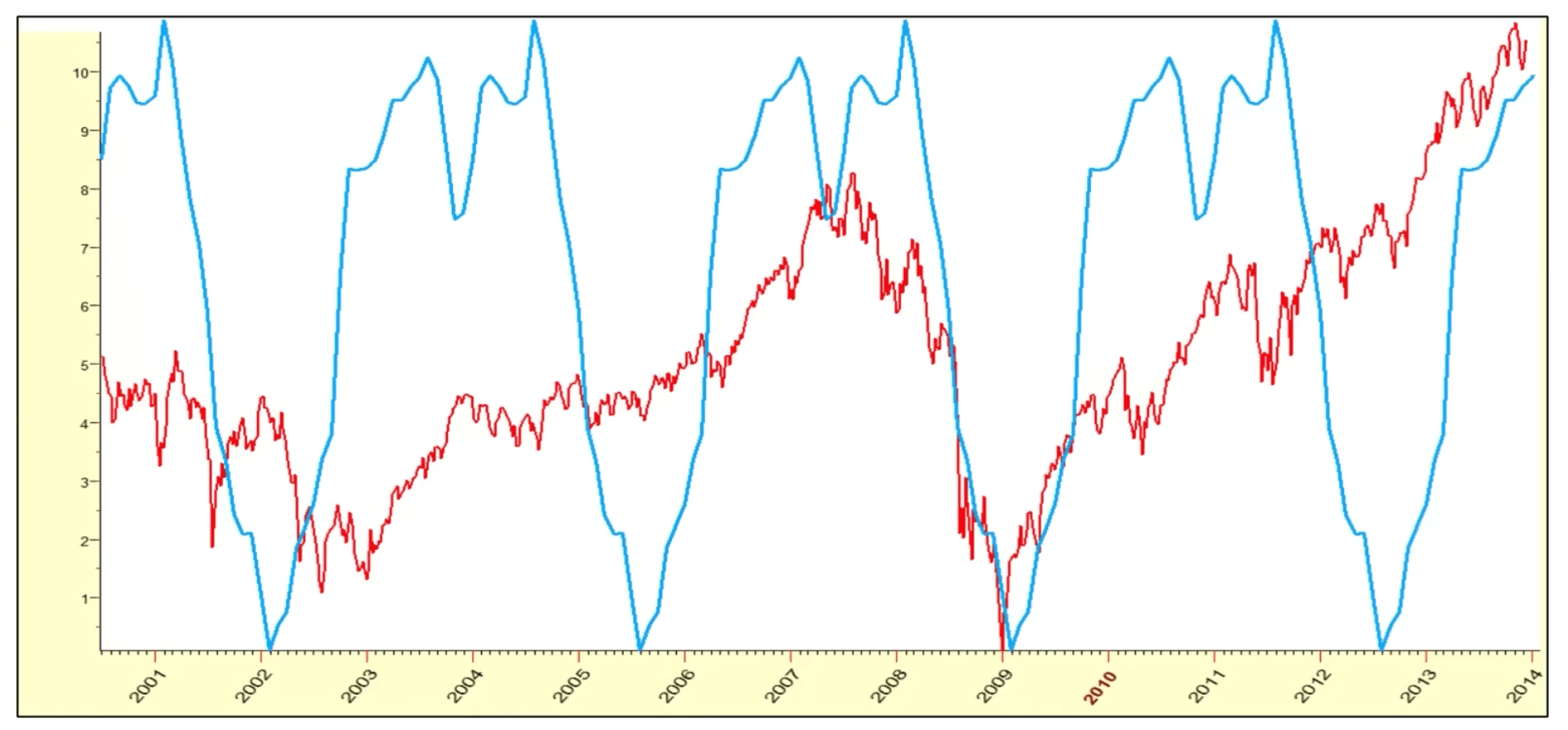
Larry Williams did his annual video about how he sees 2026.
Larry is almost 83 years old and pretty much interested in the markets. These videos that he did shows us how the markets could unfold on a longer term trend. From what I understand, Larry’s trading timeframe is much shorter than this, but his cycle work is one of the best.
I was pretty taken in by one of his annual review for a year where if we look at the inflation cycle and gold, gold actually didn’t do that well when inflation is rising and only did better when inflation is going down.
This is something that I did not see mentioned much by others.
If you believe that there are cycles and seasonality to various things, Larry Williams’ seem to have a lot of experience doing cycle work.
I tend to think that:
- Cycle turns don’t often exactly coincide with the data/market turns.
- The magnitude of new trends can be mild to more significant and cycles don’t usually tell that well.
- Markets tend to go up even if there is cycle contrasts.
- Larry often commented that cycles work best at bottoms.
These are some of the things to bear in mind with my notes below.
Based on the cycle charts of the data that I see, a lot of the positive turns happen after mid of 2026, so we might have more turbulence in the first half of 2026. You can let me know if you observe the same thing.
Larry Williams’ 2026 Market Forecast: Cycles, Risks, and Opportunities
Larry Williams brief prediction for 2026:
- Stocks will move higher
- Interest rates will decline
- Inflation will increase
I find much of the cycles and the timing to be pretty similar to another data-focus team at 3Fourteen research. Warren Pies of 3Fourteen (now you may notice why they call their company that name) did a recent podcast with Forward Guidance:
Here are the notes.
Larry Reminds Us How Many People Were Calling for a Recession in 2022/2023.
Robert Kiyosaki, Jim Rogers, Ray Dalio, Jeremy Grantham, George Gammon, Jim Rickards, Fedex CEO predicted recession in 2022/23. All still waiting.


Larry might be saying they needed better data or that it is extremely challenging to get the timing of things right.
How to Interpret the Yield Curve Un-inverting
A lot of the prediction of recession and of course bear market relates to how yield curve inversion precedes all the recession.
But yet we had that inversion but no recession.

Larry observes that unless the 10-year minus the 2-year is above 1, then we have to worry. we are still not there yet.
Interestingly, Warren Pies of 3Fourteen mentioned something similar in the Forward Guidance video.
Falling Yields and Bear Market

Larry brings us to the past historic market crashes and how the dynamic yield curve on StockCharts.com is showing. They are all sloping down while currently… the dynamic yield curve is sloping up.
Inflation Cycle: Ready to Head Back Up

Larry thinks inflation is good up to a certain point, and bad to a certain point.
Mike Wilson of Morgan Stanley reminds us that in their EPS growth estimation, they did bake in some inflation and if there is no inflation, EPS growth would have to be lower. I hope I remember it is EPS growth not price estimation.
Employment and Dow Jones Industrial Average Cycle

When employment picks up, Dow Jones Average usually goes higher (1971, 1982, 1993, 2004, 2015).
The cycle work sees us turning down from start of 2025 to mid of 2026, then the employment picks up.
Edgar Lawrence Smith Cycle from 1930
Larry discusses how Warren Buffett was influenced by Edgar Lawrence Smith’s research on stocks outperforming bonds. Not sure how true that is.
Edgar also did some cycle work with the markets going back to 1930s.


The cycle low was in (1994 end, 1998, 2002, 2005, 2008, 2012 end, 2016, 2019, 2023). The next one is like Jul-Sep 2026. This one is damn rough.
Years Ending in ‘6’

When we have positive years for 3 years in a row, what happens next.

M2 Money Supply Cycle Work
The M2 is a measure of money supply which captures how much liquidity money is in the economy. (M2: cash, checking deposits, savings deposits, small time deposits, retail money market funds. Money that can be spent or invested fairly quickly)
We watch it because we think liquidity leads to asset prices growth, which relates to a whole host of things.

Larry shows us that there might be cycle patterns to liquidity.

Which means that we can link money supply cycle work to the Dow Jones Industrial Average.


I let you all interpret if lack of liquidity == falling market.
I guess when liquidity is rough some ends up a bear market but two instances end up as smaller market corrections.
we are at the start of 2026, and kind of feels the first half is going to be rough.
The Right Way to Use Sentiment Survey
The University of Michigan Consumer Sentiment Survey is a widely watched gauge of household confidence about the economy, and market participants use it as a leading indicator of consumption and macro momentum.
It is a monthly survey of U.S. households conducted by the University of Michigan that measures:
- How consumers feel about current economic conditions
- Their expectations for income, jobs, inflation, and business conditions
Larry’s observes that sentiment usually follows the market instead of leading the market:


Larry observes the true buy signals is when the University of Michigan Sentiment survey edges below 60%.


This year the survey dip below 60% and now it is still below 60%.
Business Tendency Survey (BTS) Cycle Work
The Business Tendency Surveys (BTS) – National Indicator for the U.S. is a composite confidence measure of businesses, designed to capture how firms view current conditions and near-term prospects across the economy.
It is built based on business responses:
- Production/output
- New orders
- Employment intentions
- Inventories
- Capacity utilization
- Business expectations
So the BTS is pretty useful along side other services and goods manufacturing data such as ISM PMI, NFIB Small Business Optimism.


I think what Larry wants us to focus on is whether there are supportive business conditions that would propel the market. This supportive cycle seem to end in 2026.
If you want to trade these stocks I mentioned, you can open an account with Interactive Brokers. Interactive Brokers is the leading low-cost and efficient broker I use and trust to invest & trade my holdings in Singapore, the United States, London Stock Exchange and Hong Kong Stock Exchange. They allow you to trade stocks, ETFs, options, futures, forex, bonds and funds worldwide from a single integrated account.
You can read more about my thoughts about Interactive Brokers in this Interactive Brokers Deep Dive Series, starting with how to create & fund your Interactive Brokers account easily.

Kyith is the Owner and Sole Writer behind Investment Moats. Readers tune in to Investment Moats to learn and build stronger, firmer wealth foundations, how to have a Passive investment strategy, know more about investing in REITs and the nuts and bolts of Active Investing.
Readers also follow Kyith to learn how to plan well for Financial Security and Financial Independence.
Kyith worked as an IT operations engineer from 2004 to 2019. Currently, he works as a Senior Solutions Specialist in Insurance Start-up Havend. All opinions on Investment Moats are his own and does not represent the views of Providend.
You can view Kyith’s current portfolio here, which uses his Free Google Stock Portfolio Tracker.
His investment broker of choice is Interactive Brokers, which allows him to invest in securities from different exchanges all over the world, at very low commission rates, without custodian fees, near spot currency rates.
You can read more about Kyith here.