
I went out to meet a friend for dinner a few weeks ago.
Halfway through the dinner, my friend asked me a question regarding universal life policy. Are they actually better structured than investment-linked policy?
I told him their structure is not too different, but also what I glean from doing a couple of month’s research on universal life structure.
Sometimes I have friends or acquaintances telling me I can know a lot of a subject, especially if I am not suppose to have first hand experience with it.
- I wrote a 2 or 3 part comprehensive article on maternity insurance when… you guys know I am single and I have never gotten pregnant before.
- I kick started the model to which Havend/Providend views of investment-linked policies is based on. And I own or sold zero ILPs
- I own zero income paying unit trusts but I seem to have pretty strong views about them.
- There was a listed company whose management took a chance to meet up with me. Later on I deduce that they were doing due diligence how come I can model their financial numbers to such a finely tuned manner. To the point I think they might be wondering if there is a company information leak.
I could go on with more examples.
I got to say I am not that smart compare to a lot of people. I met my university pals that I seldom meet two days ago and we chat about the high pressure scene parents faced with their children.
At one point, my best friend and I both shared that everyone tries to act humble but for some fxxk reason, when some of us observe, its like the people we are around have their kids in your you-know-what schools.
Which makes us wonder are the people we around damn elite or we are the only people whose kids got into neighborhood schools?
Well basically I came from a background where my brain is not suppose to be elite.
And the truth is… a lot of these subjects… don’t need your brain to be THAT elite.
You just have:
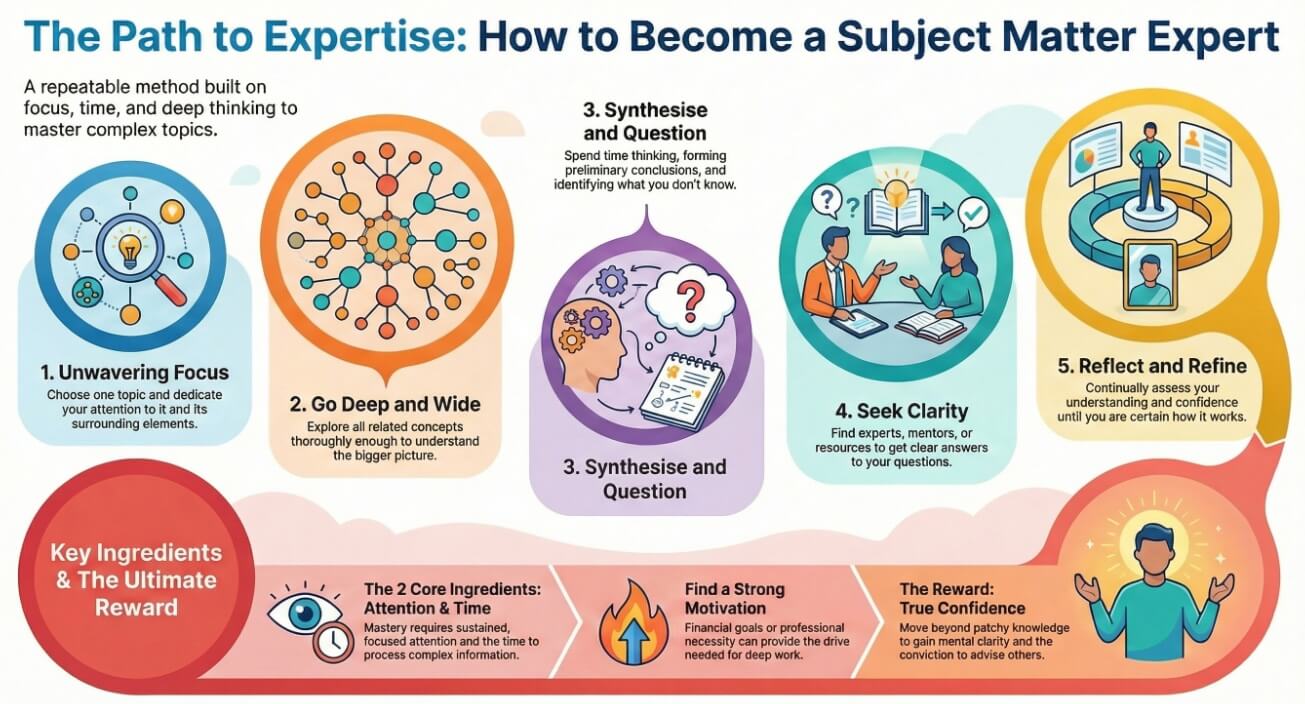
- Be very very attentive to just one topic, and everything that surrounds it.
- For most of the things “surrounding that topic”, go down far enough.
- Spend enough time thinking about it, and see what preliminary conclusions you can gather from this. You would also have a set of questions that you are unsure about.
- For the set of questions that you are unsure about, find people, entity or resources to clarify them.
- Along the way, think deeply about everything surrounds that topic. Given what you know where are you at with it?
- Do you really understand how it works? How clear are you?
- What is your confidence that you have hit “the truth”, which is that you have a high degree of confidence what you believe is really how it works?
Most of these things are like that on a high level.
But the key ingredients I find are attention and time.
You need time because it is both work and… you need time to process these things. Some stuff is not easy. Also, as Kyith gets on with age, the brain doesn’t work so well anymore. I have to re-read something a few times to comprehend them (or that I am basically more stupid/less attentive than I think I am).
You need enough motivation to be attentive.
Money is a good source of motivation.
I spend enough time reading about factor investing, read widely about it. Download data and do lots of rolling return. Ask myself weird questions and try to find if someone has answers for them.
The motivation is: I may be able to craft a strategic systematic-active portfolio that gets decent market return at best, better return if I am lucky, low-cost, tax efficient, and passive to the degree that I can get rid of the things I don’t want to do.
In a way that statement itself may also show the evolution of my thinking about the subject which is what you may faced as well.
But I am not sure about you, I find if everyone say managing their money is such a big thing, then why do they…. not spend enough time thinking around it?
I am sure there is, because some of my peers in the finance blogger and in my community do.
The motivation and attention gets us somewhere.
Sometimes I would talk to someone who by right are certified, or licensed to advice people and they would ask me some wealth management questions that made me scratch my head and wondered:
How is it that you are asking my views on this question? Shouldn’t I be asking you instead?
I have enough people asking me if income paying unit trust is a good idea.
For many of these subjects, the resources nowadays allows you to figure out pretty well. I know some of you would say Kyith now we have LLMs and AI and yes I think that helps a lot but end of the day, you may need sometime deeper to formulate a strong position about where you are at.
There are don’t know how many income unit trust information on iFAST or Poems. If you don’t know how sturdy or not sturdy is their income stream, why not you just go through 50 of income paying unit trusts one weekend?
If you are advising Singaporean clients or clients based in Singapore, is it worth the effort of going through something… that many prospects wish to address? I mean getting passive income is the ultimate goal of many and a fund that delegates this job looks a very promising strategy?
Even if that is not the main strategy to recommend to your clients (say you design dividend or REITs portfolio for your clients), you at least want to know confidently what these funds can or cannot do so that you can tailor your slide deck.
And In a way, when you get questions of disagreement, or “how about XXXX?” from the clients or prospects, you need to answer in a clear, confident manner. While some can smoke their way through, the confidence of some of you do come from empirical work and doing these work may give you a confident tone, or… it helps you adjust your tone if the conclusion is actually not so conclusive in case you fxxk up this professional relationship.
I think having enough headspace to think deeply enough about a subject is pretty important and how closer to the truth is sometimes clearing up a list of to do questions.
But lastly, you also need vital resources.
I got to thank my colleagues who were parents who explain to me what the fxxk are trimester and what are C-sections. I don’t think my brain can understand that well without close contact advise.
But Kyith, I got no time!
Then too bad lor. You got to trust whatever I say and if you dispute that, you either trust me or discard what I have to say.
You may also get people who don’t trust your stuff because:
- You are not certified, have not gone for training, not licensed.
- You are too young.
- You don’t own it or have first hand experience.
Some of these might be valid, but.. not everything.
Some that are licensed and older, with first hand experience might not really know the real truth to a lot of things.
The rewards might be worth it.
I find a lot of my rewards to be really personal. If I am able to be pretty confident how a topic actually works, and it is more important either because it is part of work, life, or money, then we don’t have to keep having open-ended mental questions. If not all the bits and pieces of information is just like patch-work band aids and not the solution.
Get more mental headspace, be motivated and focus on a topic.
If you want to trade these stocks I mentioned, you can open an account with Interactive Brokers. Interactive Brokers is the leading low-cost and efficient broker I use and trust to invest & trade my holdings in Singapore, the United States, London Stock Exchange and Hong Kong Stock Exchange. They allow you to trade stocks, ETFs, options, futures, forex, bonds and funds worldwide from a single integrated account.
You can read more about my thoughts about Interactive Brokers in this Interactive Brokers Deep Dive Series, starting with how to create & fund your Interactive Brokers account easily.

Kyith is the Owner and Sole Writer behind Investment Moats. Readers tune in to Investment Moats to learn and build stronger, firmer wealth foundations, how to have a Passive investment strategy, know more about investing in REITs and the nuts and bolts of Active Investing.
Readers also follow Kyith to learn how to plan well for Financial Security and Financial Independence.
Kyith worked as an IT operations engineer from 2004 to 2019. Currently, he works as a Senior Solutions Specialist in Insurance Start-up Havend. All opinions on Investment Moats are his own and does not represent the views of Providend.
You can view Kyith’s current portfolio here, which uses his Free Google Stock Portfolio Tracker.
His investment broker of choice is Interactive Brokers, which allows him to invest in securities from different exchanges all over the world, at very low commission rates, without custodian fees, near spot currency rates.
You can read more about Kyith here.