
One of my Telegram group members retired at 39 years old and stopped getting a full-time salary in 2014. He sold his business and have been comfortable managing his public and private investments and also seen his family thrive.
He finds it difficult to keep pace with the average wealth growth if one is not drawing any income. By his research the average wealth growth is about 4-5% p.a. or 1.6 times between the time he stopped work in 2015 to 2025.
“Imagine you retired in 2015 and invested in some portfolio. Whether it is balanced, dividend heavy or even Cash/CPF/Property heavy like many older retirees.
The returns of your net worth needs to pay for expenses and inflation. So let’s say you do 5% p.a. on net worth annually. Which is quite credible as property and cash and FI don’t usually beat that. 5% less 2-4% annual expense. That leaves you with 1-3% savings. Sounds fine? Afterall inflation is just 2%.
But wealth for an average household grew about 50-60% same period. People are still working while you don’t work. So that’s a CAGR of 4.5% p.a. vs your 1-3% p.a.. Clear decline in relative positioning.
Why does this relative position of wealth matter to him? It may not if your mindset is just to die with zero or it’s okay to be able to afford less down the road if it matches the inflation.
He finds that by not keeping up the relative positioning, it affects what the person can buy or afford.
This issue, to him, does not matter that much if a person FIRE at 50 or 60 years old but it matters a lot to someone who FIRE at 40 years old. This is because within 20 years, you would have fallen relatively by a very large sum.
After thinking about this, he sees two way to mitigate this problem:
- Do some form of income work during retirement. Work 1 week and make 20% of what you used to make. That will go straight to the net worth and close the gap.
- Invest more into equities so that your portfolio return 6-7% p.a. on net worth and not just 4-5% p.a.
“If want to retire very young, cannot invest and asset allocate like a usual 60 year old retiree. That’s why the Patrick guy keeps advocating working longer.”
I read what he wrote and after a long interaction with a few of us, I think his problem is this:
- If you retire young, the range of spending outcome is wider. You might not be able to anticipate some of your spending that comes in the next 20 years. Your peers that are working can solve this issue because they have high incomes, and they pay out of your income.
- If you pay out of your income for more unanticipated spending due to lack of foresight, too gullible, poor planning, then your net wealth, then while you have enough for spending to zero, you might not have enough to keep up with the net wealth so that you maintain your status among the household of Singapore.
- He uses this very standard investment math that I really feel like leading people down the wrong path (This median 4-5% p.a. return minus median 3% p.a. inflation and so your net wealth will grow just median 2% p.a.). So based on this, cannot keep up because in the last 10 years, the household income growth is 4-5%.
- So must work and invest in more equities.
I thought I want to share my perspective.
The Range of Unanticipated Spending That You Need in the Future Can be Vast but It is Challenging to Pin this Problem Down.
I think there are some spending that others like myself who are older can see, that someone who made their money in 30-45 would not be able to see due to their narrow lens.
Before declaring that you can really leave work, to leave that huge opportunity cost of earning a really good income, you might have to consider more.
Some good examples are that it may never occurred to you if you don’t have a child today but will have one when you stop work. You may want to help your parents when they are older. These two are where some would missed out.
If you have the income, you might want to plan a few sinking funds especially a medical one.
Good planning can go some ways.
My reader may be anticipating that there are some spending that even with this level of detail may be unanticipated.
In my dictionary, this is an expanded line items of spending.
And some of my Telegram group members contend that, even as a working person today, they may struggle to figure out and afford.
One of my Telegram group members:
“What fears me the most is those truly quality of life improvements that really make a difference to living. things like regrowing of teeth, exo-skeletons, neural-link interface, custom treatment for cancer and other diseases, .etc. Let’s say it costs $500k to 1mm in today’s dollars. Might be possible for many if they don’t fire. But maybe not if they fire.”
That is a potential problem but if you keep expanding it this way, if you want to make sure your “plan” considers all future spending outcome, yes you need work income.
That is If Your Work Income Still Moves the Needle.
My reader considers making 20% of what we used to make to be enough to move things.
There is some sensibility in that for some, we got to where we are with enough frugality and so 20% may be half of what we used to spend.
So your plan ends up like a semi-retirement plan.
But not all of us are in the vocation to be able to just work and earn 20% less.
The Portfolio Solution to have Perpetual Income that Grows Much More Than You Need After Inflation-adjusted Spending is a Low Enough Safe Withdrawal Rate.
I said a lot of people’s worry about income boils down to something the Safe Withdrawal Rate (SWR) Framework has considered.
The SWR is the HIGHEST income that you can spend in the MOST CHALLENGING x-year tenure.
And I can tell you, most people with this 6% p.a. median return minus 3% median inflation cannot have anticipate even more challenging x-year sequences than what the SWR framework usually considered.
The inflation is higher. In those deflation, you cannot even easily find work because so many people are rushing into one job. And there you are still thinking of staying in that high echelon household range.
My experience with explaining the SWR tells me a lot think they understood what it encompass, and think it doesn’t solve a lot of their concerns. When those truly understood the SWR would know it actually does consider those.
I find no easy way to use words to explain but to show people.
With Gilgamesh, my safe income spending simulator, I can better show you. I have converted Gilgamesh which was a Windows-only application to a web one on Investment Moats.
You can use it here Gilgamesh – Safe Income Spending Simulator.
There are still some small problems but its largely usable.
Part of the solution to my reader’s problem of having a portfolio that grows even more than your spending is a low enough starting income that you plan for, relative to your starting portfolio value.
There is a Reason That My Personal Planning for My Most Essential Spending is a 2% SWR.
Those who follow my blog would know about my Daedalus Income portfolio. It is meant to provide for my most essential spending and basic spending. What goes into that spending is explain in the two links. If you would like to read more about how I constructed Daedalus, the investment notes, and about the spending, you can read my Personal Notes.
Those two are not my only spending but what I currently plan for.
If it is $15,360 in end 2022, then with Core US inflation (which are usually higher than Singapore’s inflation) be 3.9%, 3.2% and 2.6% in the last 3 years, this very inflexible income requirement would be closer to $16,900 annually today.
If we use an estimate of my portfolio currently at $1.68 mil (yes it has fallen), that is 16900/1680000 = 1% SWR.
I have always plan for 2% but turns out I have more money.
Because I need every single cent of my $16,900 to keep up with inflation, for a long time, I use a low enough SWR for planning. I don’t plan to be too flexible with this (even though actually I can be a little if I were to admit). And it is planning. Planning versus what will happen is rather different.
If you want your money to last long, like perpetual, keep the SWR lower than 2.5%, if we assuming that your recurring all-in cost is 0.50% p.a. If your recurring all in cost is higher, than the SWR is lower.
I am going to show you some of this in action with Gilgamesh.
Let’s See the Range of Ending Portfolio Value for a 70-year Income Tenure if We Retire Early at 3.5% of Our Portfolio Value
70-years is about 10 years longer than my reader who is 40 who reasonably thinks that he should plan to 100. We use a portfolio value of $1 million to keep it simple.
3.5% of the portfolio is $35,000 in the initial year, and in subsequent years we will adjust that based on the prevailing inflation rate.
We are going to use US CPF inflation, US large cap equities and long term bond returns to see if the portfolios is going to thrive.
The reason I am using this is not because all our wealth is managed this way currently but that before 1950, there were a lot of really challenging inflation and market return sequence. If you use MSCI World the outcome would look better, but they don’t test if your MSCI World actually go through a Great Depression like situation. While US equity return is higher than MSCI World, we are more concern about the inflation and the volatility drag (or what you call the potential negative sequence of return).

We first select the US CPI, which has 1202 months, and we can simulate many many 70-year periods. (Your simulation would be constrain by the inflation you choose, but since all 3 option is the same, you are not too constrain here)

We craft a 60% S&P 500 and 40% 20-year US Treasury portfolio with 0.30% p.a. recurring all in cost. It is not my preference to use something so long duration for fixed income but lets just see how. (Note: If you play around with Gilgamesh, the monthly returns of different assets have different starting and ending range. Your simulation is constrained to the shortest window of which assets you chose so do be aware of that)

Just leave the US Dollar, we put in 35000 in Annual Floor Income. This is where you put the income that you are so inflexible that you need every cent to adjust for inflation. Annual Flexible Income is where you can specify the money that you can be flexible with. We don’t use this first. Set the retirement tenure years to 70 years. Then click Run Simulation.

So with 100 years of S&P 500, 20-year US Treasury and Inflation data, we can simulate 363 70-year periods. Most of you have not even invest for 20 years and the SWR is able to let you see how a portfolio of similar dynamics would do.
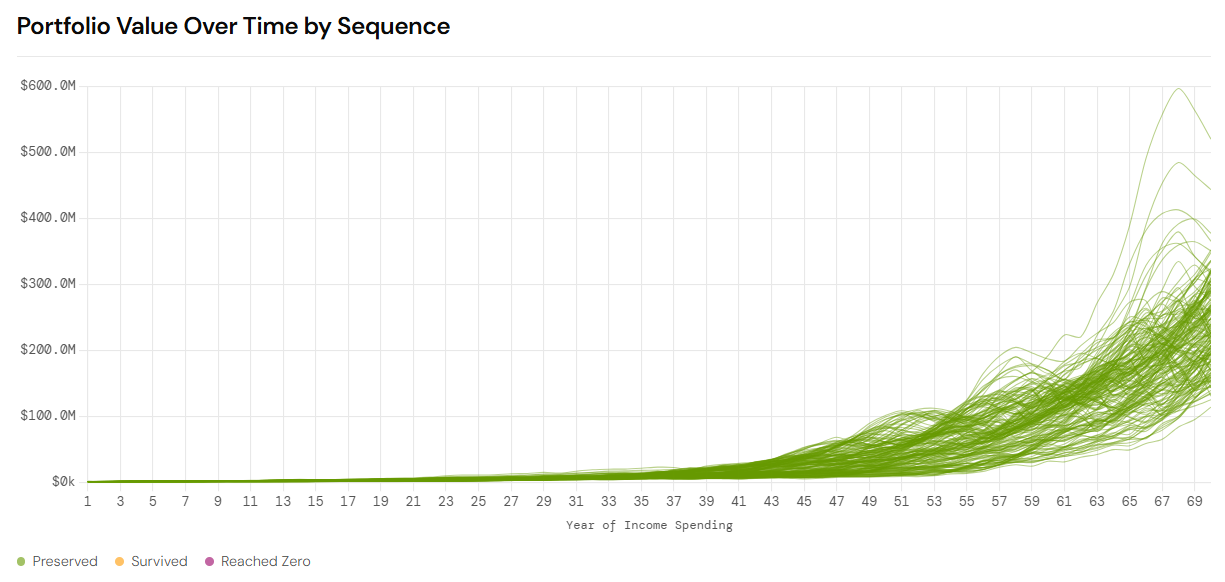
So based on this 344 out of 363 your wealth is preserved. This means after 70-years, the $1 million portfolio value is higher than the $1 million but inflation-adjusted over 70 years.
12 out of the 363 end portfolio value more than $0 but the amount did not preserve their wealth. THIS IS NOT WHAT MY READER WANTED.
7 out of the 363 actually reached zero prematurely, and obviously this is not what my reader wanted.
We can see the ending portfolio value here:

Actually, this is a very conservative plan in many people’s eyes. Why do I say that?
Because with the standard [Median 5% p.a. minus median 3% p.a. inflation left 2% p.a.] math, you would not be able to anticipate there are a few situations that the plan falls flat on the face.
In the median situations, $1 million ends up in $109 million after drawing out income. In the most pessimistic 5th percentile, $1 million ends up with $11.7 million after drawing out income.
What Happens When We Spend Within 2% SWR?
If we keep to the same portfolio, inflation, income tenure, all-in-cost but go down to just $20,000 annually out of $1 million?
2% SWR is more extreme and closer to what I plan for. But I want to show you what happens if you REALLY have a lot of money. This is like the Rich Billionaire’s Income Plan.

All the portfolio value of the 363 70-year sequences are preserved. This means their ending portfolio value is higher than if they don’t spend from the portfolio in inflation-adjusted terms.

Gilgamesh can summarize and show you the ending portfolio value (and also the compounded average growth of each sequences grouped)
The worse CAGR is 8.33% p.a. because… 70 years is a long time and even the worse sequences have pretty good return.
In the worse 70-year period… your $1 million is left with $114 million after the inflation adjusted spending.
This is What Should Be in Your Mind When You Think About a Safe Perpetual Income Plan
Many just view that [Median return – median inflation left with median what] but that in my opinion is not a conservative way of looking at it.
You should see many many threads of your portfolio value after spending and the safest would look like this:

You can see this if you click on the Sequences tab under Results.
There are many portfolio threads, the more the better. And perpetual income is all the threads to be ending up higher.
It should not look like this:

I use the most prevalent dividend kind of strategy but put them in a SWR spending sequence. This is a 37.5% success rate which means most of the portfolios don’t survive for 70 years. You start with higher income but your portfolio ends up running out prematurely.
You would notice there are more red and yellow lines, indicating if you are not lucky enough, and you are not flexible with your spending, you might not have a good outcome.
And my member reader should be thinking: “Are all my portfolio lines sloping upwards?”
Let us Examine the WORST 70-year Income Spending Sequence of the 2% SWR
In the Sequences tab, you can also review all the 363 70-year sequence.
Let us go to the worse one which ends up with $114 million. You can click on Detail -> and we can see this sequence more in detail.
This is the 70-year period starting in Sep 1929 and end in Aug 1999.
So basically start in Great Depression end in Dot-com Bust.

This chart shows the portfolio value AFTER spending the inflation adjusted income.
The green dotted line shows that if your $1 million is not spent, but grows with inflation, where would the portfolio value be every year.
- If your portfolio value is below the line, your portfolio value is not keeping up with inflation after spending.
- If your portfolio value is above the line, your portfolio value is keeping up with inflation after spending.
My reader would want a plan where the portfolio value is vastly higher than inflation if not spent.
Which it shows in this worse case.

This chart does nothing much but show you the $20,000 income will grow to $191,000 after 70 years.
Probably the Most Important Metric I Would Like to Bring to My Reader’s Attention
Now… we can take the annualized income at any year divide by the prevailing portfolio value.
What we get is a Current Withdrawal Rate.
The Current Withdrawal Rate shows us: “At any point, if you consider retirement again, how long would your money last?”

Gilgamesh is able to show the Current Withdrawal Rate of all the sequences over time.
You can see in this worst 70-year sequence, the worst was when the current withdrawal rate reaches 4.55%.
That in itself is an important point. It means even after the portfolio dropped from $1 million to $411,470, and I need to spend an inflation adjusted $16,068 (this is not $20k because its deflation, your$16k actually buys the same as $20k today), the money can actually last for a while. But in that mood you wonder if it can last another 50 years and that is how pessimistic actual life would get.
But if you look at the ending Current Withdrawal Rate, its closer to 0.16%.
Not 16%, but 0.16%.
While the last year of spending is $191,000. What we are saying is that if you want to you can go back from 0.16% to 2% again.
Based on the portfolio value of $114 million, you can jack your $191k to $2.28 million annually and your income plan would still be very, very safe.
Notice that I Haven’t Even Talked about Jacking up Equity Returns?
I merely show the Rich Billionaire’s Income Plan.
But let’s say that we are still spending $35,000 on $1 million (not $20,000) and we increase 60% equity to 85% equity.
I shared in the past that increasing your equity also made the worst sequences even worse.
You should limit your equities to 40-75%.
If you have a long income tenure, it is helpful to increase to 75% equity allocation.
So lets see the outcome of having more equities:

Instead of 344 Preserved now its 356 Preserved.
In some of the challenging sequences there is less portfolio that reached zero or just survived. All 12 that survived with a 60% equity allocation became preserved with 85% equity allocation.. 2 out of the 7 that end up with zero went up to survived.

The Median ending Portfolio Value for a higher equity allocation is higher than the Median ending Portfolio Value of a 2% SWR on 60% equity allocation.
And this is something I want the reader to think about:
- Yes if you look at the median outcome, higher equities does improve things.
- But be aware that equity doesn’t always save the worst outcomes
Kyith, How Many of Us Can Live on a 2% SWR?
Well yeah not everyone can.
That requires a lot of wealth.
But I am proving a point here:
You may have made what you deem like a lot of money. But you got to think about your spending line items not just now but in the future. If you don’t plan well, and there are numerous line items that you failed to consider, even more equities and work income cannot save you.
Use the SWR as a check to how much relative portfolio wealth to your well planned income needs. If it is not low, acknowledge that while it looks like a lot of wealth to other people, your status and income spending might not put you in the bracket that we would consider you have ‘More than Enough’
You just have enough if financial conditions, inflation, interest rates and planning work in your favor.
Epilogue
I am not advocating this level of conservatism of just going low as 2% SWR.
And as I said, I only plan this with part of my spending. The rest I just spend in a more fxxk care way.
But I feel frustrated that every time its “I have to do some kind of work” argument.
We basically don’t have enough wealth if we want our wealth to grow, under even the most challenging conditions and keep up with our peers who are working.
But if you have means, and choices, then i am saying technically you can reach that stage.
Work is not always going to be the solution.
You think about it.
It works in those high inflation situation because inflation can remain persistently high because there is some economic output happening as well. And so if you are in some sort of consultative role that an work out.
But if it is a very depression like situations like 1929, how many would pay for consultative role in an austerity first environment?
The nuances of understanding the SWR Framework will show you some answer. In this case, equities also limited. It may also show you what are the risks and you just have to live with it if retiring is more important than dying at work.
Hope those interested would like Gilgamesh.
If you want to trade these stocks I mentioned, you can open an account with Interactive Brokers. Interactive Brokers is the leading low-cost and efficient broker I use and trust to invest & trade my holdings in Singapore, the United States, London Stock Exchange and Hong Kong Stock Exchange. They allow you to trade stocks, ETFs, options, futures, forex, bonds and funds worldwide from a single integrated account.
You can read more about my thoughts about Interactive Brokers in this Interactive Brokers Deep Dive Series, starting with how to create & fund your Interactive Brokers account easily.

Kyith is the Owner and Sole Writer behind Investment Moats. Readers tune in to Investment Moats to learn and build stronger, firmer wealth foundations, how to have a Passive investment strategy, know more about investing in REITs and the nuts and bolts of Active Investing.
Readers also follow Kyith to learn how to plan well for Financial Security and Financial Independence.
Kyith worked as an IT operations engineer from 2004 to 2019. Currently, he works as a Senior Solutions Specialist in Fee-only Wealth Advisory Firm Providend. All opinions on Investment Moats are his own and does not represent the views of Providend.
You can view Kyith’s current portfolio here, which uses his Free Google Stock Portfolio Tracker.
His investment broker of choice is Interactive Brokers, which allows him to invest in securities from different exchanges all over the world, at very low commission rates, without custodian fees, near spot currency rates.
You can read more about Kyith here.