
My friend asked if we are headed for a big crash soon.
The honest answer is I don’t know. Also don’t know what is consider big enough. I ate like 30% fall in small cap and some would say this is not big enough so…
But the separate question is more of:
Are there major red flags for holding USD in the world indices. Or we can continue to just let time do its thing.
In his head, if USD really deflates and become like very weak, what will happen to the investment in USD. What happens if the USD becomes really worthless like the Venezuelan dollars?
I better not let my investment team sees this because here we are having uncertainty, and gold is going down, Bitcoin is holding and the USD is going up big time.
In a way, that should make my friend consider in the worth of the USD in the eyes of others.
There is more for me to write about this worry of his which is the de-dollarization or that the USD losing its important status.
But I thought today I want to look at if you want to hedge this USD long term decline by going with a fund that hedged to SGD.
This may be what my friend is looking for.
I don’t have easy, but good illustrations about the difference if you hedge or don’t hedge in SGD but I always remember that WisdomTree has a version of the Japanese equity that is hedged to USD that would make a good illustration.
In a sense:
- The Japanese Yen is volatile or that you think it is depreciating.
- You want exposure to the basket of Japanese equity securities but don’t want to be exposed to the currency effect.
So you can express that with a hedged version of the equity.
Now… if you are a Singaporean needing SGD, you can replace the Yen with USD and USD with SGD, this post would be rather relevant to you.
The Yen to USD from 1987 to Today:
So this is a chart of the Yen versus the USD since 1987 till today:

I don’t know if 40 years is long enough but I felt is long enough for people to wonder what they think if in their mind the USD takes the same trajectory as the Yen.
That is eventually down but before that 10 years of up move.
How would you feel about that 10 years, if you decide to sell your equities because of your worry over the USD or that you decide to choose a hedged version of the MSCI World instead of just one denominated in SGD.
iShares MSCI Japan ETF (EWJ) Versus WisdomTree Japan Hedged Equity ETF (DXJ)
The chart below shows EWJ and DXJ’s performance since DXJ’s inception in 2006:

Pretty long time to evaluate!
The blue line is the iShares MSCI Japan ETF (EWJ) and the pink line is the WisdomTree Japan Hedged Equity ETF (DXJ).
EWJ seeks to track the investment results of the MSCI Japan Index, which captures the performance of large and mid-cap Japanese equities. It’s a broad, market-cap weighted fund, meaning the biggest Japanese companies by market value — like Toyota, Sony, and Mitsubishi UFJ — get the largest allocations. The fund makes no attempt to hedge currency risk, so US-based investors get full exposure to both Japanese stock performance and the USD/JPY exchange rate. Essentially, EWJ is designed to be a straightforward, low-cost vehicle for investors who want general Japanese equity exposure and are either indifferent to or deliberately want to take a view on the yen.
DXJ seeks to track the WisdomTree Japan Hedged Equity Index, which is built around two core ideas working together.
- First, it screens for Japanese companies that generate meaningful revenue from exports — meaning companies that actually benefit operationally from a weaker yen, not just any large Japanese company.
- Second, it weights those companies by dividends rather than market cap, tilting the portfolio toward profitable, shareholder-friendly businesses.
- On top of that, the fund hedges out the USD/JPY currency exposure, so US investors capture the local Japanese equity returns without the drag of yen depreciation.
- The result is a fund that is specifically engineered to thrive in a weak yen environment — not just because the hedge removes currency losses, but because the underlying companies it holds actually earn more in JPY terms when the yen is weak, giving DXJ a kind of double tailwind that a simple hedged version of EWJ would not have.
The difference in implementation is important as we will explain later.
DXJ hedges by selling USD/JPY forward contracts (short JPY, long USD). The cost of that hedge is determined by covered interest rate parity (CIP).
Hedging Cost = US Interest Rates – Japanese Interest Rates
From 2006 the performance of both, when viewed in USD:
This is a big difference.
Denominated is not the Same as Hedged.
We get a similar question yesterday during our Providend client event asking how come the SGD class of our flagship portfolio lag the USD class of our flagship portfolio over a certain timeframe by 7%.
One key thing is our portfolio is denominated in either SGD or USD. The fixed income funds are hedged to SGD or USD but the equities are just denominated. There is a difference (which you can see above), in that if it is hedged, it takes out the currency effect in the performance significantly which a denominated one would not do.
SGD Denominated just means the fund’s unit price is quoted and traded in SGD. The underlying assets are still in their original currencies (USD, JPY, EUR etc.). You’re simply buying and selling in SGD, but you still bear full foreign currency risk on the underlying holdings. It’s essentially a pricing/transactional convenience.
Hedged to SGD means the fund actively uses forward contracts or swaps to neutralize the exchange rate movement between the underlying asset currencies and SGD. So if the USD falls against SGD, a USD/SGD hedged fund would protect you from that loss.
A simple way to think about it — SGD denomination tells you what currency you use to buy the fund, while SGD hedging tells you whether you’re protected from currency fluctuations in the underlying assets. A fund can easily be SGD denominated but completely unhedged, which is actually very common in Singapore-listed ETFs.
So if the USD weakens by 7% (as an example), the SGD class would look like it didn’t grow that much.
Overlaying EWJ and DXJ with the Yen/USD
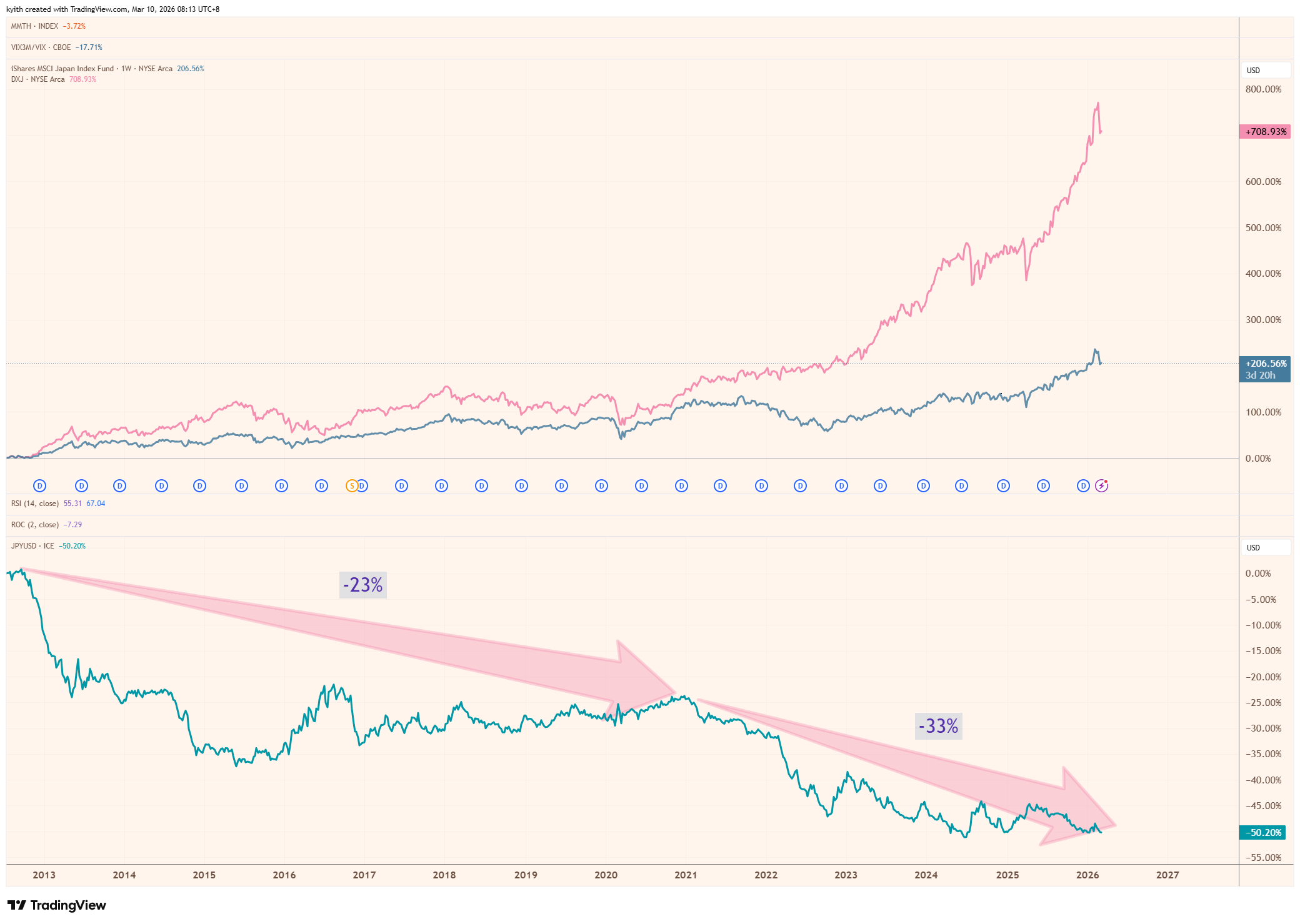
Now let me put the Japanese Yen at the lower panel so that you can contrast:

The Japanese Yen started weakening against the USD in Sep 2012 and has been relatively downhill for the next 13 years. But before that from 2006 to 2012 it is up.
Actually sometimes I also don’t know how long is long.
I know that even 2 years feels like forever in the minds of investor. I just need to see the swing in mood for how people won’t accept international equities, to them putting more money in international equities to know most folks mentally is not long term.
Examining 2006 to 2012

The Japanese Yen appreciated about 56% against the USD.
Both prices end up negative but they also went through the Great Financial Crisis during this period.
There is a cost to hedging.
Based on the hedging described, if you know that the Yen will end up lower in the future, you be shorting the Yen today and buying it back in the future. But if the Yen is higher, you make a loss and that gets aggregated into the result.
Thus, the DXJ with hedging end up worse.
But I thought there might be a bigger problem, is the strength of the Yen actually affecting the volume of sales of Japanese goods and services and thus affecting the return?
If this is the case do you wish for the currency to be this strong.
Let us zoom in to the period of 2012 to today:

Bonkers.
Mind you, that 206% gain over 13.6 years is about 8.6% p.a. so that is not too shabby. It is just that the 708% gain is mad.
The weird thing is that even after a -23% depreciation the returns of both was pretty tight. The difference in the second part of the depreciation from 2021 onwards was not too different but the performance is so much different!
In a way, the hedging cost of the second half is more expensive than the first half, and I think that would weigh on performance.
But we should be mindful that DXJ’s methodology is different in that they are weigh more heavily to the Japanese firms that would do well if exports thrived while EWJ is more general.
DXJ overweighs industrial, consumer cyclical and basic materials and these are the sectors that did well in the past 2 years.
I think folks should manage their own expectations in that if they own a hedge version, they would get this 700% effect.
It is not due only to the hedge one.
Adding HEWJ to the Comparison
I realized that iShares has a hedged version of the MSCI Japan. This means that it allows us to see what happens if the basket of securities is not too different:

The green line is DXJ, the blue line is HEWJ and the red is EWJ
Actually it feels not too different lol.
We can now see that there is partly difference due to the equity mix, and also the currency hedging.
Epilogue
If you know that the currency is definitely going in one direction, and if the direction is down, then you might want to buy the hedge version like DXJ.
This means my friend needs to find the Hedged version of the MSCI World, or MSCI All Country World.
But in the span of the time he is alive, he would have to accept that there is a cost and if the direction sometimes is volatile, the performance of his hedged version might not do so well.
He might need to become a currency direction watcher as well.
In other words, you need to self-coach yourself how to read better or poorer performance so that you don’t get shaken out.
If you want to trade these stocks I mentioned, you can open an account with Interactive Brokers. Interactive Brokers is the leading low-cost and efficient broker I use and trust to invest & trade my holdings in Singapore, the United States, London Stock Exchange and Hong Kong Stock Exchange. They allow you to trade stocks, ETFs, options, futures, forex, bonds and funds worldwide from a single integrated account.
You can read more about my thoughts about Interactive Brokers in this Interactive Brokers Deep Dive Series, starting with how to create & fund your Interactive Brokers account easily.

Kyith is the Owner and Sole Writer behind Investment Moats. Readers tune in to Investment Moats to learn and build stronger, firmer wealth foundations, how to have a Passive investment strategy, know more about investing in REITs and the nuts and bolts of Active Investing.
Readers also follow Kyith to learn how to plan well for Financial Security and Financial Independence.
Kyith worked as an IT operations engineer from 2004 to 2019. Currently, he works as a Senior Solutions Specialist in Fee-only Wealth Advisory Firm Providend. All opinions on Investment Moats are his own and does not represent the views of Providend.
You can view Kyith’s current portfolio here, which uses his Free Google Stock Portfolio Tracker.
His investment broker of choice is Interactive Brokers, which allows him to invest in securities from different exchanges all over the world, at very low commission rates, without custodian fees, near spot currency rates.
You can read more about Kyith here.