
There are things in investment that if you understand some of the nuances, it might make you look differently.
One of the nuance is about duration in fixed income.
The challenge with these nuances is that you can write so much, but if a person doesn’t get it, they just gloss over it.
I think its not the first time I written about it but why?
It is because I think people look at fixed income as all the same. It is even worse if you are a layman.
In my mind, they think the worse case for fixed income looks like equities.
Which is not the case if you respect both duration and credit.
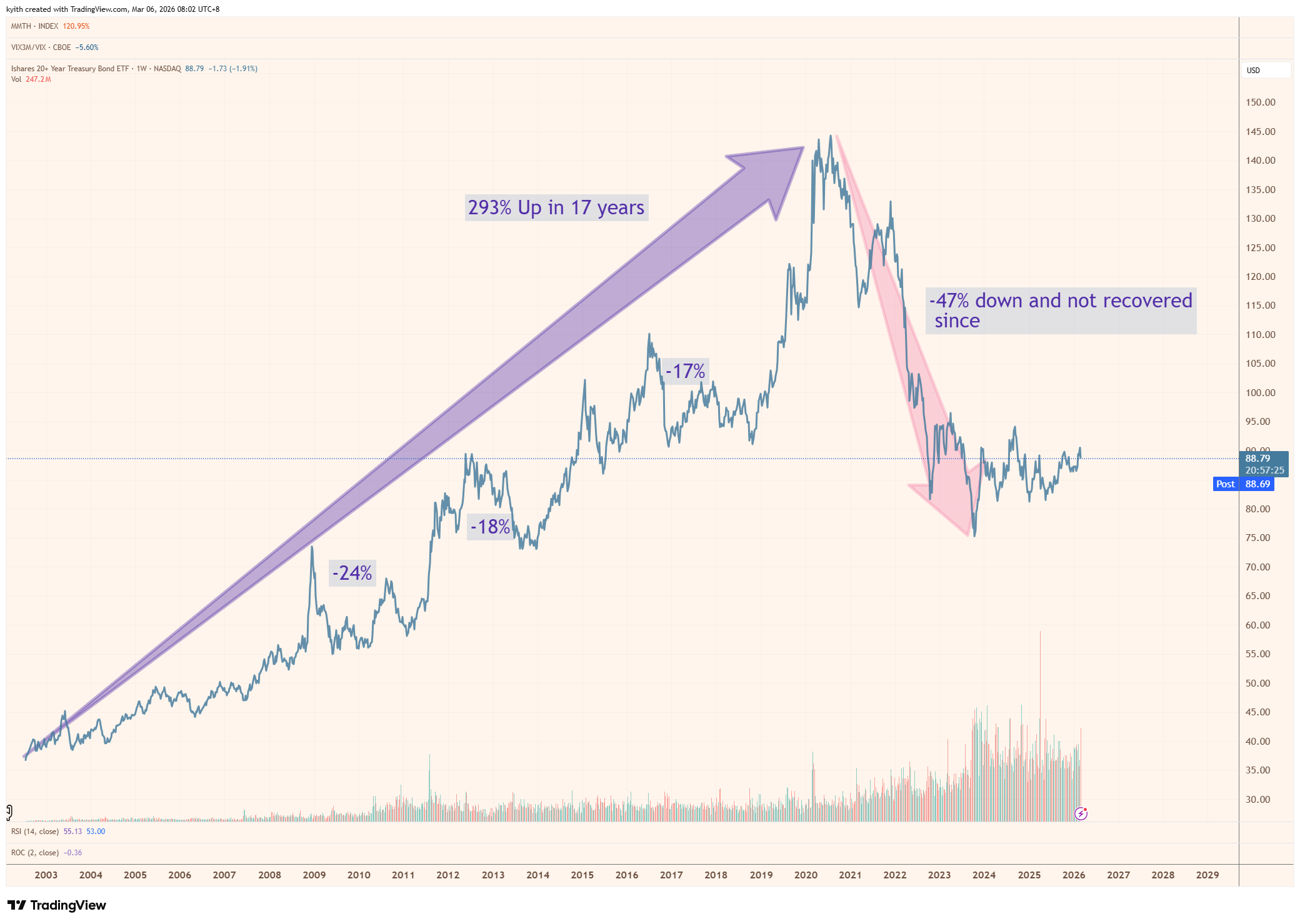
The chart below shows the price and dividend return of the TLT or the 20-year US Treasury ETF:

I think this is what everyone has in mind perhaps because financial bloggers or influencers keep using something with a 20-year maturity.
They may also find the returns more appealing during the 2010 to 2020 low interest rate environment. Indeed, for the first 17 years a TLT would compound wealth at 8.3% p.a.
But there are some pretty big drawdowns of -24%, -18%, -17% as you can see.
When short term interest rates rose 400%, and in the case of the 20-year market interest, the interest rate rose from 1.8% to 5.2%. If a 1% rise in interest rate cause a 15-20% down move in price of a 20-year fixed income based on duration, what will happen if interest rate went up 3%? you can see correspondingly, the drawdown is about 3 x 15% = 45%.
And then investors had this impression that fixed income is no different from equity.
Let me show you the 1-3 year US Treasury experience:

The annualized return is more muted over the 18 years at 2.2% p.a. but each drawdown is also much more shallow. During the same period when TLT went down 47%, the SHY went down 4.5%. The best part is that it has since recovered.
Now if you are thinking about money that you need in 3 years, you would have fxxk your plan up if you put your money in something long duration.
The most damaging thing is people seeing the 47% drawdown of fixed income and have the impression that fixed income is like equities.
It means you have to get the timing right.
And that it has no place in the portfolio or in your financial plan.
Which you can see it is not always right.
If you are diversified, and control the credit exposure of your fixed income, fixed income can be a sweet spot.
SHY took 2.7 years to fully recover and the SHY has an effective duration of 1.7-1.8 years.
If we use the rule of thumb of (2 x 1.8 – 1) = 2.6 years, that is roughly how long it takes to recover, but perhaps not capturing the returns. Then again the yield to maturity before the drawdown was rather low:
- 20 Sep 2021 2-year Govt Yield: 0.2%
- 24 Oct 2022 2-year Govt Yield (at the deepest part of the drawdown): 4.5%
If you hold 2.6 years you should earn 0.2% p.a.
The conclusion is not too wrong its just the returns are so low to begin with.
Nuances like this shape how we plan.
But admittedly, I don’t always explain well these things and because of that, I failed to value add to someone. But they can be critical.
Because if you perceive fixed income correctly they can be rather useful to you. Not just you because you might be helping your parents plan and you shape your view.
I just happen to share this with a friend and through our conversation, both of us realize he interpret a rolling returns charts wrongly, a chart on deepest fixed income drawdown differently.
If I left it to his own review and he did not clarify, I would never have known some would interpret different materials differently (it kind of show you how hard sometimes these things can be).
But interpretations matter especially if you are trying to build wealth.
If you see it the right way, you may have more peace of mind and conviction to funnel $3 mil of your spare fund into a short term diversified fixed income vehicle instead of vexing over how to get the highest return without so much risk exposure.
That is a more pleasant and feel-good personal experience than another personal experience these past 2 days.
I saw a comment that I put on a YouTube video removed. I think that is okay but it kind of lets me know how a person feels about learning the true essence of something, their degree of vulnerability, versus how others perceive their skill.
At the end of the day, we got to ask ourselves what we want.
- Do you want to rationalize that you are right, even though deep inside you, you already detect that you don’t get the full picture / there is something you felt uncomfortable but cannot explain?
- Are you more concern with presentation, how you look to others and less concern about getting the mental framework right?
There will be tough things for all of us. If we have a struggle with controlling cholesterol, learning to read materials and research on the subject is daunting because every start is daunting. At the end, perhaps the market for personal growth is also efficient between effort and money. If it is very valuable, you either spend effort to make space to comprehend (like duration) or you spend money and eventually you get the same epiphany.
If you want to trade these stocks I mentioned, you can open an account with Interactive Brokers. Interactive Brokers is the leading low-cost and efficient broker I use and trust to invest & trade my holdings in Singapore, the United States, London Stock Exchange and Hong Kong Stock Exchange. They allow you to trade stocks, ETFs, options, futures, forex, bonds and funds worldwide from a single integrated account.
You can read more about my thoughts about Interactive Brokers in this Interactive Brokers Deep Dive Series, starting with how to create & fund your Interactive Brokers account easily.

Kyith is the Owner and Sole Writer behind Investment Moats. Readers tune in to Investment Moats to learn and build stronger, firmer wealth foundations, how to have a Passive investment strategy, know more about investing in REITs and the nuts and bolts of Active Investing.
Readers also follow Kyith to learn how to plan well for Financial Security and Financial Independence.
Kyith worked as an IT operations engineer from 2004 to 2019. Currently, he works as a Senior Solutions Specialist in Fee-only Wealth Advisory Firm Providend. All opinions on Investment Moats are his own and does not represent the views of Providend.
You can view Kyith’s current portfolio here, which uses his Free Google Stock Portfolio Tracker.
His investment broker of choice is Interactive Brokers, which allows him to invest in securities from different exchanges all over the world, at very low commission rates, without custodian fees, near spot currency rates.
You can read more about Kyith here.