
Think if you read my post yesterday, I did say that I will break up my post into two.
I wanted to look at some of the potential weakness areas.
Why?
Perhaps it is to sense if the underlying health of the US economy.
If prices indicates future earnings, it also indicates future revenues and revenues come from spending.
The second reason is also the believe that nothing stays shit forever:

Some folks like to buy strong (momentum). Some have the aversion to expensive.
So lets look at some distressed areas. The chart above show the chart of the Biotech. This has been bad for 4 years. Feels a long time for some but when things get too cheap, they tend to mean revert.
I will go through the following:
- SAAS
- Alternative Asset Managers
- BDCs
- CyberSecurity
- US Insurance
- Home builders and ancillary services
- Restaurants
- Consumer discretionary
A bunch of potentially shit areas.
The first one are more of the data providers which I ended off yesterday.
This chart shows their year to date performance:

I think of think that their moat is stronger than what people think but its the margins that potentially might face problems.
This is the only group of stocks that I listed the valuation against what they were trading last year:
| Stock Name | Ticker | Performance YTD | PE | 2025 PE |
| S&P Global | SPGI | -20% | 27 | 36 |
| Moody’s | MCO | -15% | 33 | 42 |
| MSCI | MSCI | -7% | 33 | 37 |
| FactSet | FDS | -29% | 13 | 24 |
| RELX Group | RELX | -23% | 20 | 27 |
| Thomson Reuters | TRI | -34% | 25 | 39 |
| Wolters Kluwer | WKL | -27% | 13 | 35 |
| CoStar | CSGP | -33% | 876 | 210 |
| CBRE | CBRE | -11% | 35 | 42 |
| JLL | JLL | -14% | 21 | 22 |
| Nasdaq | NDAQ | -18% | 26 | 31 |
| LSEG | LSEG | -14% | 41 | 88 |
Moody announced results yesterday and guided strong numbers going forward, which lifted the whole group. In fact them been doing better the last 5-6 days.
We can group them as more data, index, analytics firms but 4 years from now, we will know what is the terminal valuation they will trade at.
Our investment team just subscribe to a data provider (among this list), and just to give an example, if it is so fxxking hard for Kyith to find a free data source that can provide MSCI Europe’s historical earnings per share as an aggregate, or forward earnings, and also not through some other paid platform, then how indispensable is that?
Yet at the same, time these firms offered a lot more, and market is repricing them that they could offer a lot more just that they could not charge like they used to.
Software-as-a-Service Stock Valuation
Altimeter Venture Capitalist Jamin Ball’s Substack is a good way to follow the space of software companies.
Jamin has a lot of good takes:
In summary – I think the market is getting it wrong in the short term. These companies have stronger moats and will be more resilient than anticipated. However, I think the market is probably right in the long term. Agents will create a ton of creative disruption, hamper expansion revenue of legacy vendors, and history is against the incumbents capturing this new vector of hyper growth.
First – when looking for examples of historical “major disruption” periods, one many people point to was the iPhone. The first iPhone came out in 2007. In that year, Nokia had a market share of ~40%. They were the king. Well, we all know what happened from there. Apple became one of the most dominant tech companies in history. However, it might surprise people that Nokia still has a ~$40b market cap today. Far from dead! This is down from ~$150b in 2007 (and they’ve had to re-invent themselves). The point is, despite Apple seemingly “killing” them, they never fully died.
Second – the market will typically discount stocks facing major disruption potential far before earnings are impacted (ie before the disruption shows up in the numbers). If we bring this back to the “is software dead” conversation, many are pointing to the recent Q4 earnings reports (we’re in the middle of earnings season right now) as “evidence” that AI isn’t eating software. For the most part, earnings have been good! Retention figures don’t seem to show any sign of cracking. However, I found an awesome graphic floating around X this week (copied below). It showed an index of newspaper companies stock performance and earnings over time (starting in 2002). What you’ll see, is the voting machine of the market saw the disruption coming from the internet, and started to discount the newspaper stocks right away. From 2002 to 2009 those stocks basically went down in a straight line. However, if you look at earnings estimates for that same set of companies, they actually grew for about 5 straight years! During that time, the stocks continued to drop. It wasn’t until 2007 when the earnings really started to get disrupted. Earnings then fell off a cliff. All of this to say – don’t take too much comfort in the short term quarterly results 🙂 Disruption generally takes a bit longer

This basically shows that if you wish to know the turning when companies become strong or go to shit…. maybe it is the stock price by itself.
You can read both of this:
Here is the latest multiple charts:

This one shows the capital at current value (market cap + debt) divide by next 12 months free cash flow. This tends to include stock-based compensation.
Relative to the last 10 years, this sector leans towards relatively cheap.

This one shows all the SAAS companies lined up based on the most expensive (freaking Cloudflare) to the cheap (the pager company PagerDuty, nah just kidding)

Another way to look at the valuation is from the growth angle. Take the capital at current value divide by next 12 months revenue dividend by next 12 months growth.
Alternative Asset Managers

We overlay the iShares Expanded Tech-Software Sector ETF with the alternatives asset management firms KKR (-21%), Apollo(-15%) and Blackstone (-17%).
Those are the year to date numbers.
In a way these private asset managers have a good for the past 10 years as the traditional US banks cannot take so much risks with their money. But in a way, it makes you wonder how much of the private lending, and also how many unlisted small companies are these SAAS companies that are facing uncertainty right now.
Again what made you do so well, can give you enough uncertainty about when things changed.
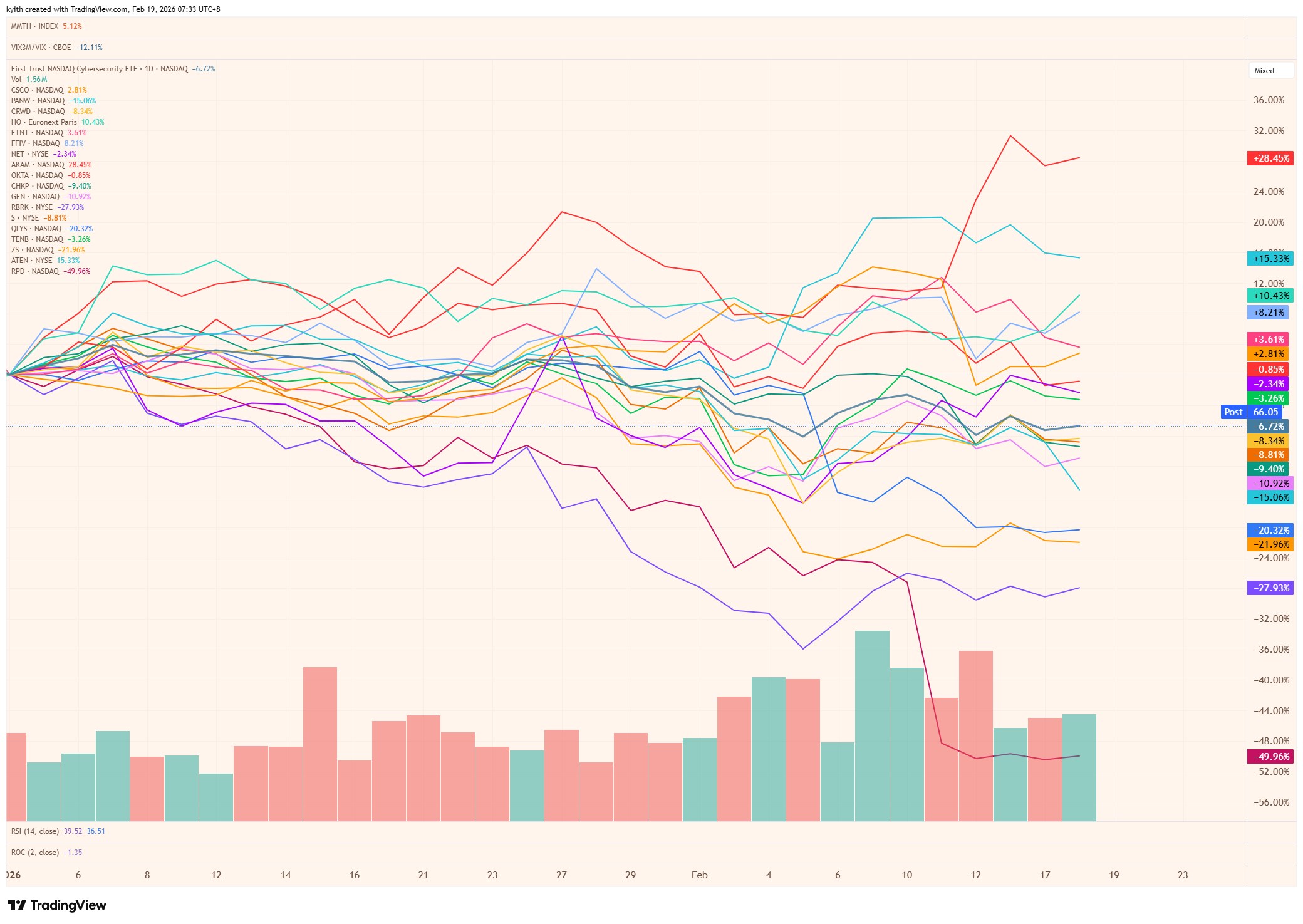
CyberSecurity
In the midst of all these correction, I thought cybersecurity will be the area you would want to look at because in such a world you would need more finely tuned networking and cyber defence.
But in a way there is still overhang.
I took the components of the First Trust NASDAQ Cybersecurity ETF and lay out their 2026 performance:

| Stock Name | Ticker | 2026 Performance |
| First Trust NASDAQ Cybersecurity ETF | CIBR | -7% |
| Cisco | CSCO | 3% |
| Palo Alto | PANW | -15% |
| CrowdStrike | CRWD | -8% |
| Thales SA | HO | 10% |
| Fortinet | FTNT | 4% |
| F5 | FFIV | 8% |
| Cloudflare | NET | -2% |
| Akamai | AKAM | 28% |
| Okta | OKTA | -1% |
| Checkpoint | CHKP | -9% |
| Gen Digital | GEN | -11% |
| Rubrick | RBRK | -28% |
| Sentinel One | S | -9% |
| Qualys | QLYS | -20% |
| Teneble | TENB | -3% |
| Zscaler | ZS | -22% |
| A10 | ATEN | 15% |
| Rapid7 | RPD | -50% |
We have a mixture of pretty good performers, but I am not sure if I am making the right conclusions but the better performers generally look like the firms that sold the network equipment companies.
Rapid7 died by weak guidance and stagnant growth.
The Payments Companies
Steve Eisman would say that every few years some start-up comes along and aims to disrupt the payments space. Then after a while, they all sing a different tune. In his eyes, Visa and Mastercard is in a category on their own.
The following shows the components of IPAY, an ETF focused on payments since 2024:

It is damn bad.
You can say Kyith has pretty poor picks with PayPal. But then even Adyen NV also died. PayPal parted ways with their CEO and give a poorer guidance, thus taking a 20% nosedive. But in general they have not done well.
Is it a sign of weak consumer spending?
That does not seem to be the case from what we see from the transcripts of Mastercard and Visa.
Here is the year to date performance:

| Stock Name | Ticker | Performance since 2024 | 2026 Performance |
| Amplify Digital Payments ETF | IPAY | -10% | -11% |
| American Express | AXP | 56% | -7% |
| Visa | V | 17% | -7% |
| Mastercard | MA | 12% | -6% |
| Corpay | CPAY | 10% | 16% |
| Fiserv | FISV | -60% | -4% |
| Wise PLC | WISE | 0% | 0% |
| Adyen NV | ADYEN | -30% | -29% |
| Global Payments | GPN | -35% | 8% |
| PayPal | PYPL | -36% | -29% |
| Block | XYZ | -33% | -18% |
| Toast | TOST | 19% | -19% |
| Affirm Holdings | AFRM | 53% | -30% |
| Fidelity National Information Services | FIS | -31% | -26% |
| WEX Inc | WEX | -34% | 7% |
| StoneCo | STNE | 1% | 12% |
| Shift4 Payments | FOUR | -14% | -6% |
| ACI Worldwide | ACIW | 25% | -11% |
| Euronet Worldwide | EEFT | -33% | -4% |
| Q2 Holdings | QTWO | 1% | -25% |
| Western Union | WU | -17% | 5% |
| Pagseguro Digital | PAGS | -18% | 11% |
| Remitly | RELY | -34% | 3% |
| Marqeta | MQ | -32% | -12% |
| Ibotta | IBTA | -80% | -9% |
| NCR Voyix | VYX | -20% | -1% |
| Evertec Inc | EVTC | -29% | -6% |
I would take a look at why Corpay did so well.
BDCs

BDCs stand for Business Development Companies, which are companies incorporated to lend money to other businesses. They are private credit vehicles setup by Alternative asset managers to provide juicy 15% yielding stuff.
Last year they been down and they are down at the start of the year as well.
- OBDC – Blue owl Capital Corporation – -9%
- HTGC – Hercules Capital – -17%
- TSLX – -Sixth Street Specialty Lending – – 11%
- PFLT – PennantPark Floating Rate Capital – -7%

The chart above shows the exposure to the software sector.
The investment grade, high yield bonds and US small caps that are profitable have little exposure so they did not benefit during the hey days.
Again, if you did well and concentrate so much, you would eventually face a different sort of anxiety.
US Insurance
The insurance companies have not done well.

| Stock Name | Ticker | Performance since 2025 |
| RLI Corp | RLI | -21% |
| Progressive | PGR | -8% |
| Brown and Brown | BRO | -31% |
Progressive is always cited as the one that ate Berkshire Hathaway’s GEICO’s lunch. Brown and Brown is part of Chris Mayer’s portfolio of stocks that can own for 100 years.
They are facing challenges due to their struggles to raise prices, questions about organic growth capabilities and rising claims costs.
Home Builders and Related Ancillary Service Providers
Housing in the US is known to be challenging for a while. If you want value, maybe you want to look at this pile.

| Stock Name | Ticker | Performance since 2024 |
| NVR | NVR | 7% |
| DR Horton | DHI | 14% |
| Pulte Group | PHM | 40% |
| Lennar | LEN | -14% |
At first glance, this wasn’t so bad! How come people are saying until the market is so fxxked?
So I took a look at the components of the State Street SPDR S&P Homebuilders ETF:

There are 35 components in the ETF
| Stock Name | Ticker | Performance since 2024 | 2026 Performance | What |
| State Street® SPDR® S&P® Homebuilders ETF | XHB | 28% | 16% | |
| TopBuild | BLD | 46% | 28% | Insulation & building materials |
| Carlisle Comp | CSL | 33% | 25% | Energy efficient solutions |
| Carrier Global | CARR | 17% | 23% | HVAC |
| Installed Building Products | IBP | 90% | 29% | Insulation |
| Johnson Controls | JCI | 150% | 14% | HVAC |
| Masco Corp | MAS | 17% | 18% | Branded home improvement |
| Toll Bro | TOL | 63% | 23% | Luxury home build |
| Lowe’s | LOW | 35% | 17% | Home improvement |
| Trane Tech | TT | 94% | 17% | HVAC |
| Owen’s Corning | OC | -6% | 18% | Insulation, roofing, fibreglass |
Turns out the top performers of the Homebuilder index is not so much the actual home builders but those ancillary services.
There can be a reason for this: The interest rate on home equity line of credit is based not on longer term interest rates but shorter term interest rates. So if shorter term interest rates is forecast to come down (regardless whether the long term comes down or not), then folks have more money to improve their home and the market forward prices in anticipation.
Logan Mohtashami from Housing Wire have some of the best fundamental data on the US housing market.

We do have higher foreclosures and bankruptcies but perhaps people are extrapolating too much that all crisis will feel like a GFC.

Here is how the credit scores of mortgage borrowers look relative to the pre GFC days. Higher credit scores means relatively higher quality borrowers.

Love the way he lays out the chart because likely, there are seasonal factors and plotting these year by year allows us to see better relative comparison.
There is a spread between the 30-year mortgage rate (most of the US loans are 30-year loans) and the US 10-year Treasury yield. There is a spread because the mortgage loan is higher risk and its longer tenure thus the loan commands a higher premium. Logan says the tightest spread is 1.6-1.8% in recent history with 1.3% the historical low. Logan also explains that traditionally speaking, spreads have declined as the rate cut cycle begins and volatility decreases. The opposite can happen as well.
In a way, if the mortgage rate is too high, people won’t feel comfortable to take on the loans and buy houses. So this is an indication of how receptive people are to buying.
Consumer Discretionary
We can also learn about the health of the economy by looking at the consumer discretionary. If money is tight, you don’t anyhow spend on things that is not necessity.
I plotted the chart of the S&P 500 equal weight consumer discretionary and the S&P small cap consumer discretionary since 2025:

| Stock Name | Ticker | Performance since 2025 | Num of Holdings |
| Invesco S&P 500 Equal Weight Consumer Discretionary ETF | RSPD | 13% | 48 |
| Invesco S&P SmallCap Consumer Discretionary ETF | PSCD | 6% | 87 |
One of the reasons I use equal weight is because Amazon and Tesla dominates the consumer discretionary and if we don’t equal weight, we cannot easily see how the rest are doing. Viewing the small cap also gives us more color.
It is not the best charts… but in a way it doesn’t show so bad as well.
I expanded the top ten components of the equal weighted ETF out:

The ETF consist of 48 holdings in total.
| Stock Name | Ticker | Performance since 2024 | 2026 Performance | What |
| Tapestry | TRP | 337% | 19% | Luxury Fashion |
| Royal Caribbean Group | RCL | 177% | 13% | Cruise |
| Carnival Corp | CCL | 95% | 3% | Cruise |
| Marriott Int | MAR | 65% | 13% | Hotel |
| Hasbro | HAS | 132% | 23% | Toy |
| Norwegian Cruise | NCLH | 24% | -6^ | Cruise |
| Darden Restaurant | DRI | 42% | 14% | |
| Hilton Worldwide | HLT | 77% | 7% | Hotel |
| Lowe’s | LOWE | 30% | 17% | Home Improvement |
| Starbucks | SBUX | 7% | 12% | Coffee |
These will tend to be the top performers in an equal weight, which is why they will bobble to the top.
It feels to me most of these are related to the hospitality.
I also tried to list the small cap consumer discretionary:

There are 87 holdings in the ETF.
Because there is so many, I decide to list out the top 25 recent holdings so you can gain a better appreciation.
| Stock Name | Ticker | Performance since 2024 | 2026 YTD Performance | What |
| PSCD | PSCD | 13% | 8% | |
| LKQ Corp | LKQ | -23% | 14% | Recycled auto parts |
| Installed Building Products | IBP | 96% | 29% | Insulation |
| Brinker International | EAT | 283% | 6% | 1600 restaurant casual dining |
| Mohawk Ind | MHK | 26% | 21% | World largest flooring manufacturer |
| CarMax | KMX | -45% | 5% | Used vehicles |
| Boot Barn | BOOT | 150% | 1% | Footwear |
| Meritage Homes | MTH | -2% | 22% | Entry, first move up homebuilder |
| Champions Homes | SKY | 29% | 13% | Manufactured homes |
| Patrick Industries | PATK | 122% | 30% | Components for RV, marine and manufactured housing |
| Victoria’s Secret | VSCO | 116% | 10% | |
| Cavco Ind | CVCO | 66% | 0% | Manufactured, modular homes |
| Etsy | ETSY | -45% | -20% | Online marketplace for unique items. |
| Asbury Automotive | ABG | 2% | -2% | Sell new and old vehicles |
| Group 1 Automotive | GPI | 10% | -15% | Sell new and old vehicles |
| Frontdoor | FTDR | 60% | -1% | SAAS platform for home repair, plumbing, electrical. |
| American Eagle | AEO | 28% | -3% | Fashion |
| Tri Pointe Homes | TPH | 29% | 47% | Premium homebuilder |
| ADT Inc | ADT | 21% | -3% | Monitored security and home automation |
| M/I Homes | MHO | 8% | 17% | Single family home builder |
| Academy Sports | ASO | -10% | 12% | Sports goods |
| Dana Inc | DAN | 138% | 34% | Power conveyance and energy management solutions |
| LCI Ind | LCII | 31% | 26% | RV, marine and manufactured housing |
| Urban Outfitters | URBN | 94% | -7% | Fashion |
| Caesars Ent | CZR | -61% | -23% | Casino |
| Signet Jewelers | SIG | -14% | 5% | Diamond Jewellery |
It should not be loss to you that the better performers since the start of 2026 are… related to homes. I am not sure if this is related to private equity trying to take some of these companies private.
But this seem to collaborate the idea that lower short term rates is related to the rate for the equity line of credit on homes, so this makes home improvements more possible.
Some companies also benefit because of what they supplied for the industrial build outs.
Restaurants
Finally, restaurants should give the best sensing. If the economy is really struggling, people tend to pull back.
And I always thought their performance is not too good.
I listed all the components of the AdvisorShares Restaurant ETF:

| Stock Name | Ticker | Performance since 2024 | 2026 YTD Performance | What |
| AdvisorShares Restaurant ETF | EATZ | 22% | 2% | |
| Casey’s General | CASY | 143% | 20% | Convenience store for small, rural communities |
| Brinker International | EAT | 283% | 6% | Full-service casual dining |
| Nathan’s Famous | NATH | 40% | 10% | Asset-light, quick service and consumer packaged goods. |
| US Foods Holdings | USFD | 117% | 34% | Provide fresh, and frozen food to restaurants |
| Dutch Bros | BROS | 71% | -14% | Young people drinks |
| YUM China | YUMC | 35% | 15% | China KFC, Pizza hut, Taco Bell, Lavazza |
| Darden | DRI | 40% | 14% | Casual dining, Olive Garden and LongHorn Steakhouse |
| YUM Brands | YUM | 29% | 7% | KFC, Taco Bell, Pizza Hut |
| Restaurant Brands | QSR | -8% | -2% | Tim Hortons, Burger King, Popeyes |
| Dine Brands | DIN | -27% | -4% | Casual dining |
| Cheesecake Factory | CAKE | 79% | 11% | Casual and fine dining. |
| Chipotle Mexican | CMG | -19% | -3% | |
| Texas Roadhouse | TXRH | 56% | 6% | Steaks, ribs |
| El Pollo Loco | LOCO | 19% | 2% | Quick serving meals |
| Domino’s | DPZ | -6% | -12% | Quick service pizza |
| Red Robin | RRGB | -73% | -23% | Casual dining burgers and sandwich |
| Aramark | ARMK | 43% | 7% | Ancillary services for food industry |
| BJ’s | BJRI | 15% | -1% | Casual pizza and burgers |
| Serve Robotics | SERV | 207% | -19% | Provide robots to deliver last-mile food. |
| Doordash | DASH | 66% | -27% | |
| Wingstop | WING | -11% | -14% | Wings for young people. |
They generally don’t look so bad except maybe Red Robin.

Kyith is the Owner and Sole Writer behind Investment Moats. Readers tune in to Investment Moats to learn and build stronger, firmer wealth foundations, how to have a Passive investment strategy, know more about investing in REITs and the nuts and bolts of Active Investing.
Readers also follow Kyith to learn how to plan well for Financial Security and Financial Independence.
Kyith worked as an IT operations engineer from 2004 to 2019. Currently, he works as a Senior Solutions Specialist in Fee-only Wealth Advisory Firm Providend. All opinions on Investment Moats are his own and does not represent the views of Providend.
You can view Kyith’s current portfolio here, which uses his Free Google Stock Portfolio Tracker.
His investment broker of choice is Interactive Brokers, which allows him to invest in securities from different exchanges all over the world, at very low commission rates, without custodian fees, near spot currency rates.
You can read more about Kyith here.